Conversational Recommender Systems (CRS)System ToolkitsLarge Language Models (LLMs)
RecWizard is a Hugging Face-based toolkit that standardizes conversational recommendation by decoupling recommender and generator modules from execution pipelines and providing an interactive interface for debugging.
Core Problem
Existing CRS toolkits lack the modularity to easily reuse LLMs, fail to support pipeline-level interaction for debugging, or are closed-source, hindering the development of holistic conversational systems.
Why it matters:
Current toolkits like CRSLab focus on module-level metrics, ignoring system-level issues like recommendation-generation inconsistency
Rapid advancements in LLMs require a portable framework to easily swap and test different models (e.g., ChatGPT) as recommenders or generators
Lack of interactive UIs makes it difficult for researchers to qualitatively evaluate or explain how a CRS pipeline functions
Concrete Example:When using existing toolkits, a developer cannot easily inspect why a system recommends an item unrelated to the generated text. RecWizard's 'DEBUG Mode' allows users to pause the pipeline, view intermediate outputs (e.g., entity links), and modify arguments on the fly.
Key Novelty
Two-Level Abstraction (Module & Pipeline) with Hugging Face Compatibility
Abstracts CRS into low-level 'Modules' (recommenders/generators) and high-level 'Pipelines' (logic flow), allowing mix-and-match construction (e.g., swapping a BERT generator for ChatGPT)
Implements a 'Composite Pattern' tokenizer to handle both text processing and entity linking within a unified interface
Provides an interactive web-based UI with 'INFO' (chat) and 'DEBUG' (inspection) modes for run-time analysis
Architecture
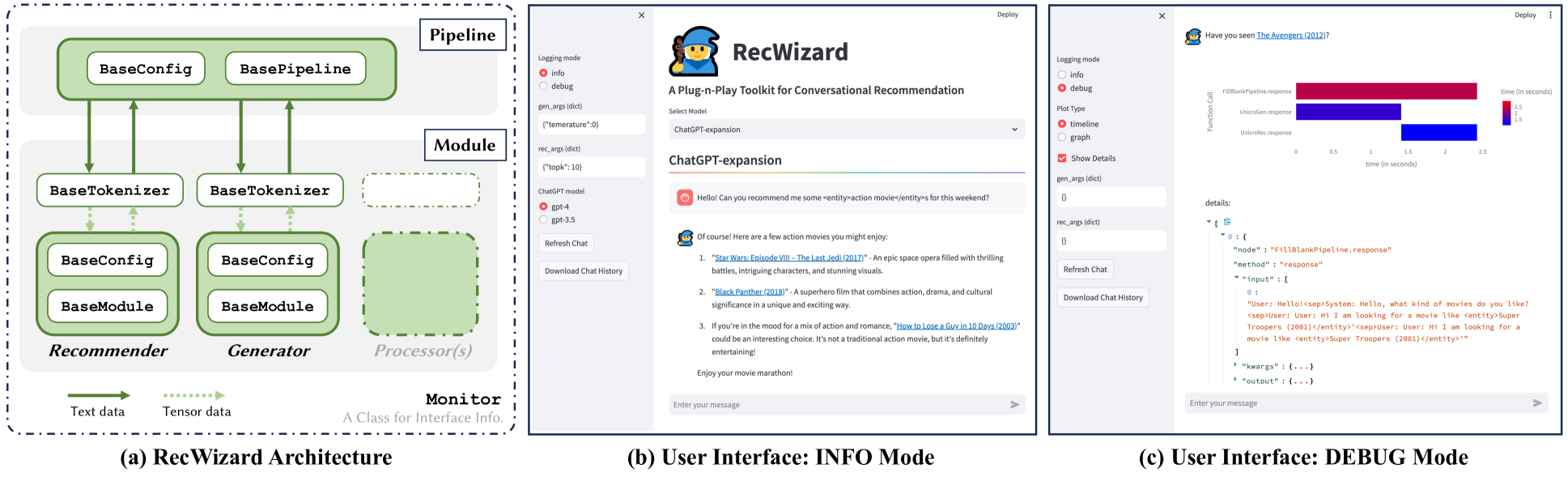
The hierarchical architecture of RecWizard, distinguishing between the Pipeline Level (high-level logic) and Module Level (Recommender, Generator, Processor)
Breakthrough Assessment
7/10
Significant engineering contribution that addresses the fragmentation in CRS research tools. While not an algorithmic breakthrough, it lowers the barrier for LLM-based CRS research.
⚙️ Technical Details
Problem Definition
Setting: Software framework for constructing, sharing, and deploying Conversational Recommender Systems
Inputs: User conversation history (text) and optional system state
Outputs: Natural language response and/or item recommendations
Pipeline Flow
Tokenizer (Parses text and entities)
Pipeline Logic (Orchestrates modules)
Modules (Recommender/Generator execution)
System Modules
RecWizard Tokenizer
Bridge text interface between modules; parse entities from raw text
Model or implementation: Extended HF Tokenizer
Recommender Module
Predict item relevance scores based on context
Model or implementation: Flexible (e.g., AutoRec, UniCRS recommender)
Generator Module
Generate natural language response
Model or implementation: Flexible (e.g., ChatGPT, Llama)
Novel Architectural Elements
Strict separation of 'Module' (model weights/inference) and 'Pipeline' (execution logic) to enable portability
Integration of tensor-based communication methods alongside default natural language (text) communication between modules
Modeling
Base Model: Framework supports various backends (UniCRS, ChatGPT, etc.)
Compute: Not reported in the paper
Comparison to Prior Work
vs. CRSLab: RecWizard focuses on Pipeline-level abstraction and HF portability, whereas CRSLab focuses on Module-level performance and native PyTorch
vs. FORCE: RecWizard is open-source and supports flexible LLM integration, whereas FORCE is closed-source and restricted to rule-based settings with mandatory knowledge graphs
vs. DeepPavlov [not cited in paper]: RecWizard is specialized for Recommender Systems, whereas DeepPavlov is a general-purpose conversational AI framework
Limitations
No comprehensive evaluation of trained models within a unified benchmark provided in this paper
Does not offer standardized training APIs (relies on external trainers like HF Trainer)
Current implemented models strictly follow original source code strategies rather than a unified training strategy
publicly available (https://github.com/McAuley-Lab/RecWizard). The paper provides code templates for creating new pipelines and modules. Several pre-trained CRS models (UniCRS, KBRD, etc.) are available via the toolkit.
📊 Experiments & Results
Evaluation Setup
Toolkit demonstration and qualitative feature comparison
Metrics:
Statistical methodology: Not explicitly reported in the paper
Main Takeaways
RecWizard successfully modularizes CRS development, allowing a 'ExpansionPipeline' to combine a ChatGPT generator with a classic AutoRec recommender in minimal lines of code
The toolkit enables 'Info Mode' for user evaluation and 'Debug Mode' for granular inspection of module inputs/outputs and execution timelines
Inherits Hugging Face features like 'push_to_hub', making CRS models portable and easily shareable compared to prior toolkits
📚 Prerequisite Knowledge
Prerequisites
Familiarity with Hugging Face Transformers library
Basic understanding of Conversational Recommender Systems (CRS)
Python programming
Key Terms
CRS: Conversational Recommender Systems—systems that elicit user preferences through natural language dialogue to provide recommendations
LLM: Large Language Model—models like GPT-4 or Llama used here for text generation or reasoning within the recommendation pipeline
Hugging Face (HF): A popular open-source library and hub for natural language processing models, which RecWizard extends
Entity Linking: The process of identifying specific items (like movie titles) in text and mapping them to a knowledge base or item index
Module Level: The lower level of abstraction in RecWizard, representing individual components like a Recommender or Generator
Pipeline Level: The higher level of abstraction in RecWizard, representing the logic flow that orchestrates how modules interact
Composite Pattern: A design pattern used here to extend HF tokenizers, allowing them to parse complex information (like entities) alongside standard text tokens