📝 Paper Summary
Clinical Trial Matching
Healthcare Information Retrieval
Privacy-Preserving NLP
TrialMatchAI automates clinical trial recruitment by combining hybrid retrieval with locally deployed, fine-tuned open-source LLMs to match patients accurately while preserving data privacy.
Core Problem
Manual patient-to-trial matching is labor-intensive and error-prone, while existing AI solutions often rely on proprietary, cloud-based APIs that compromise patient privacy and lack transparency.
Why it matters:
- Patient recruitment is a major bottleneck in drug development, often delaying life-saving treatments
- Proprietary API-based models (like GPT-4) create barriers regarding cost, reproducibility, and regulatory compliance (GDPR/HIPAA)
- Oncology matching requires complex reasoning over unstructured criteria (e.g., biomarkers, prior treatments) that keyword search misses
Concrete Example:
A patient with 'metastatic non-small cell lung cancer' and an 'EGFR mutation' might be eligible for a trial recruiting 'advanced solid tumors' with specific genetic profiles. Standard keyword search misses the 'solid tumor' semantic connection, while proprietary LLMs raise privacy concerns. TrialMatchAI normalizes these entities and uses chain-of-thought reasoning to verify the genetic match locally.
Key Novelty
Privacy-First Modular RAG for Clinical Matching
- Deconstructs the matching process into a local pipeline: Entity Normalization → Hybrid Retrieval → LLM Re-ranking → Chain-of-Thought Reasoning
- Replaces massive proprietary models with smaller, fine-tuned open-source models (Gemma-2-2B, Phi-4) optimized for biomedical reasoning
- Uses Phenopackets standardization to ingest heterogeneous patient data (structured records and unstructured notes) into a unified format
Architecture
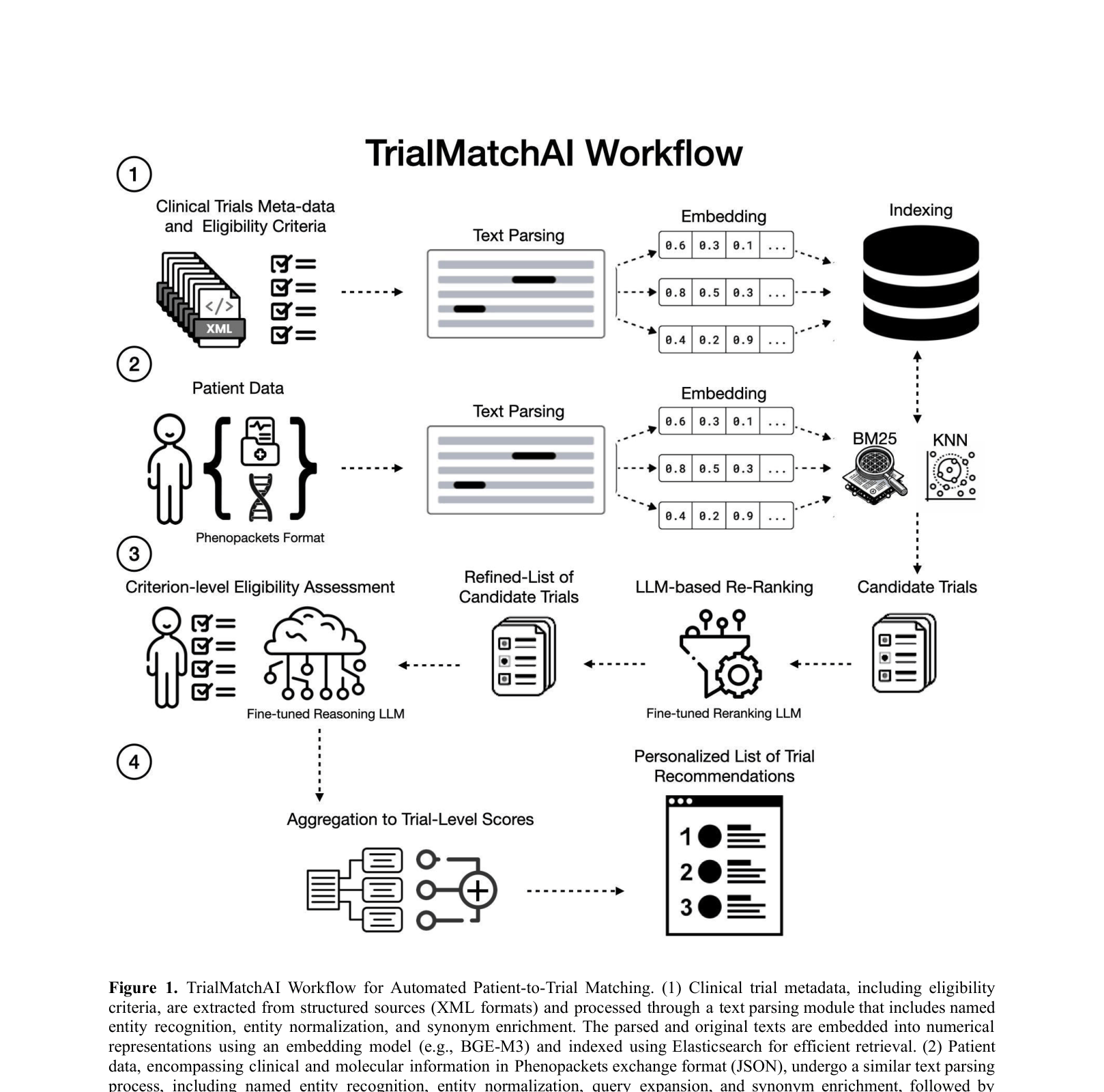
The end-to-end workflow of TrialMatchAI, detailing the four processing levels from data ingestion to final ranking.
Evaluation Highlights
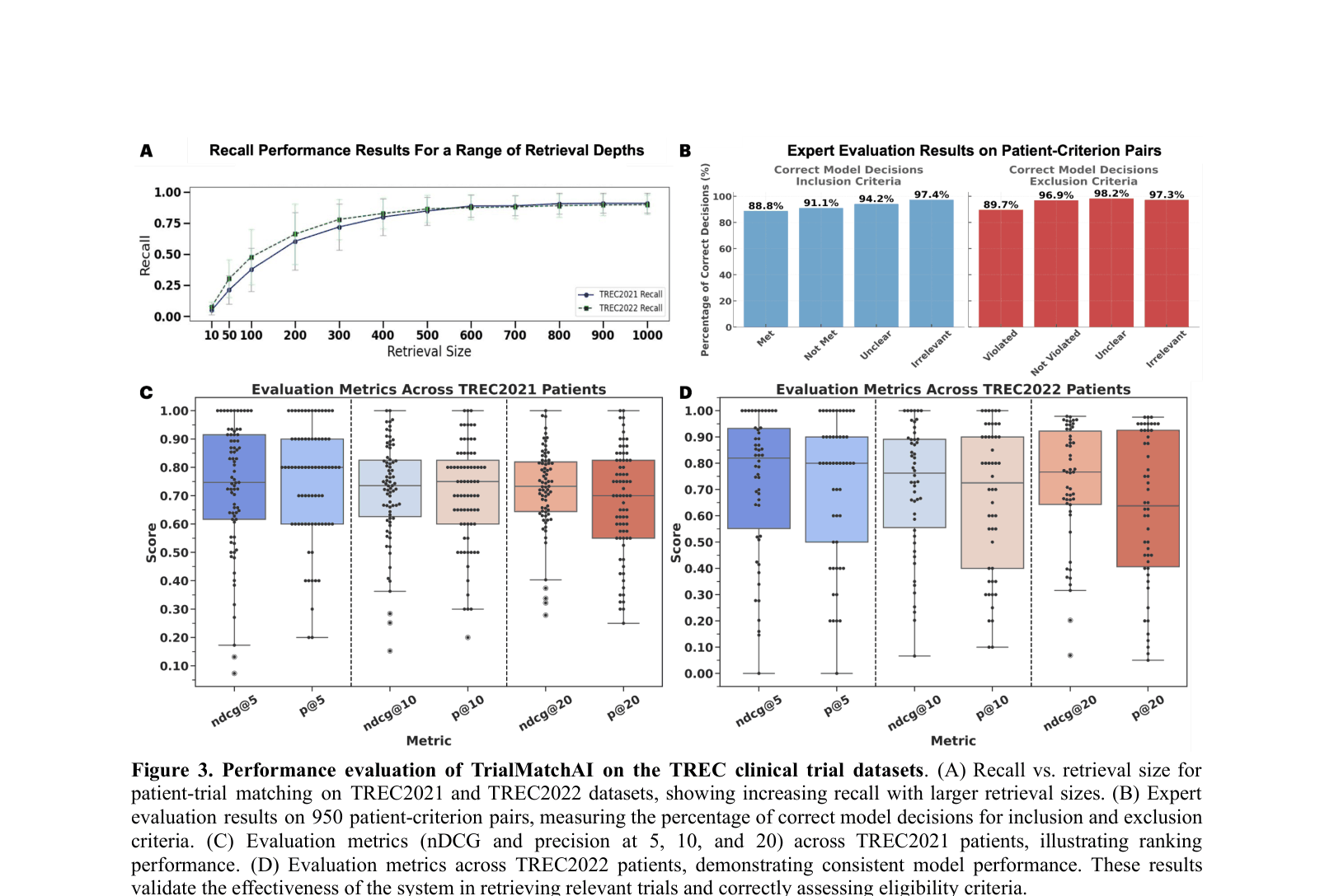
- 92.3% of real-world cancer patients (WIDE cohort) had at least one relevant trial retrieved within the top 20 recommendations
- Achieved >90% recall on synthetic benchmarks (TREC 2021/2022) while retrieving only 3% of the total trial pool (approx. 500 documents)
- Expert evaluation validated >90% accuracy in criterion-level eligibility classification using the fine-tuned reasoning model
Breakthrough Assessment
8/10
Strong contribution to privacy-preserving healthcare AI. It matches the performance of proprietary systems (like TrialGPT) using open-source models manageable in clinical settings, addressing a critical deployment barrier.