📝 Paper Summary
Inductive Cold-Start Recommendation
Academic Collaborator Recommendation
Neuro-Symbolic Graph Learning
TAG-HGT addresses the cold-start problem by distilling semantic knowledge from a frozen LLM into a lightweight Heterogeneous Graph Transformer, using structural signals to filter semantically similar but socially unreachable candidates.
Core Problem
Existing academic recommendation systems fail for new scholars (cold-start) because structure-based models lack connectivity data, while generative LLMs are too slow and expensive for real-time industrial deployment.
Why it matters:
- Thousands of new scholars join platforms daily without interaction history, rendering traditional GNNs (which rely on topology) ineffective ('Topological Void').
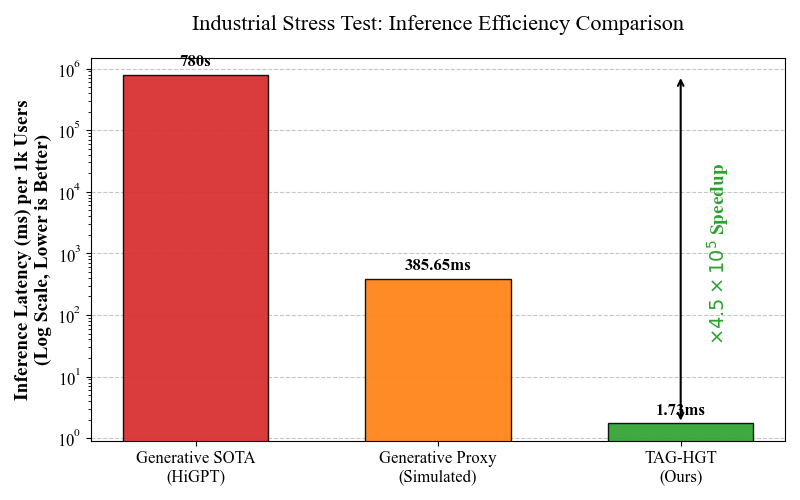
- Generative Graph Models like HiGPT offer quality but suffer from prohibitive latency (>13 minutes/1k requests) and cost, making them practically undeployable at scale.
- LLMs alone struggle with 'Local Discrimination': they can retrieve scholars with similar interests but fail to distinguish valid collaborators from random strangers in dense embedding spaces.
Concrete Example:
In a specialized field, an LLM might retrieve hundreds of researchers with identical semantic interests to a new user. However, many are random strangers with no social path to the user. A structure-blind LLM recommends them all equally, while TAG-HGT uses graph structure to filter for those who are actually reachable collaborators.
Key Novelty
Implicit Knowledge Distillation via 'Semantics-First, Structure-Refined' Paradigm
- Uses a frozen LLM (DeepSeek-V3) only for offline semantic profile generation, then distills this knowledge into a lightweight graph model via contrastive learning.
- Constructs a Semantic k-NN Graph to connect isolated cold-start nodes to the existing graph, bridging the 'topological void'.
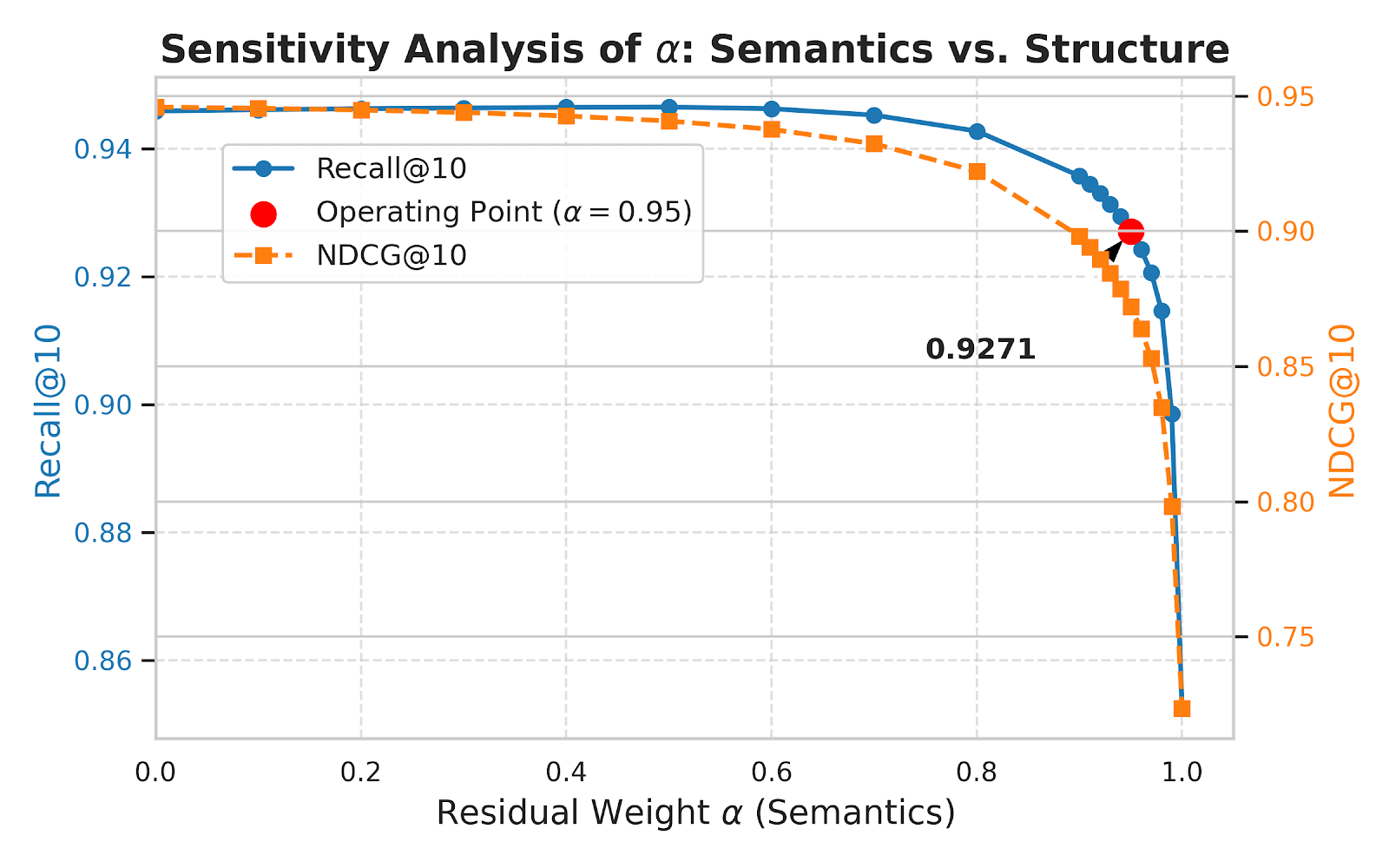
- Deploys a hybrid inference strategy where semantic similarity ensures recall (finding relevant people) and structural signals provide discrimination (filtering for reachable collaborators).
Architecture
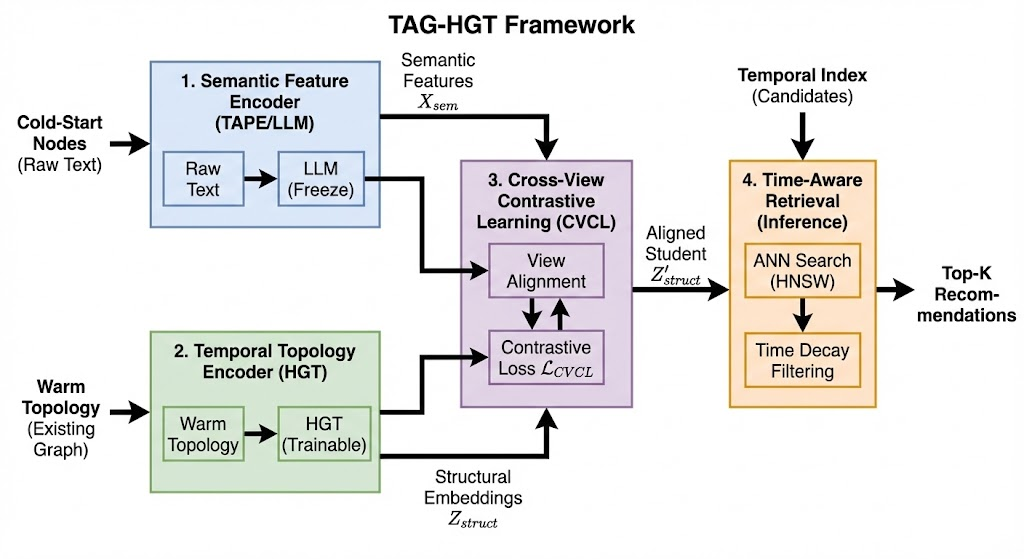
The overall architecture of TAG-HGT, illustrating the distillation process from the LLM Teacher to the HGT Student and the hybrid inference mechanism.
Evaluation Highlights
- Achieves Recall@10 of 91.97% on OpenAlex under strict inductive settings, outperforming structure-only baselines by +20.7%.
- Reduces inference latency by 5 orders of magnitude (450,000x speedup) compared to generative baselines (780s down to 1.73ms per 1k queries).
- Slashes inference costs by 99.9%, dropping from ~$1.50 to <<$0.001 per 1k queries.
Breakthrough Assessment
8/10
While the components (LLMs, HGT, Contrastive Learning) are known, the specific architecture for industrial scalability—achieving 99.9% cost reduction while maintaining SOTA accuracy—is a significant practical breakthrough for recommender systems.