📝 Paper Summary
Generative Recommendation
Sequential Recommendation
LLM-based Recommendation
IDGenRec aligns LLMs with recommendation tasks by training a generator to create concise, unique, and semantically rich textual IDs for items using their metadata.
Core Problem
Generative recommendation models struggle to encode items into the text-to-text framework because existing ID methods (numerical indices or UUIDs) lack semantic meaning and are not transferable across datasets.
Why it matters:
- Numerical IDs (e.g., '1001') are treated as meaningless tokens by LLMs, forcing them to learn co-occurrence rather than semantic characteristics
- Lack of semantic IDs prevents transfer learning; models trained on one dataset cannot recommend items in another (zero-shot) because the ID vocabularies are disjoint
- Current approaches undermine the primary benefit of using LLMs: harnessing their pre-trained semantic knowledge
Concrete Example:
In standard approaches, an item like 'Apple iPhone 13' might be assigned the token '1001'. The LLM sees 'User bought 1001', which has no linguistic connection to 'phone' or 'Apple'. IDGenRec generates a textual ID like 'apple_iphone_13' that the LLM inherently understands.
Key Novelty
Textual ID Generation via Collaborative LLMs
- Trains a dedicated 'ID Generator' LLM to compress lengthy item metadata (titles, categories) into short, unique, semantically meaningful textual IDs (e.g., 'blue_denim_jacket')
- Uses a 'Base Recommender' LLM that takes these textual IDs as input history to generate the target item's textual ID
- employs an alternating training strategy where the ID Generator optimizes ID quality for the Recommender, and the Recommender optimizes accuracy given the IDs
Architecture
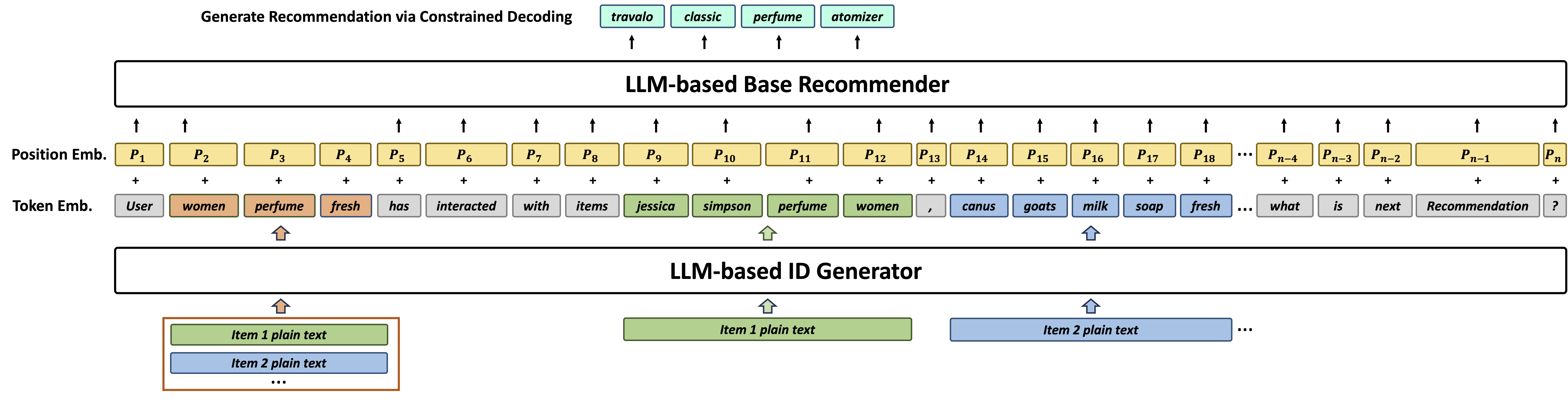
The overall framework of IDGenRec, illustrating the flow from item metadata to ID generation, prompt construction, and final recommendation.
Evaluation Highlights
- Outperforms baselines on 4 widely-used sequential recommendation datasets (Beauty, Sports, Toys, Yelp) in standard supervised settings
- Zero-shot performance on unseen datasets (after training on 19 datasets) is comparable to or better than traditional supervised models like SASRec
- Significantly surpasses numerical ID-based generative models (like P5) by leveraging semantic information in IDs
Breakthrough Assessment
8/10
Offers a fundamental solution to the ID encoding problem in LLM-RecSys, enabling true foundation models with zero-shot transfer capabilities across different platforms.