Fan Liu, Yaqi Liu, Huilin Chen, Zhiyong Cheng, Liqiang Nie, Mohan Kankanhalli
National University of Singapore,
Hefei University of Technology,
Harbin Institute of Technology, Shenzhen
arXiv
(2023)
RecommendationP13NKG
📝 Paper Summary
Graph Neural Networks (GCNs) for RecommendationLLM-augmented RecommendationReview-based Recommendation
SAGCN leverages Large Language Models to extract fine-grained semantic aspects from reviews, constructing aspect-specific interaction graphs to learn accurate and interpretable user/item representations.
Core Problem
Conventional aspect-aware recommendation models rely on noisy, sparse implicit behaviors or statistical topic models that extract non-meaningful words, leading to poor interpretability and suboptimal accuracy.
Why it matters:
Topic models often identify stop words (e.g., 'the', 'year') as aspects, introducing noise into preference learning.
Disentangled representation learning typically relies on sparse interaction data, making it difficult to capture robust underlying user intents.
Implicit latent factors in matrix factorization or standard GCNs are elusive and fail to provide semantic reasons for recommendations.
Concrete Example:A user review might praise a product's 'functionality' and 'durability' but ignore 'ease of use'. A standard model treats this as a generic positive interaction, whereas SAGCN identifies edges only for the mentioned aspects, avoiding a false positive link for 'ease of use'.
Uses a chain-based prompting strategy with LLMs to decompose raw reviews into structured 'semantic aspects' (e.g., price, quality) and filters interactions to only those relevant to each aspect.
Constructs multiple aspect-specific user-item graphs rather than a single generic interaction graph.
Aggregates embeddings from these semantic sub-graphs to form final representations that explain *why* a user likes an item.
Architecture
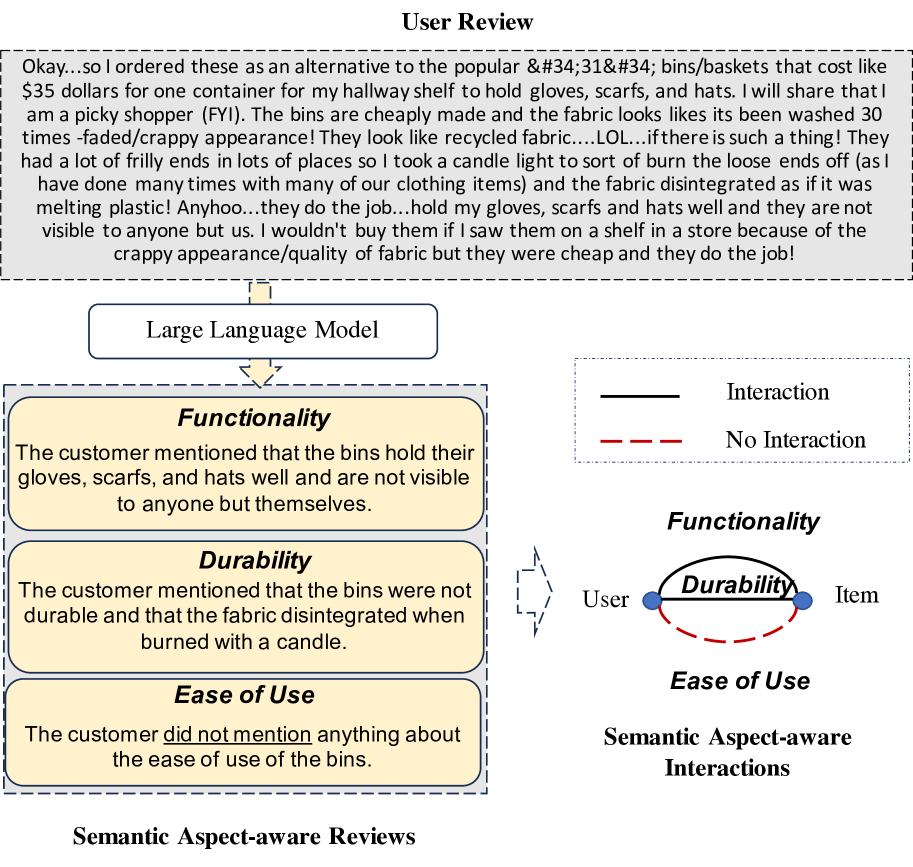
An illustration of Semantic Aspect-Aware Interactions. It shows a user review mentioning specific aspects ('functionality', 'durability') while omitting others ('ease of use').
Breakthrough Assessment
7/10
Novel integration of LLM-based semantic extraction into GCN structure construction. Addresses the long-standing 'topic noise' problem in review-based recsys, though the core GCN mechanism is an evolution of existing architectures.
⚙️ Technical Details
Problem Definition
Setting: Recommendation with implicit feedback and textual reviews.
Inputs: User-item interaction matrix R, Set of user reviews.
Outputs: Predicted user preference scores for unobserved items.
Identify specific reviews that align with the selected high-quality semantic aspects
Model or implementation: Large Language Model (Specific version not reported in text)
Aspect-Specific Graph Builder
Construct user-item interaction graphs for each extracted semantic aspect
Model or implementation: Deterministic Graph Construction
SAGCN
Learn user/item embeddings by propagating information over aspect-specific graphs and combining them
Model or implementation: Graph Convolutional Network
Novel Architectural Elements
Construction of interaction graphs based on LLM-extracted semantic aspects rather than raw interactions or latent factors
Chain-based prompting pipeline to denoise review data before graph construction
Modeling
Base Model: Large Language Model (used for feature extraction, specific architecture not reported in text)
Training Method: The text implies standard supervised training of the GCN using interaction data, but specific loss functions and hyperparameters are not present in the truncated text.
Compute: Not reported in the paper
Comparison to Prior Work
vs. ALFM/A3NCF: SAGCN uses LLMs to extract interpretable semantic aspects instead of noisy statistical topics (which often include stop words).
vs. DGCF: SAGCN defines aspects explicitly from review text via LLMs, whereas DGCF infers latent intents from sparse interaction behaviors which can be unreliable.
vs. LightGCN: SAGCN incorporates fine-grained semantic information via multi-graph convolution, whereas LightGCN uses a single holistic interaction graph.
Limitations
LLMs struggle to autonomously discover unseen aspects without explicit instructions (mitigated by chain-prompting but still a limitation).
Reliance on the presence of reviews; users without reviews may not benefit from the aspect extraction phase (inferred limitation typical of review-based methods).
No statistical significance tests or specific performance metrics are available in the provided text.
Code is publicly available at https://github.com/HuilinChenJN/LLMSAGCN. The paper mentions utilizing 'four publicly available datasets' but the text ends before naming them or specifying training hyperparameters.
📊 Experiments & Results
Evaluation Setup
Recommendation performance evaluation on benchmark datasets.
Benchmarks:
Four publicly available datasets (Top-K Recommendation)
Metrics:
Not reported in the paper (Text truncated)
Statistical methodology: Not explicitly reported in the paper
Main Takeaways
The paper claims SAGCN outperforms state-of-the-art GCN-based recommendation models (like LightGCN, DGCF) across four datasets (quantitative proof not in text).
LLM-based aspect extraction reduces noise compared to traditional topic models, preventing irrelevant words (e.g., 'the', 'year') from being modeled as user preferences.
Constructing graphs based on semantic aspects allows for interpreting *why* a recommendation is made (e.g., matching user interest in 'durability'), which is difficult with latent factor models.
The chain-based prompting strategy effectively filters reviews to identify aspect-aware interactions, addressing the data noise problem.
📚 Prerequisite Knowledge
Prerequisites
Graph Convolutional Networks (GCNs)
Collaborative Filtering (CF)
Basic understanding of Large Language Models (LLMs) and Prompting
Key Terms
SAGCN: Semantic Aspect-based Graph Convolution Network—the proposed model that propagates embeddings on graphs constructed from specific semantic aspects found in reviews.
Semantic Aspects: Specific attributes or features of an item (e.g., 'durability', 'price') extracted from text, as opposed to latent mathematical factors.
Chain-based Prompting: A strategy using sequential prompts where the output of one step (identifying aspects) guides the next step (extracting reviews matching those aspects).
GCN: Graph Convolutional Network—a neural network architecture that operates on graph structures to learn node representations by aggregating neighbor information.
Disentangled Representation: Learning separate embedding vectors for different underlying factors (intents/aspects) of user preference, rather than a single entangled vector.
Topic Models: Statistical models (like LDA) used to find abstract topics in text; often criticized in this paper for extracting noisy, non-semantic words.