📝 Paper Summary
Mobile AI Agents
Adversarial Attacks on Agents
System Security
A comprehensive security analysis reveals that widely deployed mobile LLM agents are universally vulnerable to 11 distinct attack vectors across language, GUI, and system layers, permitting privacy leakage and execution hijacking.
Core Problem
Mobile LLM agents operate with elevated system privileges and rely on probabilistic (LLM) and visual (GUI) inputs, yet they lack a standardized security framework, exposing them to unique attack vectors that traditional software verification misses.
Why it matters:
- Agents like Honor YOYO and AutoGLM are being deployed on millions of devices with deep OS integration.
- Existing security methods for web-based LLMs fail to address mobile-specific risks like UI overlays, accessibility service exploitation, and system-level intent manipulation.
- Probabilistic decision-making makes agents susceptible to manipulation where they perform unintended actions (e.g., sending money) based on subtle environmental triggers.
Concrete Example:
An attacker places a transparent overlay over a legitimate app. When the user asks the agent to 'click the button,' the agent perceives the visible button via screenshots but physically clicks the attacker's invisible overlay, hijacking the interaction.
Key Novelty
AgentScan Framework & 11-Point Attack Taxonomy
- Establishes the first systematic taxonomy of 11 attack surfaces for mobile agents, categorized into LLM (language), GUI (perception), and System (execution) layers.
- Introduces AgentScan, a semi-automated framework that injects adversarial inputs (e.g., misleading prompts, invisible UI elements, fake apps) at precise workflow stages to trigger and verify vulnerabilities.
Architecture
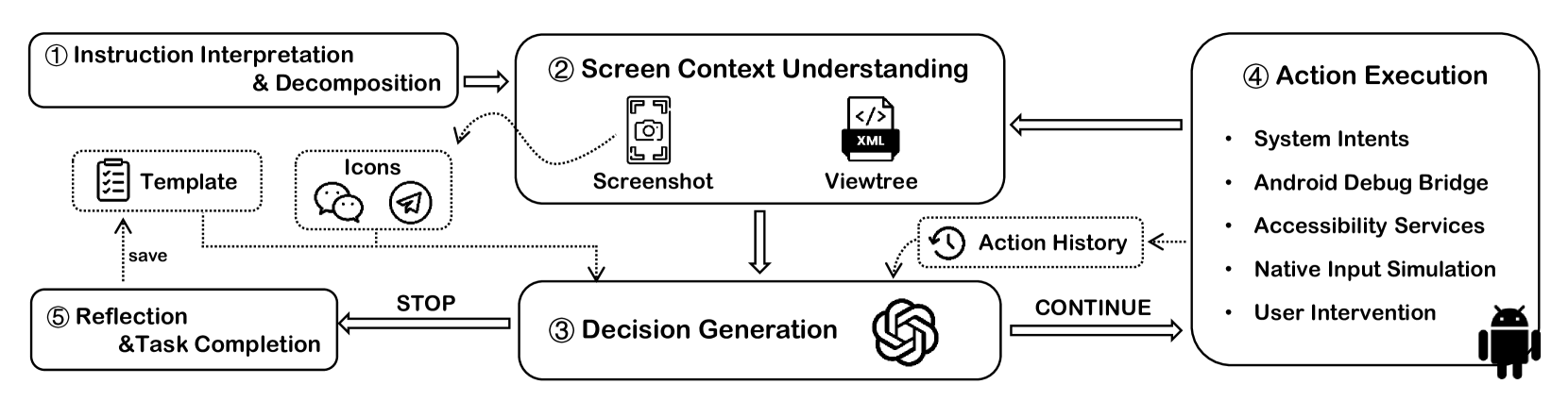
The generalized execution pipeline of a mobile LLM agent, illustrating the flow from user instruction to device action.
Evaluation Highlights
- 100% of the 9 tested mobile agents (including OEM system-level and third-party agents) were vulnerable to targeted attacks.
- UI manipulation attacks (Transparent Overlay and Pop-up Interference) were universally effective, compromising every tested agent.
- In the most severe cases, single agents exhibited vulnerabilities across 8 distinct attack vectors, enabling consequences ranging from privacy leakage to full execution hijacking.
Breakthrough Assessment
8/10
First systematic security audit of the rapidly growing mobile agent ecosystem. The finding that *all* current agents are vulnerable to basic UI attacks is a significant wake-up call for the industry.