📝 Paper Summary
Recommendation Systems
Knowledge Graph Reasoning
Vector Database Retrieval
KGSR-ADS integrates a heterogeneous knowledge graph with LLM-based semantic embeddings and vector database indexing to improve the accuracy and speed of personalized advertisement retrieval.
Core Problem
Traditional ad retrieval relies on keyword matching or simple collaborative filtering, failing to capture complex semantic relationships between diverse entities (users, products, ads) and struggling with real-time scalability.
Why it matters:
- Explosion of unstructured ad content (text, logs) demands understanding deep semantic relevance beyond simple co-occurrence
- Existing systems struggle to balance high-precision semantic reasoning with low-latency retrieval required for real-time bidding and personalization
- Heterogeneous data types (user interests, product categories, ad creatives) are often modeled in isolation rather than as a connected semantic graph
Concrete Example:
A user interested in 'hiking' might not be matched with a 'waterproof jacket' ad if the system relies only on exact keywords. KGSR-ADS uses the knowledge graph to link 'hiking' -> 'outdoor activity' -> 'waterproof jacket', enabling the recommendation even without direct interaction history.
Key Novelty
Knowledge Graph Semantic Recommendation with Database Optimization (KGSR-ADS)
- Combines structured reasoning (Ad-Knowledge Graph) with deep textual understanding (LLM embeddings) to capture both explicit relations and implicit semantic context
- Integrates a dedicated vector database layer (e.g., FAISS/Milvus) directly into the recommendation pipeline to accelerate retrieval of these complex fused embeddings
Architecture
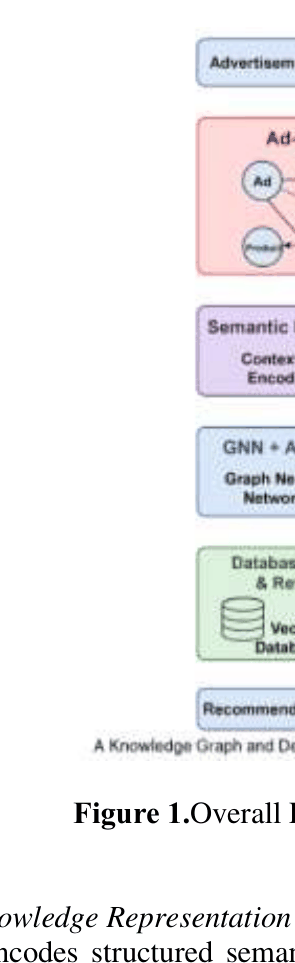
The overall framework diagram showing the data flow from the Knowledge Graph Layer through Semantic Embedding and GNN layers to the Database Retrieval Layer.
Evaluation Highlights
- Achieves 0.512 Precision@10, outperforming the strongest baseline GraphRec by 5.7%
- Reduces Average Response Latency by 23.9% (34.7 ms vs 45.6 ms for GraphRec) via optimized vector database indexing
- Improves NDCG@10 to 0.509 (+6.3% over GraphRec), indicating superior ranking of relevant advertisements
Breakthrough Assessment
7/10
Solid engineering integration of KGs, LLMs, and vector databases for ad tech. Performance gains are significant, though the architectural components (TransE, GAT, FAISS) are individually standard.