📝 Paper Summary
Conversational Recommender Systems (CRS)
Large Language Models (LLMs) in E-commerce
Pre-sales Dialogue Systems
The paper investigates two collaboration strategies where Large Language Models enhance the semantic understanding of Conversational Recommender Systems, while CRSs provide domain-specific product knowledge to LLMs.
Core Problem
Conversational Recommender Systems (CRS) struggle with semantic understanding and generation, while Large Language Models (LLMs) lack domain-specific product knowledge required for accurate recommendations.
Why it matters:
- High-quality pre-sales dialogues significantly increase purchase rates but require both natural interaction and accurate domain knowledge
- Existing CRSs rely heavily on external knowledge bases and struggle with complex semantic contexts
- LLMs hallucinate or fail to recommend specific products because they lack access to real-time candidate product inventories
Concrete Example:
A CRS might accurately retrieve a product ID but generate a robotic response. Conversely, an LLM might generate a fluent sales pitch but recommend a non-existent product or fail to account for the specific attributes (e.g., specific phone RAM size) available in the store's inventory.
Key Novelty
Bi-directional Collaboration Framework (LLM assisting CRS & CRS assisting LLM)
- LLM assisting CRS: The LLM's natural language predictions are used to enhance the CRS's input prompts and user representations (vectors), improving semantic understanding.
- CRS assisting LLM: The CRS's domain-specific predictions (product lists/scores) are converted to text and appended to the LLM's instructions, grounding the generation in actual inventory.
Architecture
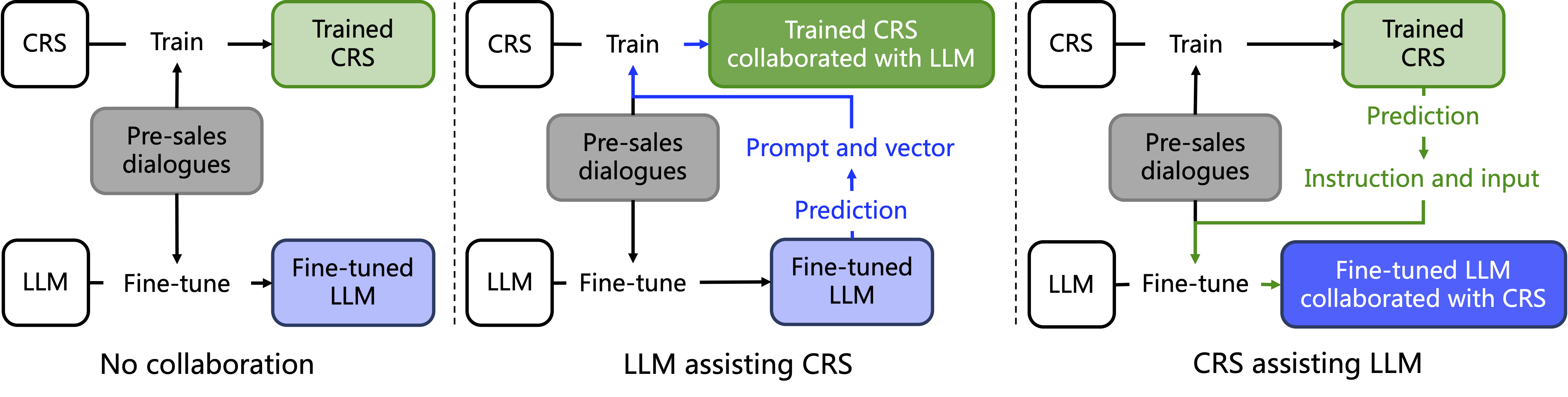
The collaboration framework illustrating the two distinct pipelines: LLM assisting CRS and CRS assisting LLM.
Breakthrough Assessment
6/10
Proposes a logical, complementary integration of LLMs and specialized systems. While the architectural combination is sound, the text provided lacks the results to confirm the magnitude of the breakthrough.