📝 Paper Summary
Explainable Recommendation
Personalized Natural Language Generation
GaVaMoE combines a Gaussian-Variational Autoencoder for robust user preference modeling with a fine-grained Mixture of Experts to generate personalized explanations, effectively handling sparse interaction data.
Core Problem
Current LLM-based explainable recommendation systems struggle with inadequate collaborative preference modeling, generic (non-personalized) explanations, and poor performance when user interaction data is sparse.
Why it matters:
- Explanations build user trust and aid decision-making, but generic outputs fail to persuade or inform users effectively.
- Existing methods rely on simple ID embeddings that miss complex non-linear user-item relationships.
- Data sparsity is common in real-world systems; without transferring knowledge between similar users, models fail to explain recommendations for users with limited history.
Concrete Example:
Existing approaches typically map discrete user/item IDs directly to embeddings. For a user with few ratings, this results in a generic embedding that leads the LLM to generate a bland explanation like 'You might like this movie because it is popular,' rather than referencing the specific genre or style nuances the user actually prefers.
Key Novelty
Hierarchical Preference-Guided Mixture of Experts
- Uses a VAE-GMM (Variational Autoencoder with Gaussian Mixture Model) to learn dense user preference representations and automatically cluster users with similar behaviors.
- Implements a cluster-aware multi-gating mechanism where user-item pairs are routed to specific 'expert' models based on the user's preference cluster, ensuring explanations match their specific style.
- Decomposes large experts into fine-grained micro-experts to maintain computational efficiency while allowing precise specialization for different explanation patterns.
Architecture
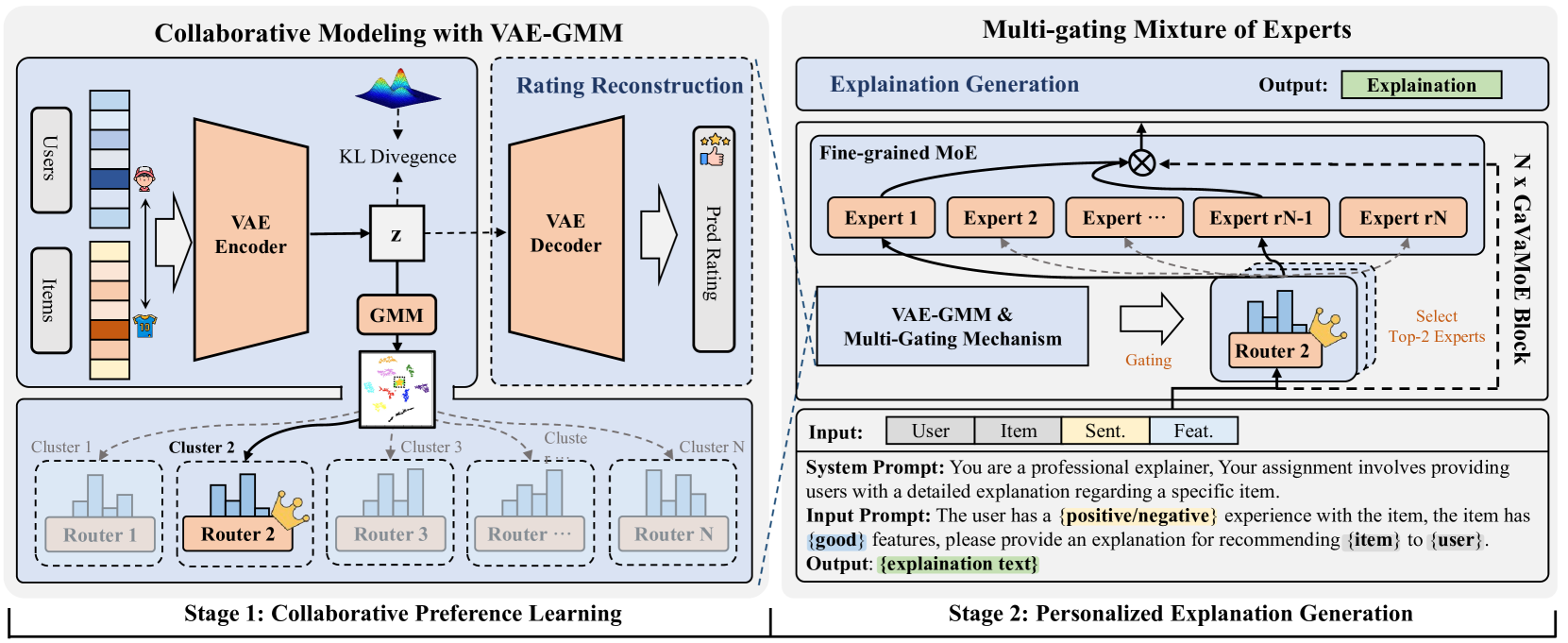
The overall architecture of GaVaMoE, illustrating the two-stage process: VAE-GMM for preference learning/clustering and the Multi-gating Mixture of Experts for explanation generation.
Evaluation Highlights
- Significant improvements in explanation quality and personalization metrics across three real-world datasets compared to baselines like PEPLER and LLM2ER.
- Robust performance in data sparsity scenarios, maintaining high quality even for users with limited interaction history due to the VAE-GMM's ability to transfer knowledge within clusters.
- Effective expert specialization, where specific gates learn distinct linguistic patterns and reasoning strategies corresponding to different user groups.
Breakthrough Assessment
7/10
Strong architectural novelty in combining VAE-GMM with MoE for recommendation. Addresses the critical sparsity problem effectively, though the core LLM components are standard.