📝 Paper Summary
Agentic RAG pipeline
Self-evolving Agentic reasoning
The paper automates deep reasoning by steering LLMs through a recursive descent algorithm that builds And-Or trees of subtasks and alternatives, validating hypotheses against ground-truth embeddings or oracle advice.
Core Problem
steering LLM dialogs toward complex goals requires labor-intensive prompt engineering and often fails to maintain focus or depth when relying on simple one-shot queries.
Why it matters:
- Users currently struggle to keep LLMs focussed on a task while digging deep into details without extensive manual intervention
- Standard LLM interactions lack a structured memory of the reasoning path, leading to drift and hallucinations in multi-step tasks
- Existing logic programming approaches are too rigid for natural language, while LLMs lack the inherent structure to perform rigorous step-by-step logic independently
Concrete Example:
When asked to explain a complex causal chain, a standard LLM might provide a surface-level summary or drift into irrelevant topics. In contrast, this system forces a recursive breakdown: first generating alternative causes (OR-step), then breaking each into necessary conditions (AND-step), creating a verifiable trace of justification.
Key Novelty
Logic-Guided Recursive Descent for LLM Dialogs
- Adapts the SLD-resolution algorithm from Horn Clause logic to natural language, replacing unification with LLM-generated clause heads and bodies
- Maintains an explicit goal stack and context history to steer the LLM, treating the conversation as a proof search rather than a Markov chain
- Uses semantic similarity to ground-truth embeddings or 'oracle' LLM agents to validate leaf nodes (abducibles) effectively acting as integrity constraints
Architecture
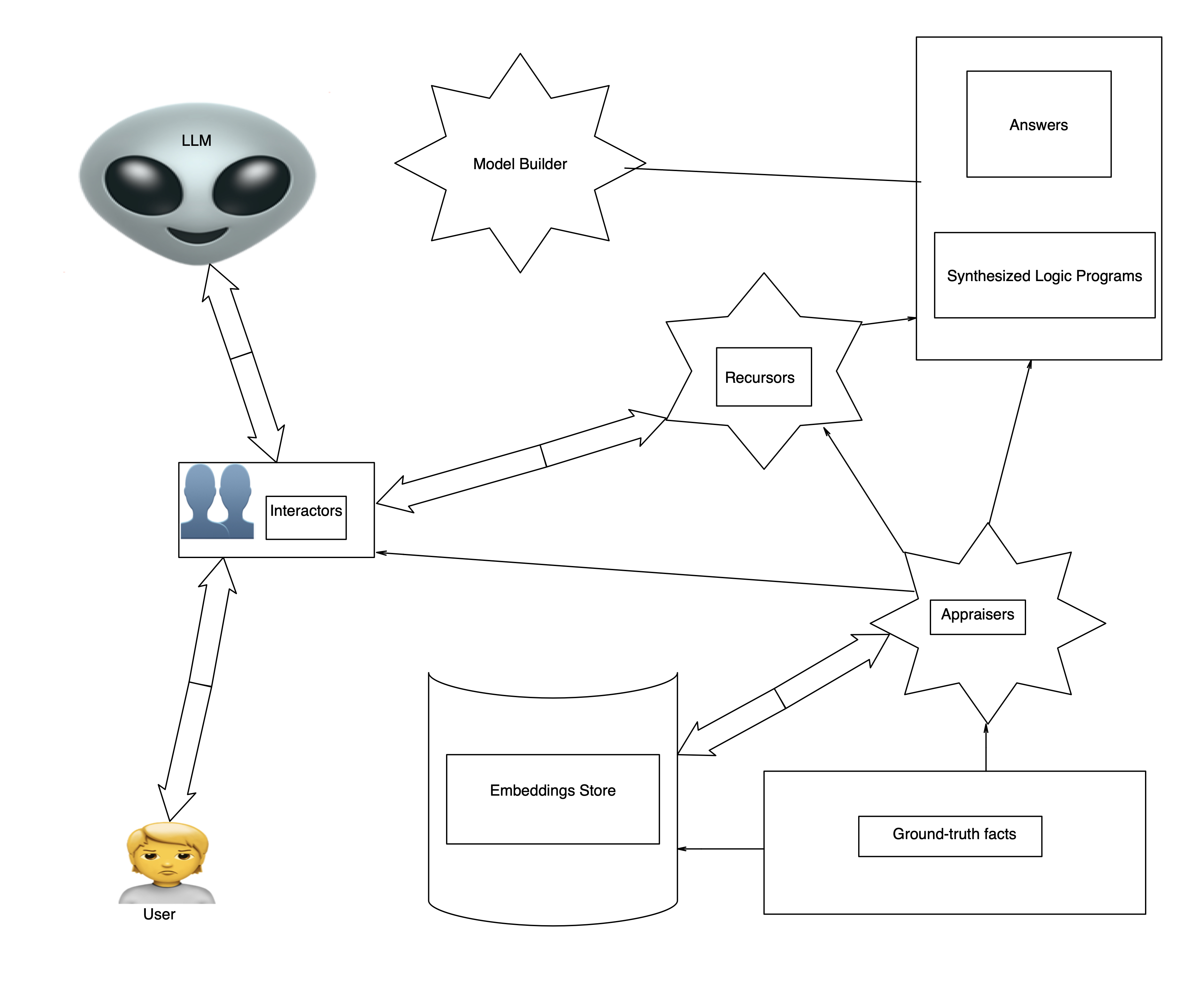
The system architecture and execution flow, illustrating the interaction between the Python-based logic controller and the LLM API.
Evaluation Highlights
- The system successfully generates full justification traces for complex tasks like causal explanations and scientific literature exploration
- Demonstrates compilation of natural language dialog threads into executable Propositional Horn Clause programs
- Qualitative validation shows the approach produces 'hallucination-free', crisp answers closer to ground truth than standard chat interactions
Breakthrough Assessment
7/10
Novel integration of symbolic logic control flow (SLD-resolution) with neural generation. While experimental results are qualitative, the architectural mapping of logic programming concepts to LLM prompting is highly innovative.