📝 Paper Summary
E-commerce search and recommendation
Commonsense reasoning in information retrieval
E-CARE distills LLM reasoning capabilities into a static reasoning factor graph offline, enabling efficient commonsense-aware retrieval during inference with only a single LLM forward pass per query.
Core Problem
Accurately matching vague user queries to products requires commonsense reasoning, but using LLMs to evaluate every query-product pair in real-time is prohibitively expensive and slow.
Why it matters:
- Standard semantic matching (Bi-encoders) fails on implicit user intents (e.g., 'shoes for elderly' implying 'slip-resistant')
- Cross-encoder or LLM-based reranking methods have high latency and cost, scaling poorly to millions of products
- Existing reasoning-based methods (like FolkScope) rely heavily on expensive human annotation and Supervised Fine-Tuning (SFT)
Concrete Example:
A user searches for 'shoes for the elderly'. A standard retriever might miss 'slip-resistant shoes' if the text doesn't explicitly overlap. E-CARE infers the hidden 'need' (prevent falls) and 'utility' (slip resistance) via a pre-computed graph, connecting the query to the right product without running a heavy LLM reasoning step at runtime.
Key Novelty
Efficient Commonsense-Augmented Recommendation Enhancer (E-CARE)
- Decouples reasoning from inference by pre-generating a 'reasoning factor graph' using LLMs to mine 'needs' and 'utilities' from historical query-product pairs offline
- Replaces expensive real-time LLM pairwise reasoning with a lightweight adapter that maps incoming queries to this pre-computed graph using a single vector embedding
- Uses a 3-stage pipeline (Generation, Clustering, Filtering) with LLM self-evaluation to construct the graph without any human annotation or Supervised Fine-Tuning
Architecture
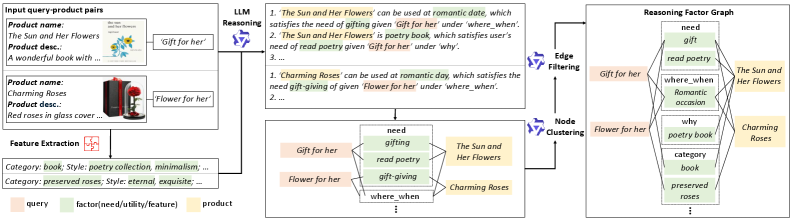
The 3-stage pipeline of E-CARE: (1) LLM Reasoning to extract factors, (2) Node Clustering to merge factors, and (3) Edge Filtering to clean the graph.
Evaluation Highlights
- Improves Precision@5 by up to 12.1% on downstream tasks compared to baselines
- Achieves up to 12.79% improvement on Macro F1 for search relevance tasks
- Requires only one LLM forward pass per query during inference, unlike methods requiring passes per query-product pair
Breakthrough Assessment
7/10
Strong practical contribution for e-commerce, offering a credible solution to the latency/cost bottleneck of LLMs in search. The automated graph construction without SFT is a significant efficiency win.