📝 Paper Summary
LLM-Enhanced Recommender Systems (LLMERS)
Hybrid Recommender Systems
This survey defines and categorizes 'LLM-Enhanced Recommender Systems' (LLMERS), a paradigm that leverages offline LLMs to improve the data or architecture of conventional recommenders without incurring the high latency of online LLM inference.
Core Problem
Conventional recommender systems (RS) lack semantic understanding and suffer from data sparsity, while 'LLM-as-RS' approaches suffer from intolerant inference latency and memory costs unsuitable for real-time applications.
Why it matters:
- Pure LLM-based recommendations (e.g., LLaMA-7B) take seconds per response, failing the millisecond-latency requirement of real-world systems
- Conventional RS relies on collaborative signals (IDs) and misses the rich semantic knowledge and reasoning capabilities embedded in text
- Data sparsity (cold start) remains a critical bottleneck that conventional methods struggle to solve without external knowledge
Concrete Example:
A user viewing a specific history of items might be recommended irrelevant items by a conventional model due to sparse interaction data. A direct LLM recommender could reason about the user's interest correctly but would take too long to serve. LLMERS solves this by using the LLM offline to generate a 'user preference summary' or 'pseudo-interactions', which the conventional model then uses for fast, accurate online prediction.
Key Novelty
Formalization of LLMERS (LLM-Enhanced Recommender Systems)
- Explicitly separates 'LLM-Enhanced RS' from 'LLM-as-RS', focusing on methods where the LLM assists in training or data augmentation but is NOT required during the inference service
- Proposes a comprehensive taxonomy with three pillars: Knowledge Enhancement (generating features), Interaction Enhancement (generating training samples), and Model Enhancement (assisting architecture/training)
Architecture
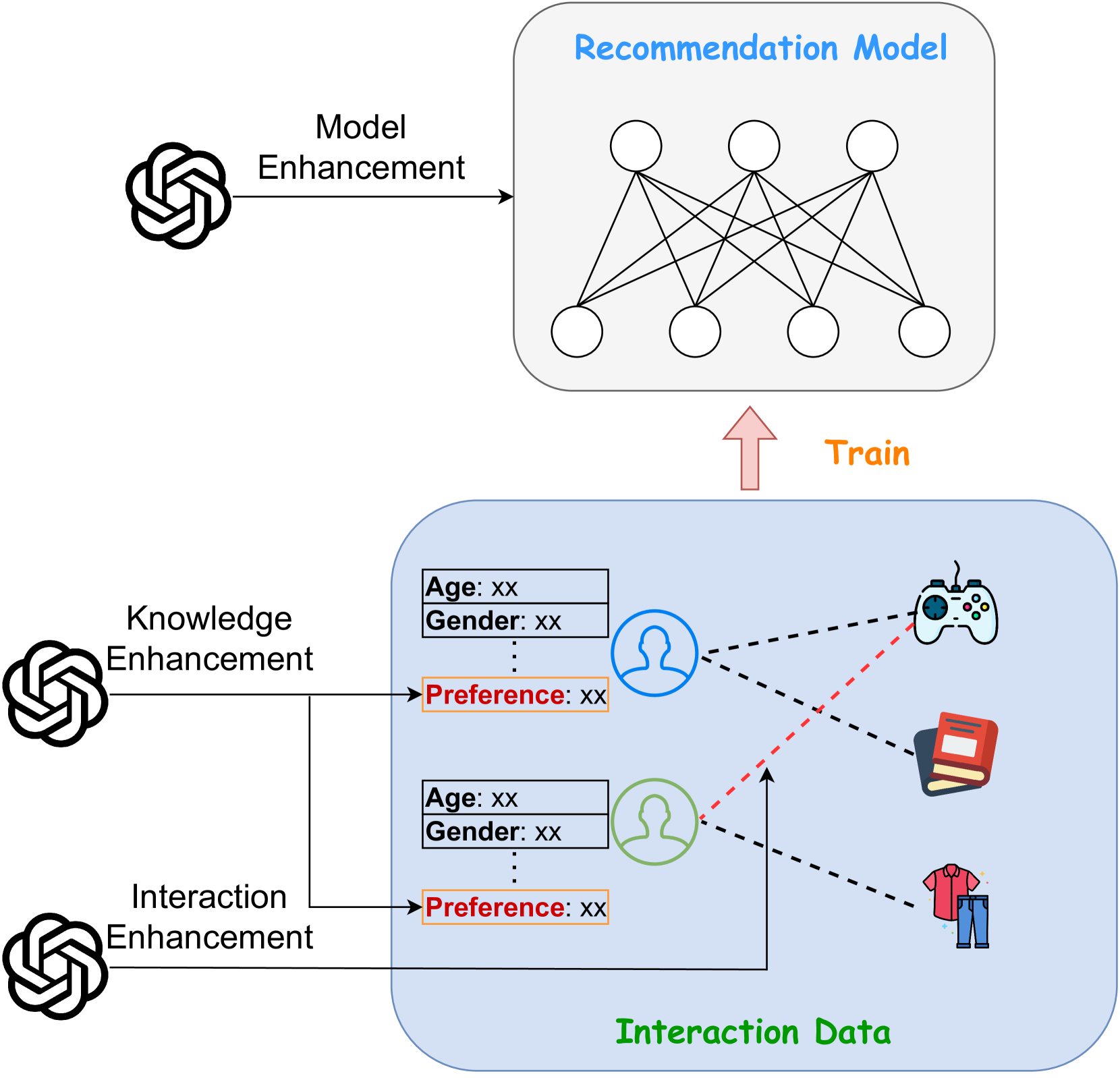
Conceptual framework contrasting Conventional RS with the three types of LLM-Enhanced RS (Knowledge, Interaction, Model Enhancement)
Evaluation Highlights
- Categorizes over 60 works published after early 2024, highlighting the rapid growth of this specific sub-field
- Identifies a critical shift in research focus from direct LLM inference towards offline LLM utilization to address real-world latency constraints
Breakthrough Assessment
8/10
Timely and necessary survey that clarifies the confusion between using LLMs *as* recommenders versus using them to *enhance* recommenders. The taxonomy is clear and addresses the practical bottleneck of deployment.