📝 Paper Summary
Graph Construction for Recommendation
LLM-enhanced Recommender Systems
AutoGraph constructs recommendation graphs by using LLMs to generate semantic vectors and vector quantization to extract latent factor nodes, enabling global-view learning with linear complexity.
Core Problem
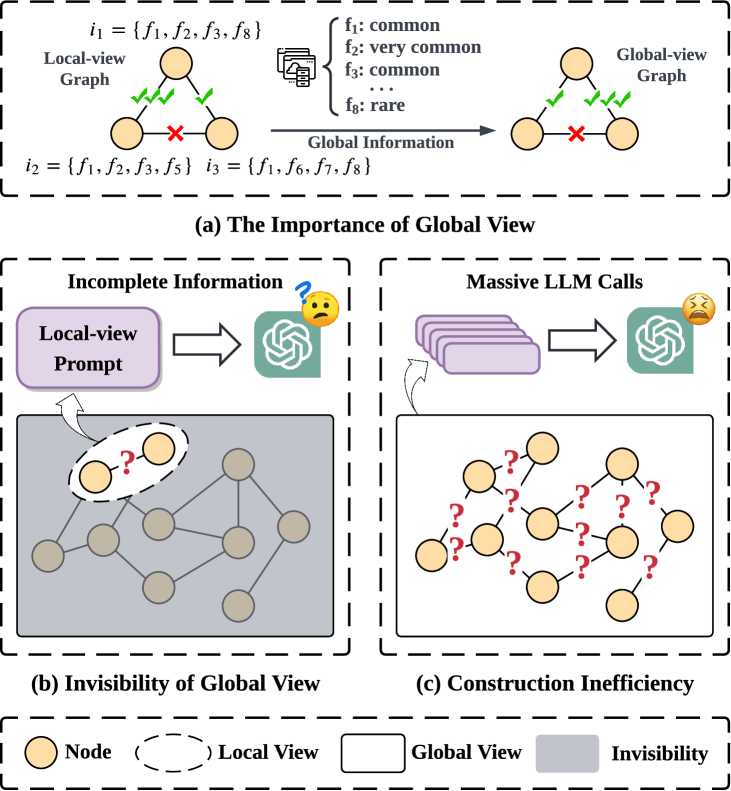
Existing LLM-based graph construction methods rely on pairwise comparisons, which lack a global view due to context window limits and are computationally inefficient ($O(N^2)$).
Why it matters:
- Graph structure quality fundamentally limits GNN performance; poor graphs lead to suboptimal recommendations.
- Pairwise assessment is prohibitively expensive for industrial systems with millions of users/items.
- Local-view comparisons overlook global context (e.g., feature frequency), leading to inaccurate similarity assessments.
Concrete Example:
Consider items $i_1, i_2, i_3$. Locally, $i_1$ and $i_2$ might seem most similar due to many shared features. However, if $i_1$ and $i_3$ share a globally rare/informative feature $f_8$, they should be strongly linked. Pairwise LLM methods miss this global distribution context.
Key Novelty
Quantization-based Graph Construction
- Uses Vector Quantization (VQ) to map LLM-enriched user/item vectors to discrete latent codes.
- Treats these latent codes as new graph nodes, effectively creating 'hubs' that link users/items based on global semantic patterns rather than just local pairwise similarity.
- Decouples semantic inference (Pointwise LLM call) from structure learning, reducing complexity from quadratic to linear.
Architecture
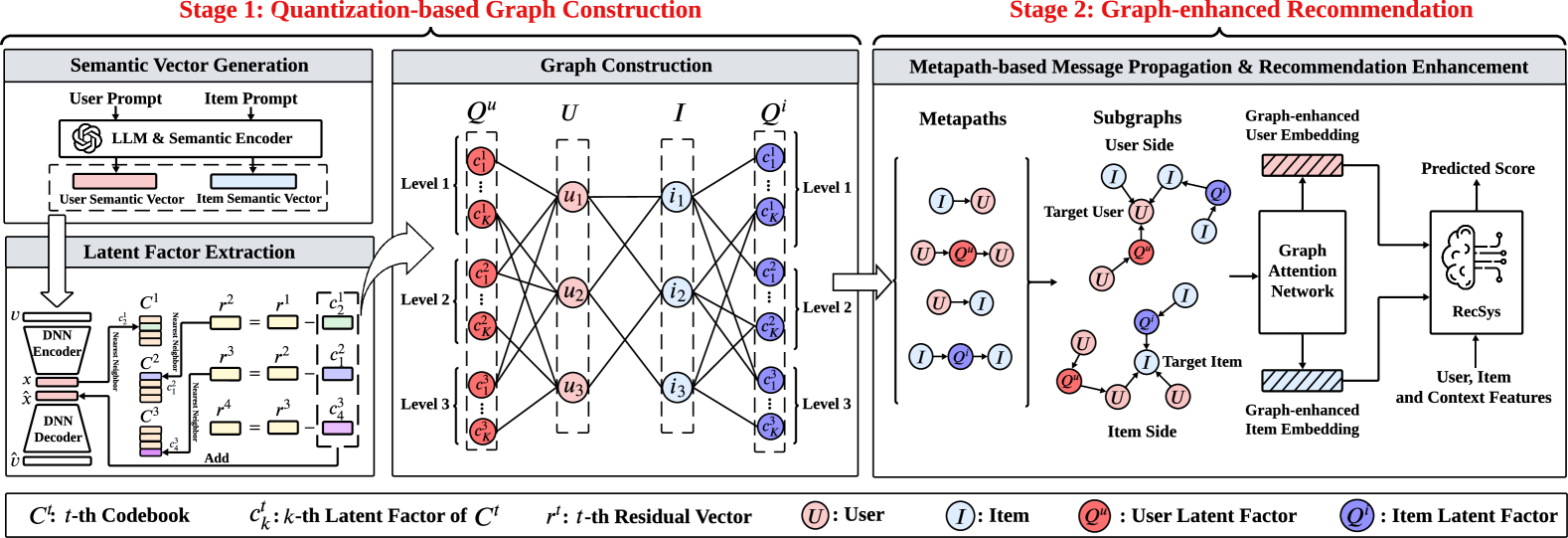
The complete AutoGraph framework, illustrating the two-stage process: Quantization-based Graph Construction and Graph-enhanced Recommendation.
Evaluation Highlights
- +2.69% improvement on RPM (Revenue Per Mille) in online A/B testing on Huawei's advertising platform.
- +7.31% improvement on eCPM (effective Cost Per Mille) in online A/B testing.
- Deployed as the main traffic model serving hundreds of millions of users.
Breakthrough Assessment
8/10
Significantly improves efficiency of LLM-based graph construction (linear vs quadratic) while adding a mechanism for global context, validated by large-scale industrial deployment.