Anima Singh, Trung Vu, Nikhil Mehta, Raghunandan Keshavan, Maheswaran Sathiamoorthy, Yilin Zheng, Lichan Hong, Lukasz Heldt, Li Wei, Devansh Tandon, Ed H. Chi, Xinyang Yi
Google,
Google DeepMind
arXiv
(2023)
RecommendationP13N
📝 Paper Summary
Recommendation SystemsRepresentation Learning
The paper replaces random item IDs in ranking models with Semantic IDs—discrete, hierarchical codes derived from content—adapted via SentencePiece tokenization to improve generalization on new items while maintaining memorization.
Core Problem
Randomly hashed item IDs allow efficient memorization but fail to generalize to new or long-tail items, while pure content embeddings often degrade overall ranking quality due to poor memorization.
Why it matters:
Industrial recommender systems (e.g., YouTube) deal with billions of dynamic items; pure ID approaches struggle with the 'cold-start' problem for new uploads
Replacing IDs with raw content embeddings often causes a drop in quality because dense vectors lack the item-level memorization capacity of discrete ID embedding tables
Existing solutions like end-to-end video encoders (VideoRec) are computationally prohibitive (10-50x cost) for latency-sensitive production ranking
Concrete Example:A new video uploaded to YouTube has no interaction history, so a random ID embedding cannot capture its properties. However, using its raw visual embedding might blur it with thousands of similar videos, losing the specificity needed to rank it precisely for a user.
Key Novelty
Semantic IDs (SIDs) with SentencePiece Adaptation
Use a frozen RQ-VAE (Residual-Quantized VAE) to compress content embeddings into a sequence of discrete integers (Semantic IDs) that capture hierarchical concepts
Adapt these Semantic ID sequences for ranking models using SentencePiece Model (SPM) tokenization, which learns variable-length sub-word units to hash items effectively, balancing granularity (memorization) and sharing (generalization)
Architecture
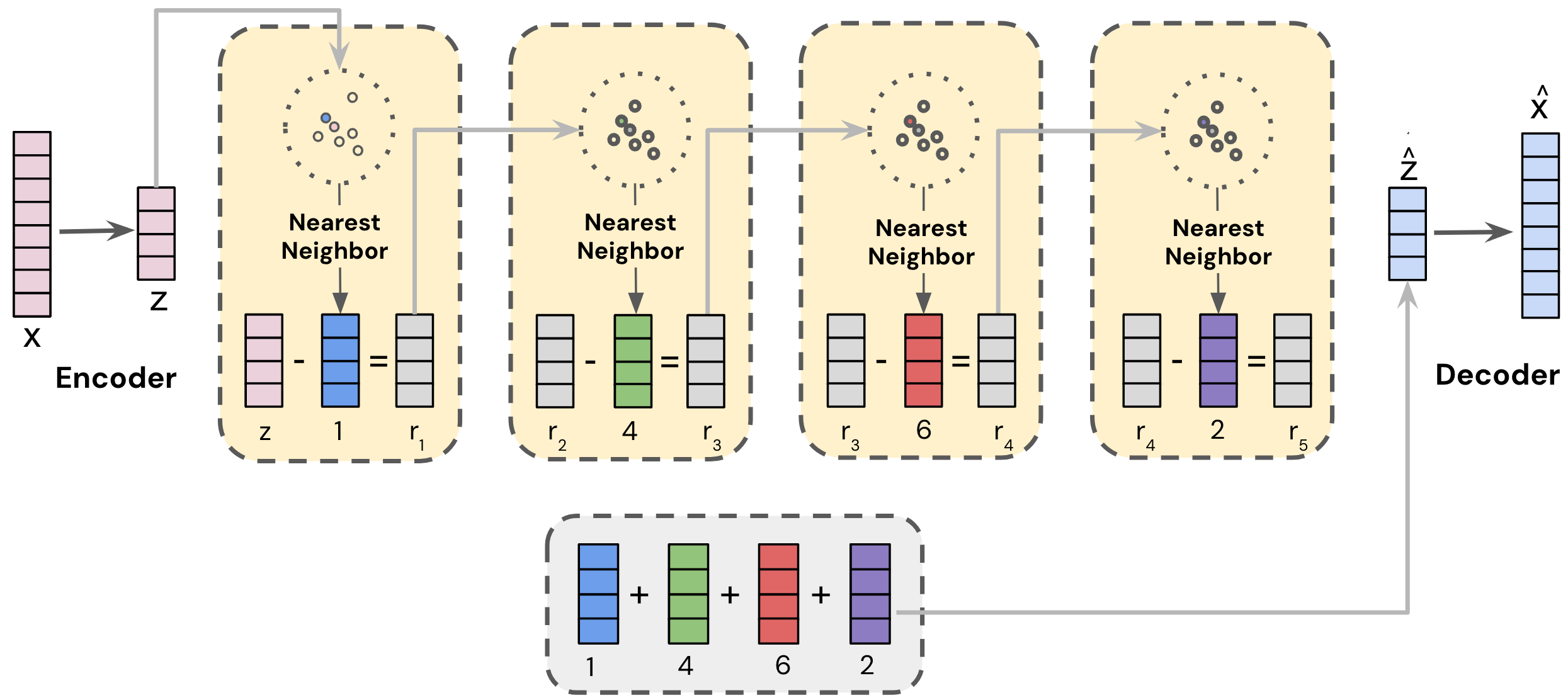
The RQ-VAE (Residual-Quantized Variational AutoEncoder) architecture used to generate Semantic IDs.
Evaluation Highlights
Demonstrates that SentencePiece Model (SPM) adaptation outperforms N-gram adaptation for Semantic IDs in industry-scale ranking
Qualitatively reported to improve generalization on new and long-tail item slices in YouTube production without sacrificing overall model quality (specific numbers not in provided text)
Breakthrough Assessment
7/10
Offers a practical, compute-efficient strategy for integrating content semantics into large-scale ID-based rankers. Bridges the gap between ID memorization and content generalization.
⚙️ Technical Details
Problem Definition
Setting: Large-scale item ranking in video recommendations
Inputs: User history and candidate item features (including video content)
vs. N-gram adaptation: SPM creates variable-length tokens based on distribution, optimizing the embedding table usage
Limitations
Relies on frozen RQ-VAE; requires retraining or verification that semantic representations remain stable over time (addressed in Appendix)
Requires pre-trained content embeddings; quality depends on the upstream encoder
Two-stage process adds complexity compared to simple ID hashing
Reproducibility
No replication artifacts mentioned in the paper. The dataset is internal YouTube production data.
📊 Experiments & Results
Evaluation Setup
Production-scale video recommendation ranking at YouTube
Benchmarks:
YouTube Internal Dataset (Video Ranking)
Metrics:
Generalization ability (on new/long-tail items)
Overall model quality
Statistical methodology: Not explicitly reported in the paper
Main Takeaways
Replacing video IDs with Semantic IDs (SIDs) improves generalization on new and long-tail item slices compared to random ID hashing.
SentencePiece Model (SPM) adaptation outperforms N-gram adaptation for SIDs by learning variable-length sub-units that better match the item distribution.
Directly replacing IDs with raw content embeddings causes a significant quality reduction in large-scale ranking; SIDs bridge this gap by restoring memorization capability through discrete tokens.
The semantic representations learned by RQ-VAE are stable enough over time that freezing the model does not significantly hurt performance on recent data.
📚 Prerequisite Knowledge
Prerequisites
Embedding tables and hashing tricks
Vector Quantization (VQ-VAE / RQ-VAE)
Subword tokenization (SentencePiece/BPE)
Key Terms
Semantic IDs: Discrete, hierarchical item representations (sequences of integers) derived from content embeddings using residual quantization
RQ-VAE: Residual-Quantized Variational AutoEncoder—a model that quantizes vectors by recursively approximating residuals at multiple levels
SPM: SentencePiece Model—a tokenizer that learns to break sequences into variable-length sub-units based on frequency, commonly used in LLMs
N-gram: A fixed-size sequence of N items (or tokens); here, grouping N consecutive codes from a Semantic ID
Hashing trick: Mapping high-cardinality categorical features (like IDs) to a fixed-size embedding table by hashing the ID to an index
Codebook: A fixed set of learned vectors used in quantization to approximate input data
Stop-gradient: An operator that prevents error signals (gradients) from flowing backward through a specific part of the network during training