📝 Paper Summary
Serendipity in Recommender Systems
Aspect-Based Sentiment Analysis
Personalized Recommendation
ATARS generates serendipitous recommendations by identifying item aspects that are atypical for their category (like an origami station in a restaurant) and re-ranking them based on their utility to the user.
Core Problem
Traditional recommender systems focus on accuracy, leading to choice overload and filter bubbles, while existing serendipity methods rely on statistical surprise rather than semantic unexpectedness.
Why it matters:
- Choice overload causes decision paralysis and anxiety (the 'overchoice' effect)
- Users experience higher satisfaction and meaningfulness from serendipitous (unexpected but positive) encounters
- Current systems fail to leverage 'schema-discrepant' features (atypical aspects) that naturally trigger surprise
Concrete Example:
A user named Sheldon loves comic books. A standard recommender shows high-rated cafes. ATARS recommends a specific cafe because reviews mention it has 'Batman Adventures issue from 96' (atypical for a cafe), which matches Sheldon's profile, creating a positive surprise.
Key Novelty
Atypical Aspect-Based Recommender System (ATARS)
- Introduces 'atypical aspects' (features unrelated to the core business, like harpsichords in a hotel) as the primary source of surprise
- Decouples surprise (atypicality) from relevance (utility), calculating them separately to engineer serendipity
- Uses a pipeline of LLM-based extraction and utility estimation to re-rank items without disclosing the surprise element to the user
Architecture
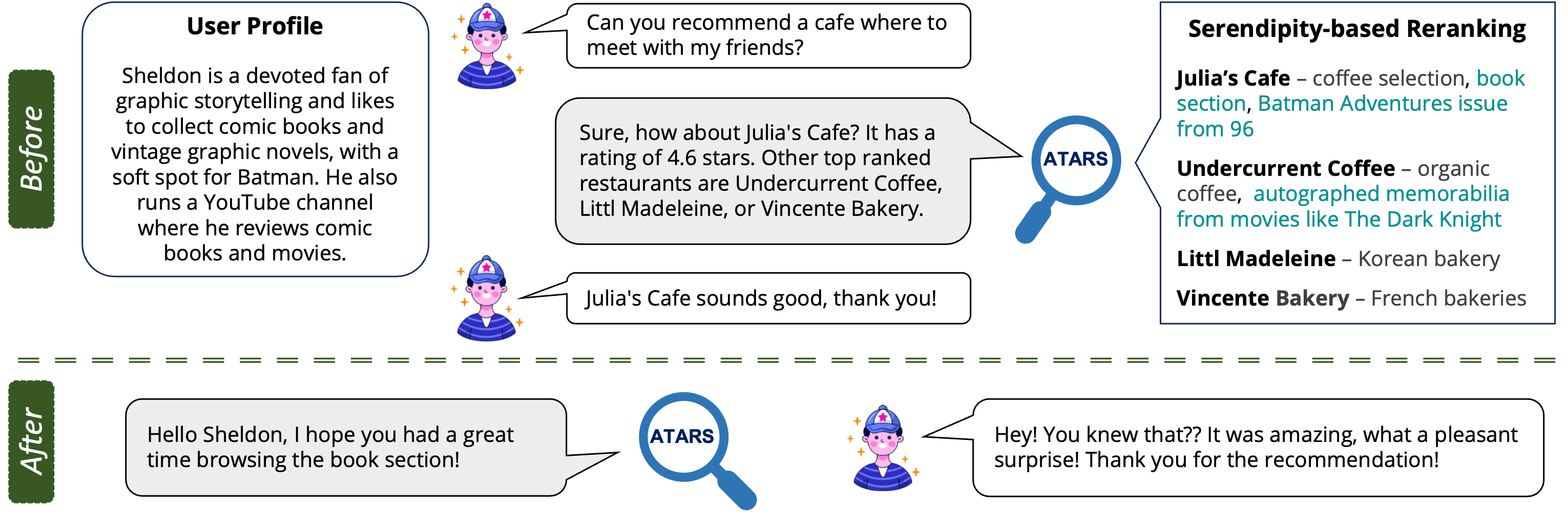
The ATARS pipeline interaction flow. Figure 1 shows the user (Sheldon) querying for a cafe and receiving a recommendation based on an unrevealed atypical aspect (Batman comics). Figure 2 details the 3-step internal process.
Breakthrough Assessment
7/10
Novel task formulation (atypical aspect extraction) that shifts serendipity from latent vectors to interpretable semantic features. However, limited by the extreme scarcity of such data (needle-in-haystack problem).