DaRec improves recommendation by disentangling LLM and collaborative model representations into shared and specific components, preventing the noise transfer inherent in perfect alignment strategies.
Core Problem
Directly aligning LLM and collaborative filtering representations (e.g., via contrastive learning) is sub-optimal because it forces the distinct 'specific' information of each modality to merge, introducing noise.
Why it matters:
LLMs and collaborative models rely on fundamentally different data (natural language vs. interaction graphs), creating a natural semantic gap
Theorem 1 proves that reducing this representation gap to zero theoretically bounds the optimal error by the 'information gap' (Delta p), meaning perfect alignment hurts performance
Simply mapping representations into the same space introduces irrelevant noise from modality-specific features
Concrete Example:If a collaborative model learns user preferences from clicks, and an LLM learns from review text, forcing their embeddings to be identical (zero gap) discards the unique, complementary signals each modality provides, degrading downstream accuracy.
Key Novelty
Disentangled Structure Alignment
Separates (disentangles) the latent representations of both the LLM and the recommender into 'shared' (common semantics) and 'specific' (modality-unique) components using projection layers
Aligns only the 'shared' components using global structure alignment (similarity matrices) and local structure alignment (adaptive preference clustering), rather than point-wise vector alignment
Architecture
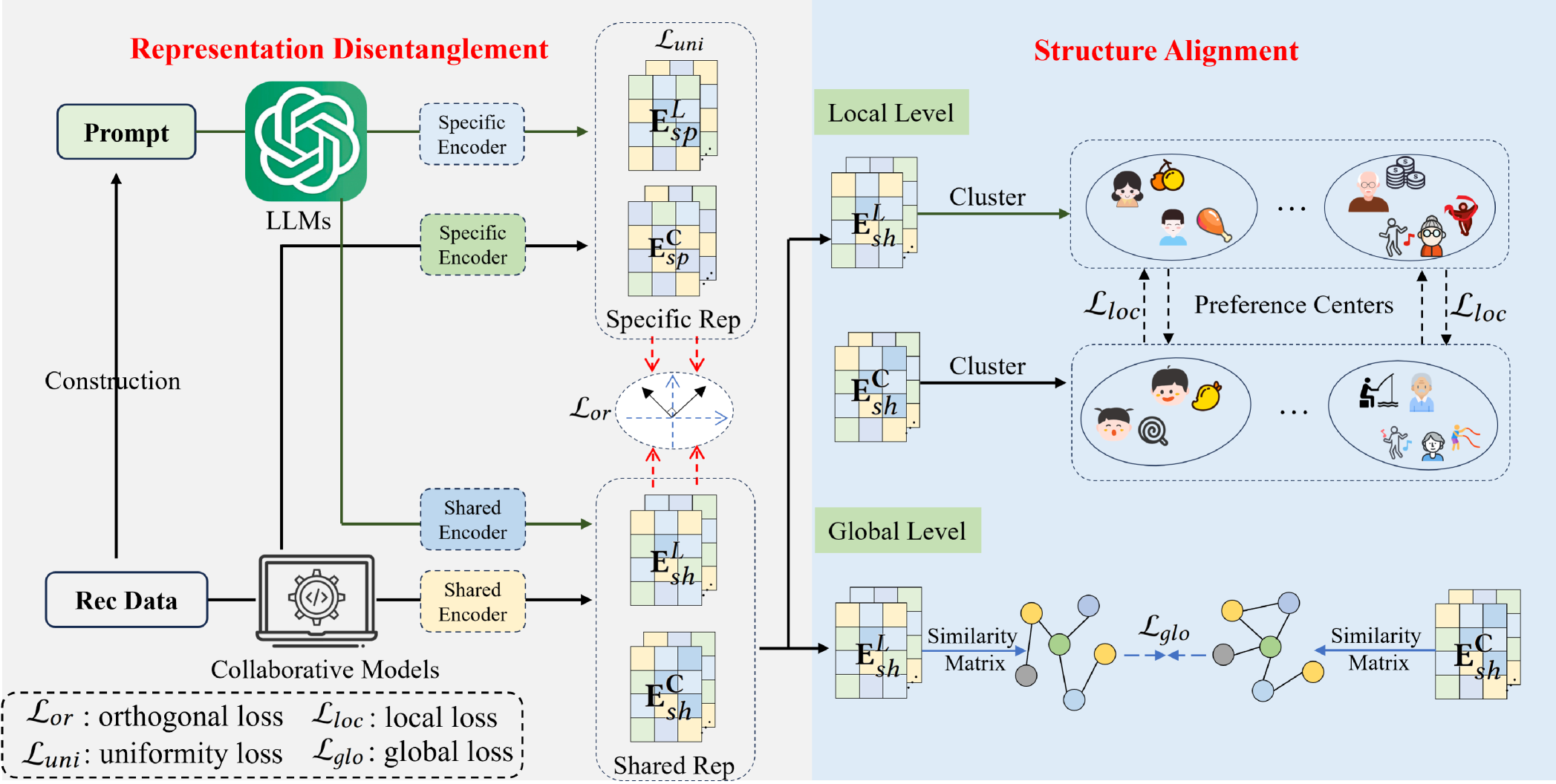
The overall DaRec framework, illustrating the disentanglement of representations and the dual-level (global and local) structure alignment.
Breakthrough Assessment
7/10
The theoretical proof that 'zero gap' alignment is sub-optimal is a strong contribution that challenges the prevailing contrastive learning paradigm in this sub-field.
⚙️ Technical Details
Problem Definition
Setting: Aligning semantic representations between a Collaborative Model (CM) and a Large Language Model (LLM) for recommendation
Inputs: Interaction data D (for CM) and Prompt data D' (for LLM)
Outputs: Target variable Y (recommendation prediction)
Pipeline Flow
Encoders: Generate initial embeddings from LLM and Collaborative Model
Disentanglement: Project embeddings into Shared and Specific components
Regularization: Apply Orthogonality and Uniformity losses
Alignment: Align Shared components via Global and Local structure losses
System Modules
Base Encoders
Extract initial latent representations
Model or implementation: Generic Collaborative Model f_C and LLM f_L
Disentangler
Split representations into shared and specific parts
Model or implementation: MLP (Multi-Layer Perceptron) projection layers
Global Aligner (Alignment)
Align the global pairwise similarity structure of shared representations
Model or implementation: Matrix multiplication + Frobenius norm minimization
Local Aligner (Alignment)
Align coarse-grained user preference clusters
Model or implementation: Clustering (e.g., K-Means) + Adaptive Matching
Novel Architectural Elements
Dual-stream disentanglement projecting single embeddings into orthogonal 'shared' and 'specific' vectors
Adaptive preference-matching mechanism that sorts and aligns cluster centers without explicit labels
Modeling
Base Model: Generic framework applicable to various Collaborative Models and LLMs (specific backbones not detailed in provided text)
Training Method: Joint optimization of base recommendation loss and alignment regularizers
Objective Functions:
Purpose: Ensure specific and shared representations contain unique info.
Formally: Minimize cosine similarity between E_sh and E_sp.
Purpose: Prevent specific representations from collapsing (becoming noise).
Formally: Uniformity loss (Gaussian potential) on E_sp.
Purpose: Transfer semantic knowledge by aligning global structures.
Formally: Minimize difference between similarity matrices S_C and S_L.
Purpose: Align user preferences at a local cluster level.
Formally: Minimize distance between sorted cluster centers C_C and C_L.
Compute: Time complexity for alignment is O(N^2 d + Nd + K^2 d), approximated to O(N_hat^2 d) with sampling
Comparison to Prior Work
vs. Contrastive Learning: DaRec disentangles features first and avoids 'zero gap' alignment to prevent specific noise transfer
vs. Direct Alignment: DaRec aligns 'structures' (similarity matrices and cluster centers) rather than point-wise embeddings
Limitations
Computational complexity of global alignment involves N^2 operations, requiring sampling for large datasets
Relies on the assumption that 'shared' information is sufficient for alignment and 'specific' information is noise/interference
📊 Experiments & Results
Evaluation Setup
Recommendation task using aligned representations
Benchmarks:
Not reported in the provided text (Recommendation)
Metrics:
Not reported in the provided text
Statistical methodology: Not explicitly reported in the paper
Main Takeaways
The paper provides a theoretical proof (Theorem 1) that perfect alignment (zero gap) between LLM and Collaborative representations is sub-optimal when an information gap exists between modalities.
The proposed method relies on disentanglement to separate shared semantics from modality-specific noise.
Quantitative experimental results (tables, metrics, baselines) are not present in the provided text snippet.
📚 Prerequisite Knowledge
Prerequisites
Collaborative Filtering (CF)
Representation Learning
Mutual Information
Contrastive Learning
Key Terms
Disentanglement: Separating a representation vector into distinct sub-vectors that encode different types of information (here, shared vs. specific)
Collaborative Signal: Information derived from user-item interaction patterns (e.g., clicks, purchases) used by traditional recommenders
Information Gap: The difference in mutual information between the input data and the target label for two different modalities
Uniformity Loss: A regularization term that encourages embeddings to be uniformly distributed on the hypersphere to preserve informativeness
Orthogonal Constraints: Forcing two vectors to be perpendicular (dot product near zero) to ensure they encode non-overlapping information