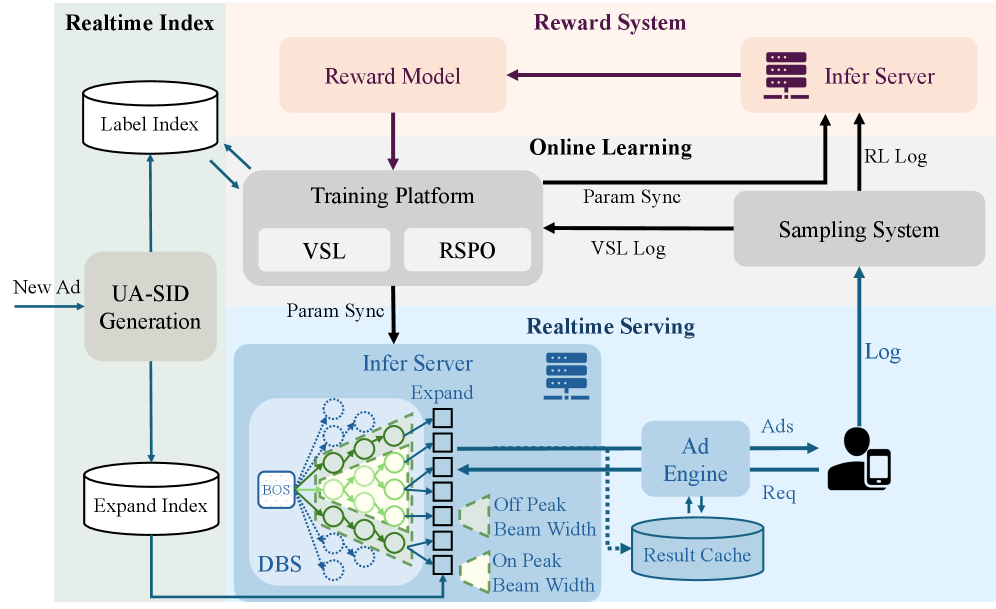
📝 Paper Summary
Generative Recommendation
Computational Advertising
Large-Scale Recommender Systems
GR4AD adapts generative recommendation for high-throughput advertising by introducing lazy autoregressive decoding for speed and a list-wise reinforcement learning objective for business value alignment.
Core Problem
Adapting LLM-style generative recommendation to real-time advertising fails because standard decoding is too slow for high-traffic multi-candidate generation, and standard training ignores list-wise business metrics like eCPM and NDCG.
Why it matters:
- Advertising systems have strict latency budgets (<100ms) that interactive LLM serving techniques cannot meet when generating hundreds of candidates
- Directly applying next-token prediction aligns with semantic probability but fails to capture the ranked-list utility crucial for ad revenue (eCPM)
- Standard tokenization misses critical non-semantic business signals (e.g., conversion type, account ID) that drastically alter ad delivery logic
Concrete Example:
Identical ad creatives (same video) might target completely different users based on conversion goals (e.g., 'app install' vs 'purchase'). A standard semantic ID model treats them as identical, causing collisions. GR4AD avoids this by hashing non-semantic business signals into the final token layer.
Key Novelty
Production-Oriented Generative Ad Recommendation (GR4AD)
- LazyAR Decoder: Delays autoregressive dependencies to later layers, allowing the first K layers to be computed once in parallel for all beams, drastically speeding up multi-candidate generation
- RSPO (Ranking-Guided Softmax Preference Optimization): A list-wise reinforcement learning objective that directly optimizes ranking metrics (NDCG) derived from business values (eCPM) rather than just next-token likelihood
- UA-SID (Unified Ad Semantic ID): Fuses multimodal content semantics with hash-based business signals (conversion type) to create collision-free, meaningful discrete identifiers
Architecture
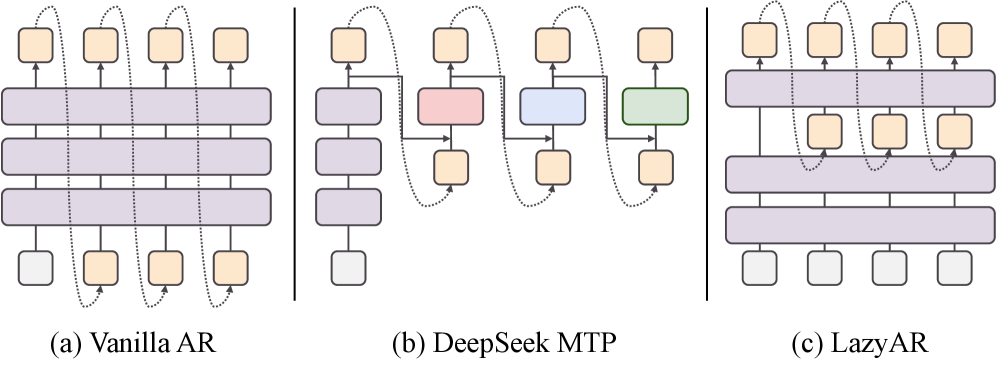
Comparison of Standard Autoregressive, DeepSeek-MTP, and the proposed LazyAR decoder architectures.
Evaluation Highlights
- +4.2% ad revenue improvement (RPM) in online A/B tests against a production DLRM-based stack serving 400M users
- Achieves >500 QPS per L20 GPU with <100ms latency, enabling real-time generative serving at massive scale
- +1.1% revenue gain specifically from the RSPO alignment component compared to standard supervised fine-tuning baselines
Breakthrough Assessment
9/10
Successfully deploys generative recommendation in a massive-scale, latency-critical ad system (400M users), solving critical bottlenecks in serving efficiency (LazyAR) and value alignment (RSPO) that previously hindered industrial adoption.