📝 Paper Summary
Generative Recommender Systems
LLM-based Recommendation
Gen-RecSys replaces traditional discriminative recommendation models with generative paradigms that sample user preferences from complex distributions (interactions, text, images) to enable novel tasks like zero-shot and conversational recommendation.
Core Problem
Traditional recommender systems (RS) act as 'narrow experts' relying solely on user-item ratings, limiting their ability to handle complex multimodal data or perform generalized tasks without domain-specific training.
Why it matters:
- Narrow expert models struggle with cold-start problems and cannot easily adapt to new tasks (e.g., explanation generation) without retraining
- Discriminative models miss the rich semantic information available in text, images, and videos that modern generative models can leverage
- Current surveys often focus narrowly on LLMs or specific architectures (like GANs), lacking a holistic view of the generative recommendation landscape across modalities
Concrete Example:
A traditional matrix factorization model can predict a rating for a movie but cannot explain 'why' the user might like it or generate a new movie poster tailored to the user's taste. Gen-RecSys using an LLM can reason: 'You liked generic sci-fi, so try this cyberpunk movie because it features similar dystopian themes.'
Key Novelty
Unified Taxonomy for Gen-RecSys
- Classifies systems by data modality: Interaction-Driven (structure-only), Text-Driven (LLMs/NLP), and Multimodal (Text+Image/Video)
- Distinguishes between 'Directly Trained' models (learning distributions from scratch on interactions) and 'Pretrained' models (adapting foundation models via fine-tuning or prompting)
- Integrates evaluation of 'impact and harm' alongside standard accuracy metrics, addressing the generative nature of new risks
Architecture
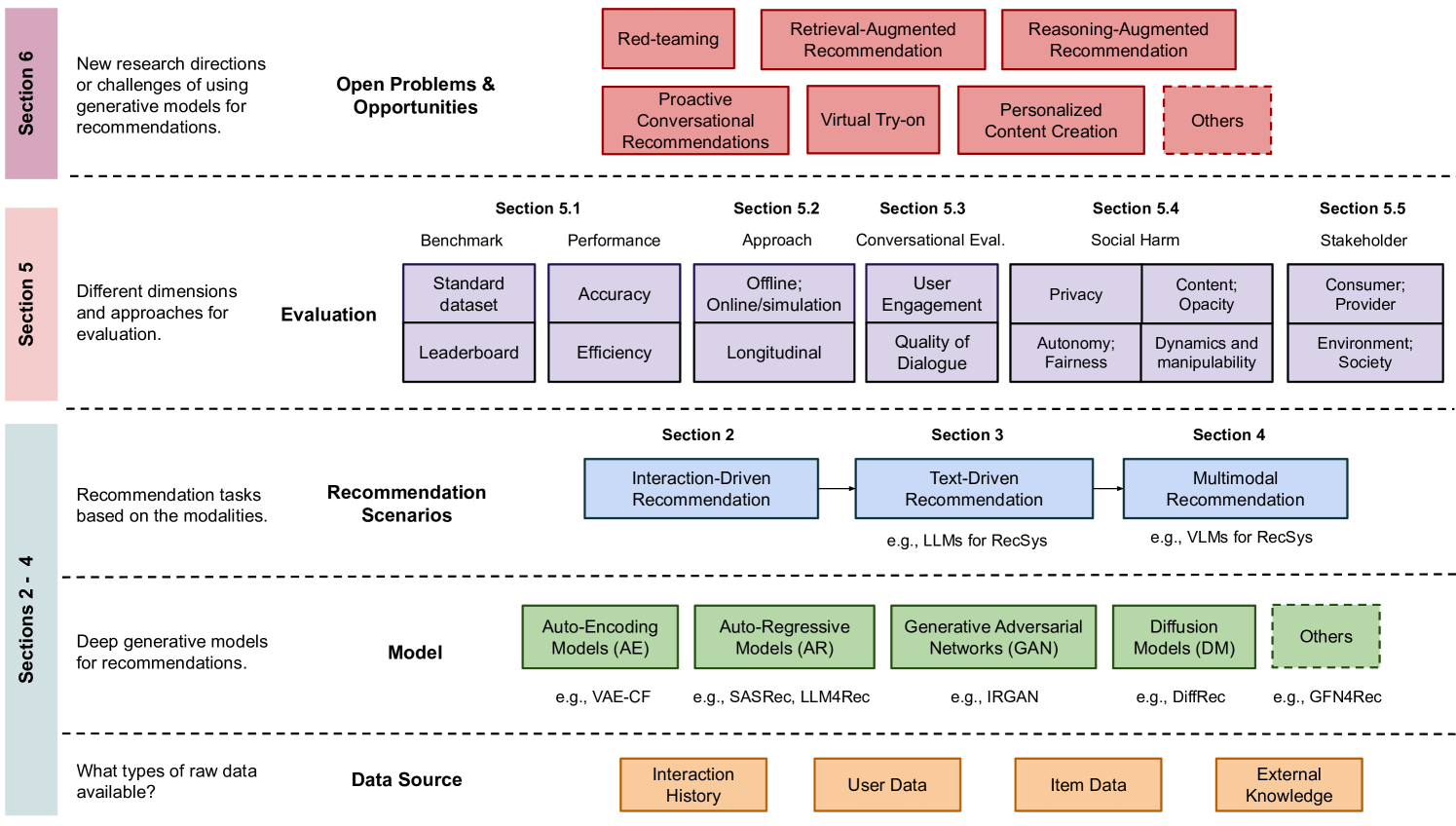
A hierarchical taxonomy of the Gen-RecSys survey structure
Evaluation Highlights
- Not reported in the paper (Survey paper without new empirical benchmarks)
- Provides a structured review of existing literature rather than comparative performance metrics
Breakthrough Assessment
8/10
Comprehensive survey that establishes a necessary taxonomy for a rapidly exploding field. While it doesn't propose a new model, it structures the chaotic landscape of LLMs and generative models in RecSys.