📝 Paper Summary
Legal AI
Knowledge Graph Construction
Retrieval-Augmented Generation (RAG)
A framework combining a Case-Enhanced Law Article Knowledge Graph (CLAKG) with LLMs to improve Chinese criminal law recommendation accuracy and mitigate hallucinations through grounded retrieval.
Core Problem
Grassroots courts face massive backlogs, and existing tools either lack semantic understanding (text classification) or suffer from hallucinations (LLMs), making them unreliable for high-stakes legal decisions.
Why it matters:
- Judicial efficiency is critical for social stability, but current reliance on manual cognitive effort slows down decision-making
- Direct use of LLMs in law is dangerous due to fabrication of legal citations (hallucinations)
- Traditional classifiers (BERT, CNN) focus on fact-to-ID mapping, neglecting the semantic rationale and interpretability required in law
Concrete Example:
Direct use of LLMs can produce plausible-sounding but non-existent law articles (hallucinations). The paper's method grounds the LLM in a verified knowledge graph (CLAKG) to ensure recommendations are based on actual statutes and historical precedents.
Key Novelty
Case-Enhanced Law Article Knowledge Graph (CLAKG)
- Unifies abstract law articles and concrete historical cases into a single graph schema, enabling retrieval based on both statutory rules and similar past judgments
- Uses a closed-loop human-machine collaboration where expert feedback on recommendations explicitly updates the Knowledge Graph to refine future performance
Architecture
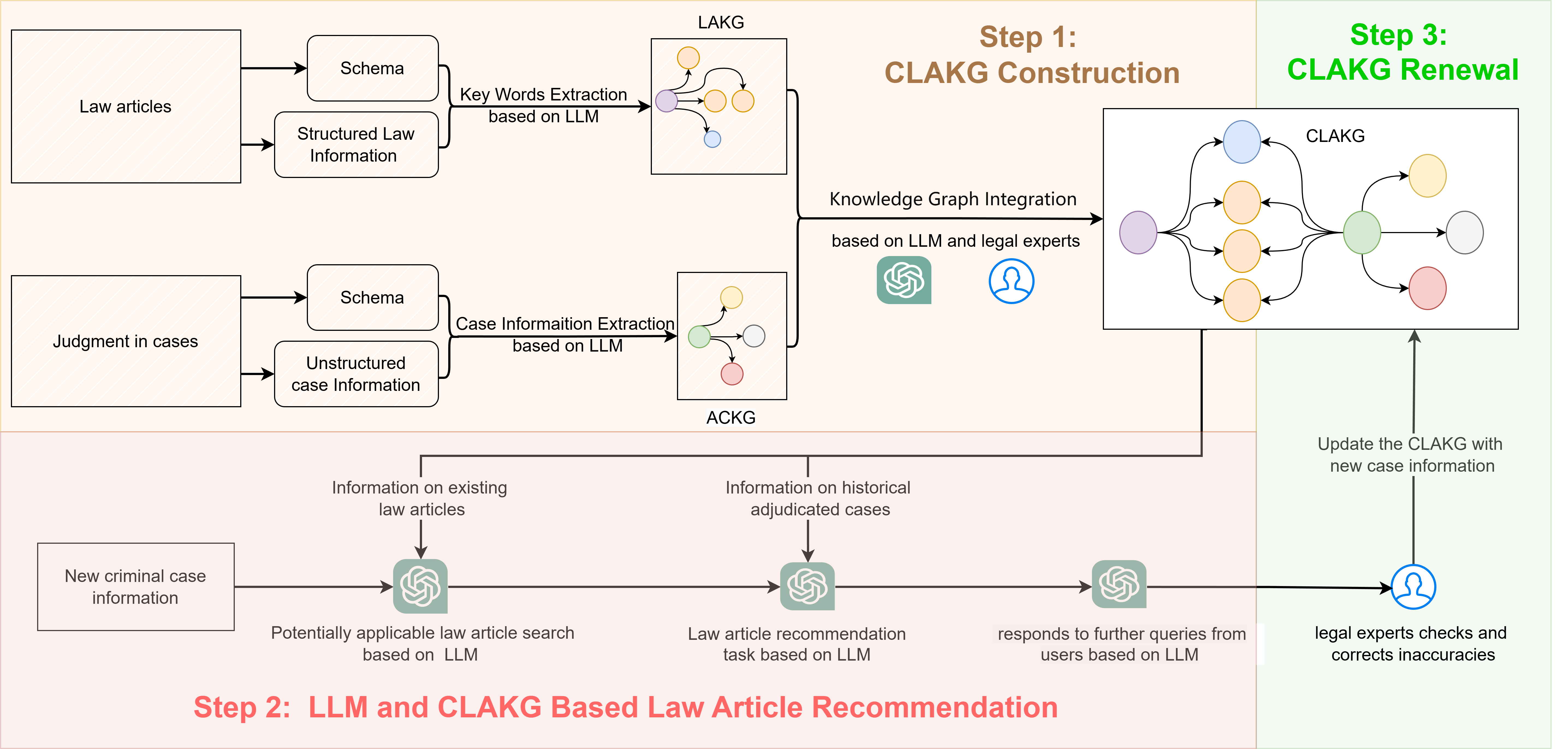
The closed-loop law article recommendation pipeline
Evaluation Highlights
- Boosts law article recommendation accuracy from 0.549 (LLM baseline) to 0.694 (Proposed LLM + CLAKG)
- Outperforms strong baselines including BERT, DPCNN, Graph-RAG, and Light-RAG (specific baseline numbers not in snippet, but improvement is cited as significant)
Breakthrough Assessment
7/10
Significant accuracy jump (+14.5%) in a high-stakes domain by effectively integrating symbolic knowledge (KG) with probabilistic models (LLM). The closed-loop expert feedback is a practical addition for legal settings.