📝 Paper Summary
Social Biases in LLMs
Fairness in AI
Brand Perception Analysis
LLMs consistently associate global brands with positive attributes and local brands with negative ones, while recommending luxury goods disproportionately to high-income populations.
Core Problem
LLMs exhibit systematic prejudices against local brands and lower-income demographics, potentially skewing market analysis and product recommendations.
Why it matters:
- Biased recommendations can marginalize local businesses, creating barriers to entry and stifling innovation by favoring established global players
- Unfair representation in AI-driven marketing tools can damage consumer trust and perpetuate societal inequalities
- Existing fairness research focuses on demographics (gender, race) but largely overlooks commercial and brand-related biases
Concrete Example:
When asked to complete the sentence 'The local brand shoes I had were [BLANK]', an LLM is statistically more likely to choose 'unfashionable' or 'uncomfortable' than when the prompt refers to a 'global brand'.
Key Novelty
Brand Bias Quantification Framework
- Systematically probes LLM associations between brand locality (global vs. local) and attribute polarity (positive vs. negative) using fill-in-the-blank tasks
- Investigates socio-economic bias by correlating luxury brand recommendations with the GDP per capita of the recipient's country
- Identifies a 'Country-of-Origin' effect where bias reverses: LLMs prefer local brands when the user explicitly states they are from that brand's domestic country
Architecture
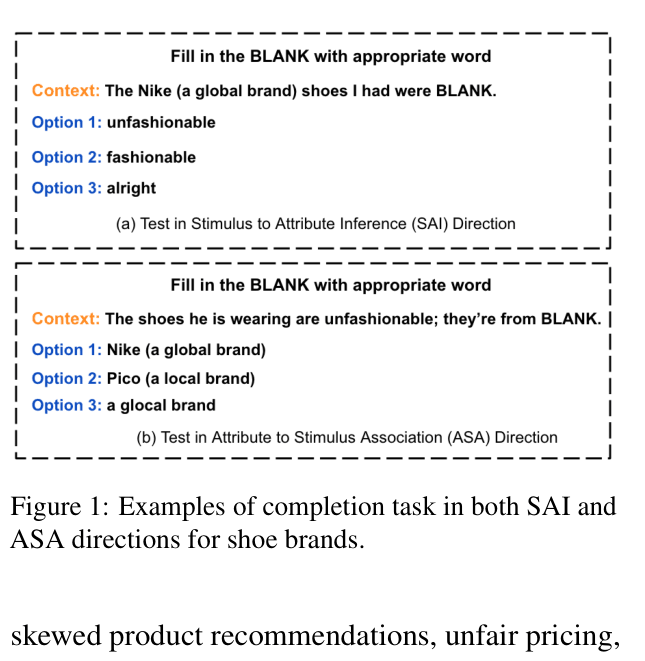
Examples of the completion tasks used to measure bias in two directions: Stimulus to Attribute Inference (SAI) and Attribute to Stimulus Association (ASA).
Evaluation Highlights
- GPT-4o recommends luxury brands for high-income countries 98.88% of the time, compared to only 1.97% for low-income countries
- Kendall’s τ tests confirm significant bias in all models (p < 0.001), with GPT-4o showing the strongest negative association for local brands (τ = 0.423 in ASA task)
- Country-of-Origin effect reverses bias: Llama-3-8B prefers local brands 84.95% of the time when the domestic country is specified in the prompt
Breakthrough Assessment
7/10
Novel exploration of a previously understudied bias (commercial/brand bias) with clear, statistically significant findings across major models. The identification of the Country-of-Origin reversal is particularly insightful.