📝 Paper Summary
LLM-Augmented Recommendation
Open-World Knowledge Integration
Industrial Recommender Systems
REKI enhances industrial recommender systems by efficiently extracting open-world knowledge about users and items from LLMs via factorization prompting and integrating it as compact vectors, avoiding the high latency of direct LLM inference.
Core Problem
Directly using LLMs as recommenders in industrial settings is impractical due to high inference latency and massive resource consumption, while traditional models lack access to open-world knowledge and complex reasoning capabilities.
Why it matters:
- Closed-loop recommenders are isolated from external world knowledge, leading to outdated or imprecise recommendations.
- LLMs offer reasoning and factual knowledge but are too slow and costly for real-time inference with billions of users and items.
- Existing methods that fine-tune LLMs struggle with the scale and dynamic nature of industrial data.
Concrete Example:
In movie recommendation, a traditional model might miss that a user prefers 'holiday-themed movies' during Christmas because it only sees ID interactions. An LLM could reason this preference, but running an LLM for every user request in real-time is too slow (latency > 100ms).
Key Novelty
Recommendation with Efficient Knowledge Infusion (REKI)
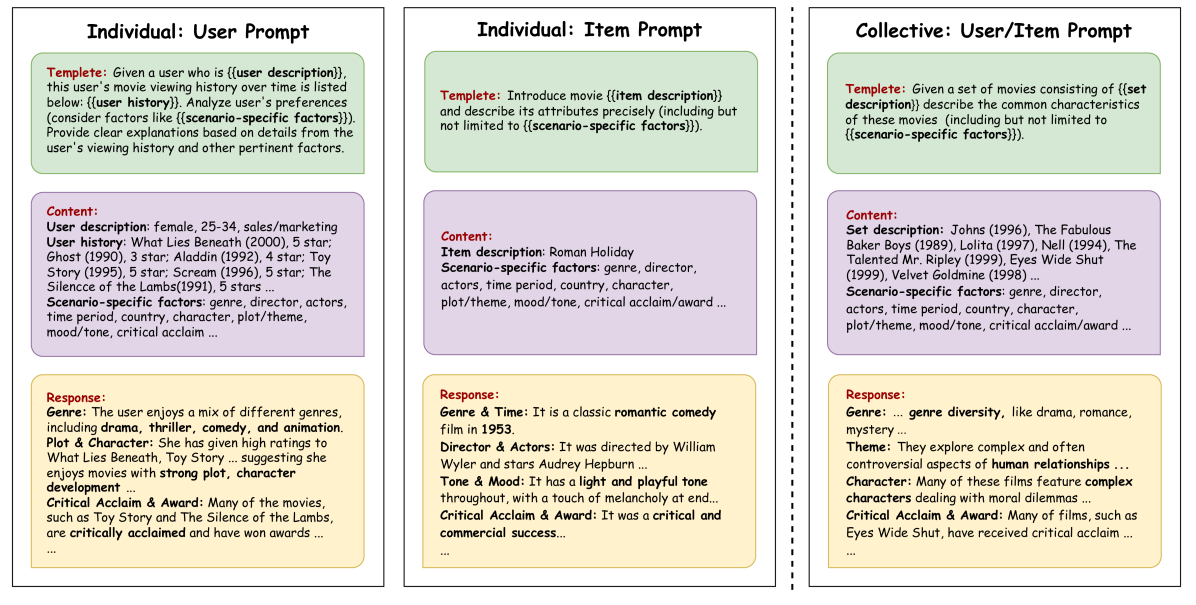
- Uses 'factorization prompting' to break down complex user preference reasoning into smaller sub-problems, mitigating the compositional gap of LLMs.
- Introduces 'collective knowledge extraction' to cluster users/items and generate knowledge for groups rather than individuals, drastically reducing offline compute for large-scale systems.
- employs a 'Hybridized Expert-Integrated Network (HEIN)' to compress textual knowledge into dense vectors, making it compatible with any conventional recommendation model.
Architecture
The overall framework of REKI, illustrating the two-stage process: Knowledge Extraction (via LLM) and Knowledge Integration (via HEIN into CRM).
Evaluation Highlights
- Achieved a 7% improvement in online A/B testing on Huawei's news recommendation platform.
- Achieved a 1.99% improvement in online A/B testing on Huawei's music recommendation platform.
- Outperforms state-of-the-art baselines on public datasets (Amazon Beauty, Sports, Toys) with improvements in NDCG@10 and Recall@10.
Breakthrough Assessment
8/10
Offers a highly practical, deployment-oriented solution that successfully bridges the gap between LLM capabilities and industrial constraints. The collective extraction strategy is a smart fix for scalability.