📝 Paper Summary
LLM-based Recommendation
Sequential Recommendation
SCoTER automates the discovery of effective reasoning patterns using LLMs and transfers this logic to efficient recommendation models via a structure-preserving fusion architecture, eliminating online inference costs.
Core Problem
Current LLM-based recommenders struggle with two issues: reliance on brittle, hand-crafted reasoning templates that fail to capture diverse user intents, and 'structure-collapsing' integration that compresses reasoning chains into single vectors, losing logical dependencies.
Why it matters:
- Manual templates fail to generalize across heterogeneous user behaviors, leading to suboptimal recommendation quality
- Direct online prompting of LLMs is computationally prohibitive for real-time industrial systems
- Compressing multi-step reasoning into a single vector discards the step-by-step logic essential for interpretability and accuracy
Concrete Example:
A user buys a 'PS5 Console' then 'FIFA 24'. A standard model might just associate vectors. A manual template might ask 'What did they buy?'. SCoTER discovers a pattern: 'Analyze history (new console owner) -> Match interest (needs multiplayer) -> Recommend (DualSense Controller)', preserving this specific 3-step logic during inference.
Key Novelty
Joint Optimization of Pattern Discovery and Structure-Aware Transfer
- Generate-Validate-Mine (GVM) Pipeline: Instead of using fixed prompts, an LLM generates many reasoning paths, validates them against actual recommendation accuracy (Recall), and mines the best cluster to form a data-driven template
- Structure-Preserving Integration: Transfers reasoning not as a single vector, but as a sequence of step-wise embeddings that the downstream model attends to sequentially, preserving the 'thought process' without running the LLM online
Architecture
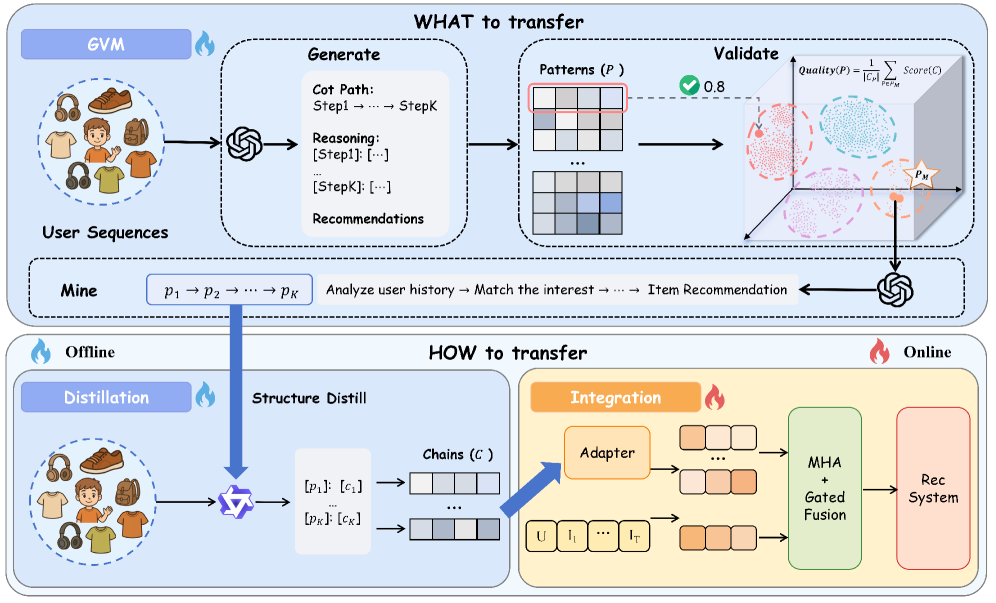
The complete SCoTER framework, illustrating both the offline GVM (Generate-Validate-Mine) pipeline and the online Structure-Preserving Integration.
Evaluation Highlights
- Achieved 2.14% lift in Gross Merchandise Value (GMV) in online A/B testing on Tencent Advertising Platform
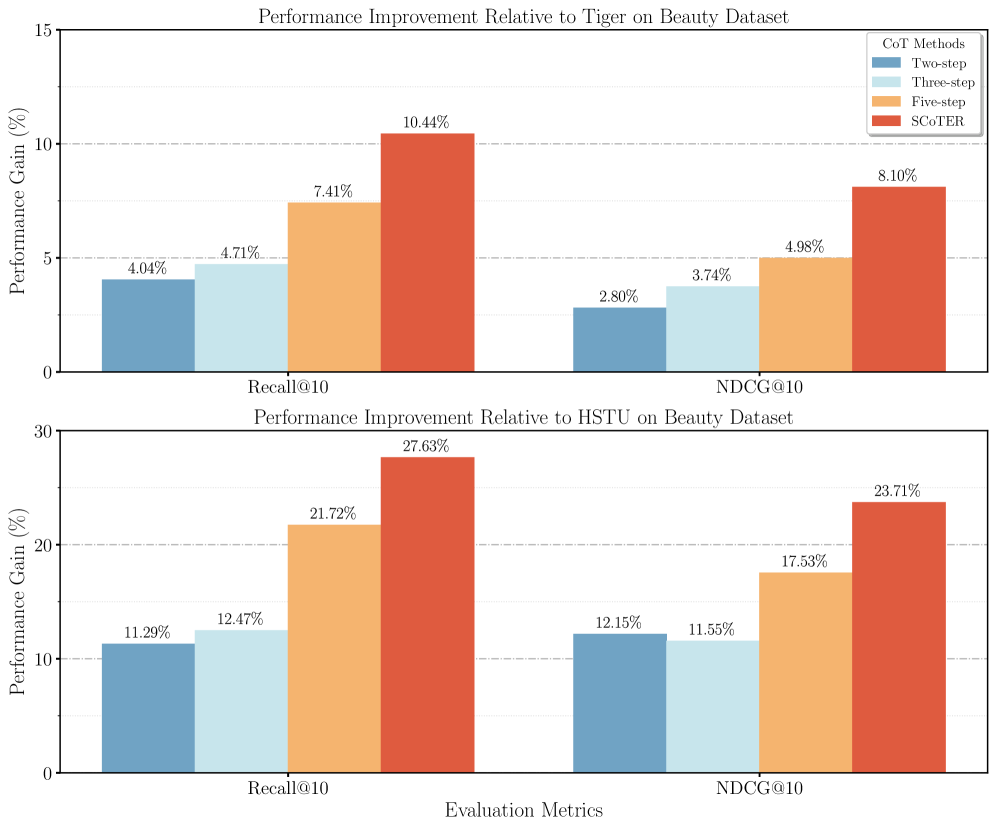
- Consistent improvements across four public benchmarks (Beauty, Toys, Sports, Yelp) compared to diverse baselines like SASRec and BERT4Rec
- Outperforms standard LLM-enhanced methods (like KAR and LLM-ES) that use structure-collapsing strategies
Breakthrough Assessment
8/10
Strong combination of automated prompt discovery and efficient deployment. The 2.14% GMV lift in a major production environment validates practical impact, addressing the critical latency/cost bottleneck of LLMs in RecSys.