📝 Paper Summary
Review-based Recommendation
LLM-enhanced Recommendation
Explainable Recommendation
HADSF improves recommendation accuracy and interpretability by using a two-stage LLM framework to extract controlled, non-redundant aspect-opinion triples from reviews while managing hallucination via novel fidelity metrics.
Core Problem
Current LLM-based recommenders extract free-form reviews without scope control, leading to redundant, noisy representations and uncontrolled hallucinations that degrade downstream performance.
Why it matters:
- Uncontrolled extraction creates fragmented, semantically overlapping tags that inflate redundancy and introduce statistical noise.
- Existing systems lack metrics to link LLM hallucination severity directly to downstream recommendation accuracy, preventing principled model selection.
- The cost-quality trade-off of using smaller vs. larger LLMs for extraction remains unexplored, hindering scalable deployment.
Concrete Example:
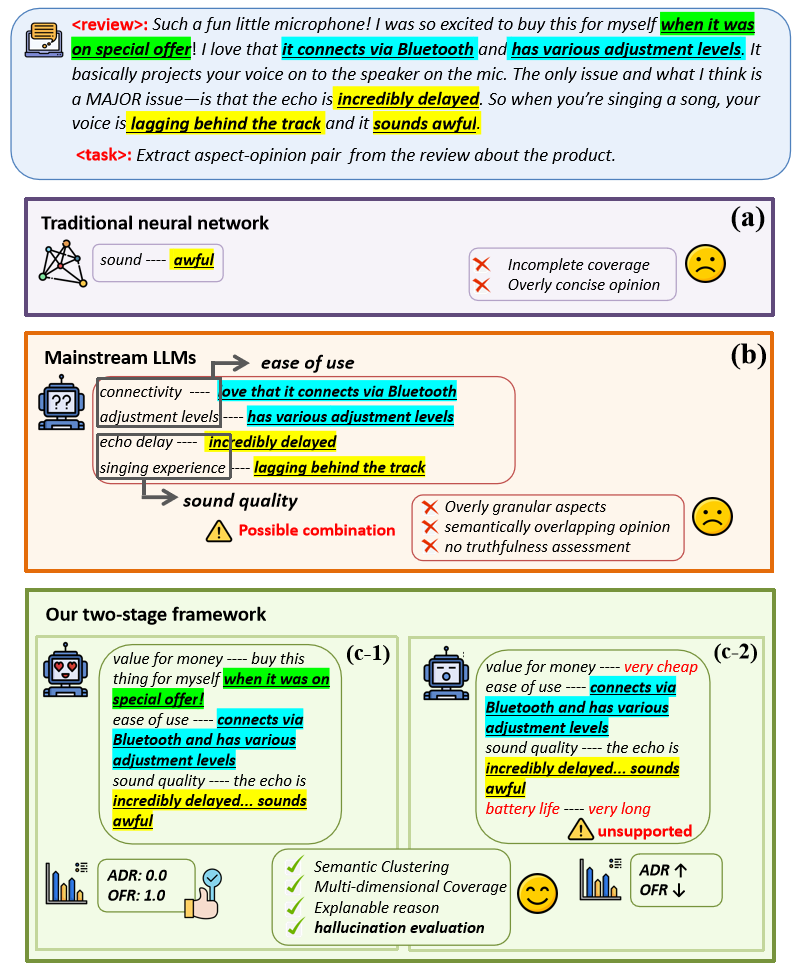
Traditional methods might extract fragmented pairs like 'screen-good' and 'display-nice' for the same issue. Uncontrolled LLMs might decompose reviews into overly granular, low-frequency tags (as shown in Fig.1b), or hallucinate attributes not present in the text, inflating noise and redundancy.
Key Novelty
Hyper-Adaptive Dual-Stage Semantic Framework (HADSF)
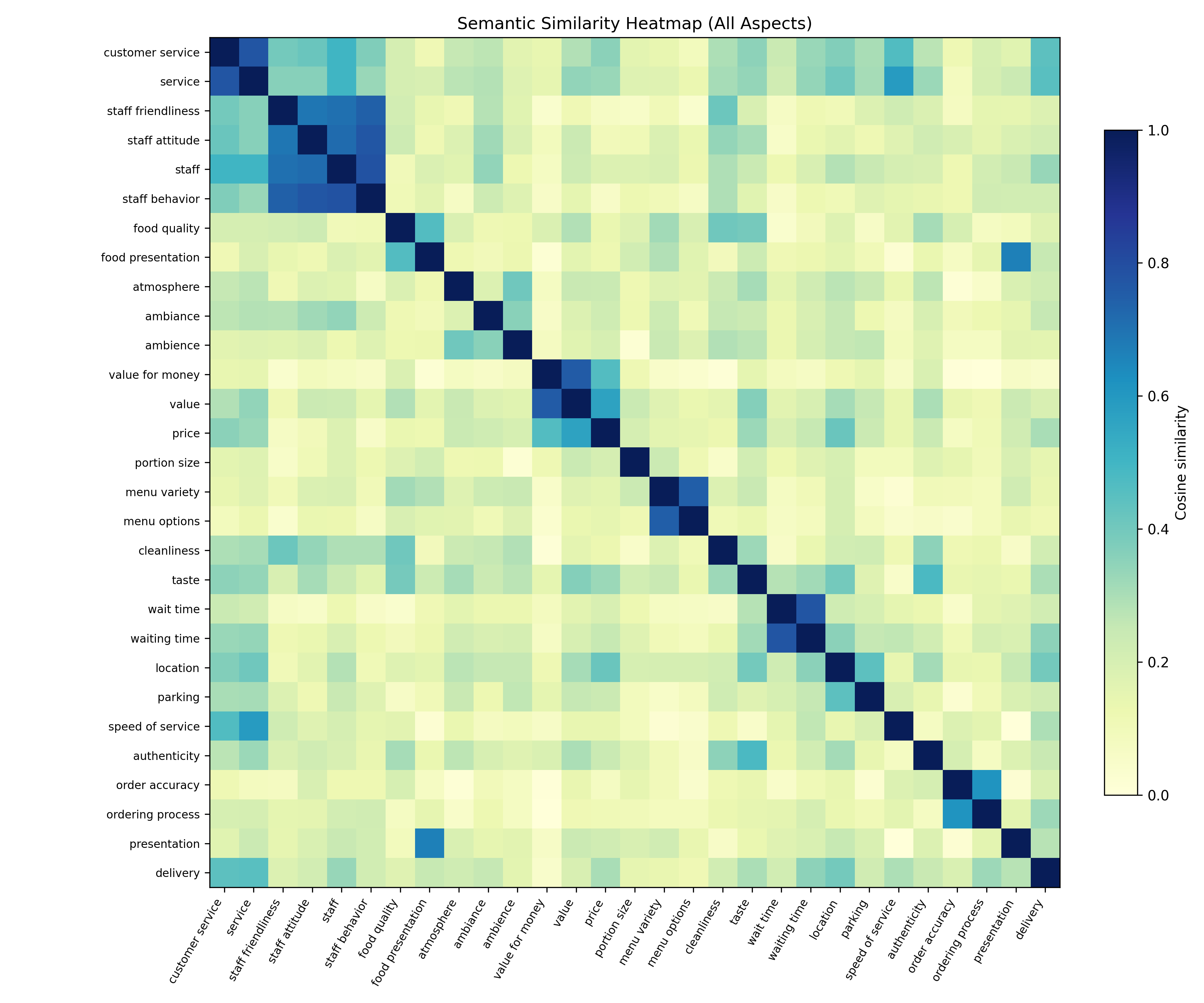
- **Stage I (Consensus):** Creates a compact, corpus-level aspect vocabulary by sampling reviews, generating abstracts, and merging semantically similar aspects via embedding-based clustering.
- **Stage II (Constraint):** Uses this vocabulary and user/item history as explicit constraints to guide an LLM in extracting structured aspect-opinion-sentiment triples, reducing noise and drift.
- **Hallucination Metrics:** Introduces Aspect Drift Rate (ADR) and Opinion Fidelity Rate (OFR) to quantify fabrication and correlates them with recommendation error.
Architecture
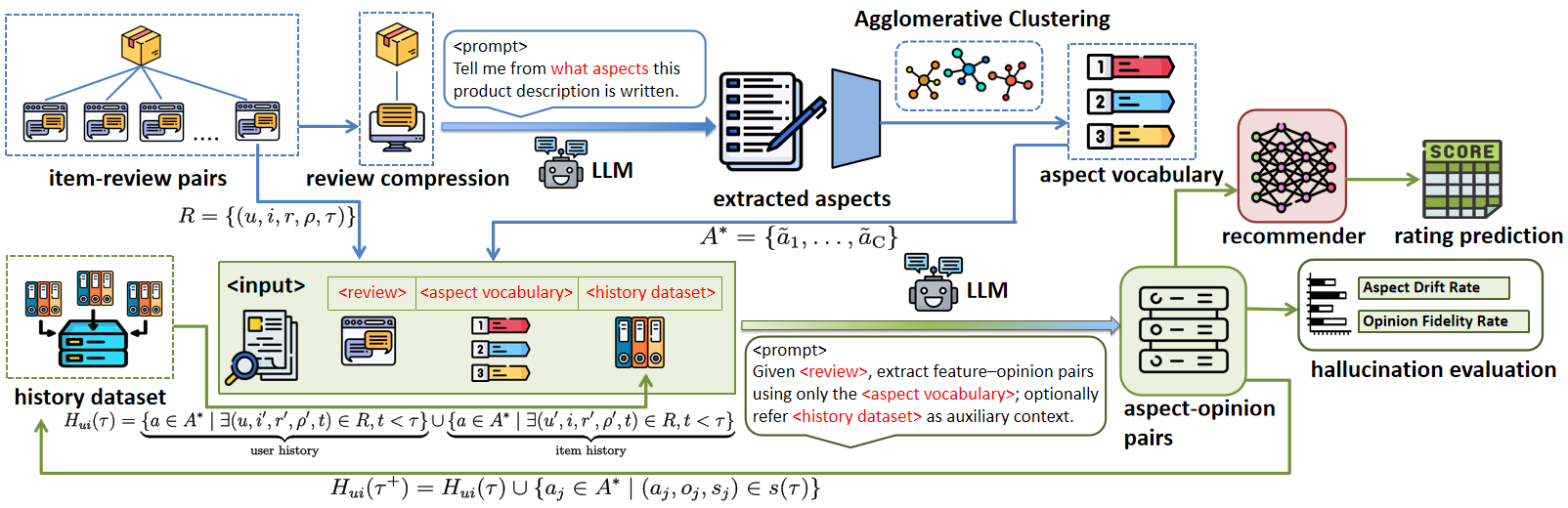
The overall HADSF framework consisting of Stage I (Vocabulary Induction) and Stage II (Dynamic Aspect-Aware Review Processing).
Evaluation Highlights
- Demonstrates consistent reductions in rating prediction error across datasets spanning ~3 million reviews.
- Uncovers a non-monotonic relationship between hallucination severity (ADR/OFR) and prediction error, aiding model selection.
- Shows that smaller LLMs (e.g., 1.5B parameters) using HADSF's controlled extraction can match or exceed the performance of larger models in specific regimes.
Breakthrough Assessment
7/10
Strong contribution in formalizing 'control' for LLM extraction in RecSys and linking hallucination metrics to downstream utility. The non-monotonic finding is particularly insightful for practical deployment.