📝 Paper Summary
Cross-Domain Recommendation (CDR)
Out-of-Distribution (OOD) Generalization
Causal Recommendation
CICDOR tackles both cross-domain and single-domain distribution shifts by learning dual-level invariant causal structures and utilizing LLMs to extract and deconfound observed variables from user reviews.
Core Problem
Standard Cross-Domain Recommendation assumes target domain data is identically distributed, failing to account for the simultaneous presence of Cross-Domain Distribution Shift (CDDS) and Single-Domain Distribution Shift (SDDS).
Why it matters:
- Real-world systems face complex OOD environments where user preferences shift across domains (e.g., movies vs. books) and within domains (e.g., regional differences), degrading generalization.
- Existing methods typically address either CDDS or SDDS in isolation, leading to information loss and error accumulation when shifts co-exist.
- Prior causal approaches often overlook observed confounders in unstructured text or rely only on unobserved environmental factors.
Concrete Example:
Consider a system recommending books to users in Beijing based on Movie domain data. Users in Beijing prefer Chinese classics (SDDS: regional shift vs. Hong Kong users), while book readers generally prefer delayed gratification unlike movie watchers (CDDS). A model must transfer invariant preferences (e.g., 'heroic adventure') that hold true despite both shifts, which current isolated methods fail to capture effectively.
Key Novelty
Causal-Invariant Cross-Domain Out-of-distribution Recommendation (CICDOR)
- Proposes a dual-level causal preference learning module that disentangles user preferences into domain-specific and domain-shared components, learning separate causal structures for each to handle both CDDS and SDDS.
- Introduces an LLM-guided confounder discovery module that uses Large Language Models to extract candidate causal variables from reviews, refined by the FCI algorithm to identify observed confounders.
Architecture
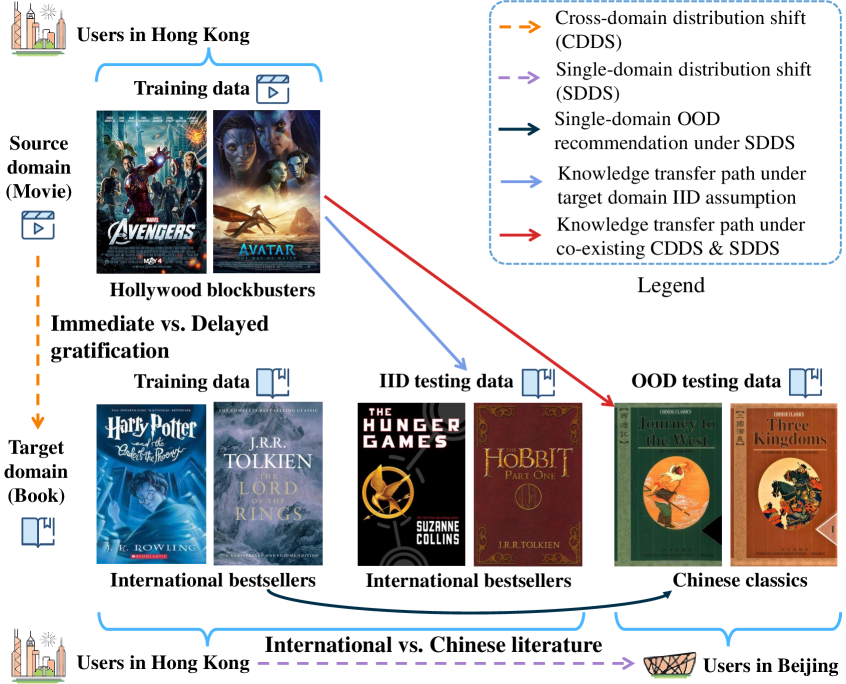
Conceptual illustration of Cross-Domain Distribution Shift (CDDS) and Single-Domain Distribution Shift (SDDS) using a Movie-to-Book recommendation scenario.
Evaluation Highlights
- Achieves an average increase of 6.28% in HR@10 compared to the best-performing state-of-the-art baseline across various OOD scenarios.
- Achieves an average increase of 9.42% in NDCG@10 compared to the best-performing state-of-the-art baseline across various OOD scenarios.
Breakthrough Assessment
7/10
Novel integration of LLMs for explicit confounder discovery in causal recommendation. Addresses a realistic dual-shift problem (CDDS + SDDS) often treated separately. Quantitative gains are significant, though full experimental details are missing from the text.