📝 Paper Summary
Knowledge-aware Recommendation
LLM for Recommendation
CIKGRec uses Large Language Models to infer and structure explicit user interests from behavioral history, then integrates this new user-side knowledge graph into recommendations using noise-robust contrastive learning.
Core Problem
Existing Knowledge-aware Recommendation methods only utilize structured knowledge on the item side (e.g., movie genres), ignoring the user side because user features are often scarce, coarse-grained, or unstructured.
Why it matters:
- User meta-features (age, gender) are too broad to capture specific interests, leading to over-smoothing in Graph Neural Networks (GNNs).
- Item-only knowledge graphs fail to bridge the semantic gap between abstract user preferences and specific item attributes.
- Directly using LLM-generated text embeddings introduces noise (hallucinations) and semantic misalignment with collaborative filtering signals.
Concrete Example:
A user might watch several sci-fi movies, but traditional metadata only labels them 'Male, 25'. An LLM can infer specific interests like 'Space Exploration' or 'Dystopian Future'. Without this structured user-side knowledge, the recommender misses the specific reason for the user's choices.
Key Novelty
Collaborative Interest Knowledge Graph (CIKG)
- Constructs a user-side knowledge graph by prompting LLMs to infer explicit interest tags from interaction history, then clustering these tags to form structured edges between users and interests.
- Integrates this user-side graph with the traditional item-side knowledge graph and interaction graph into a unified structure (CIKG).
- Uses a curriculum-based masking strategy to reconstruct user interests, filtering out LLM-generated noise while learning robust representations.
Architecture
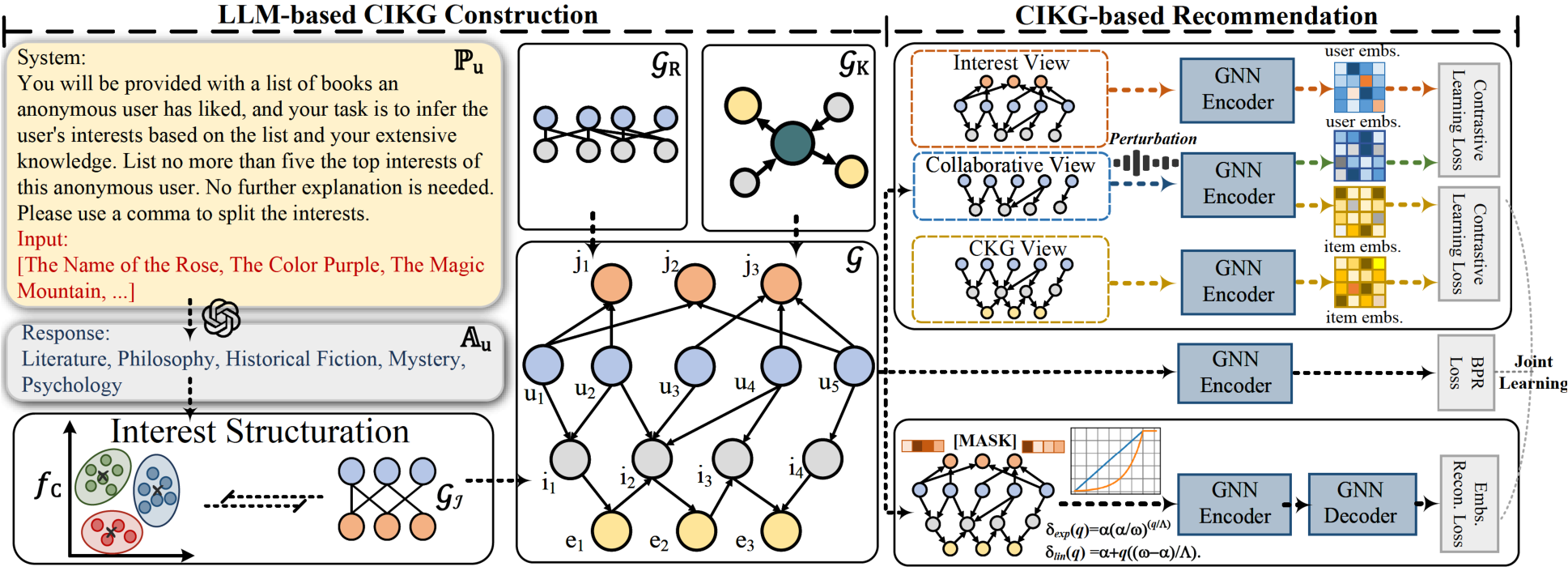
The overall framework of CIKGRec, split into LLM-based CIKG Construction (Left) and CIKG-based Recommendation (Right).
Evaluation Highlights
- Outperforms state-of-the-art baselines (like KGIN and KGCL) on three real-world datasets (Amazon-Book, Last-FM, Yelp2018).
- Achieves significant improvements in sparse data scenarios; e.g., for users with <20 interactions, performance drops much less than baselines.
- Ablation studies confirm the necessity of the user interest reconstruction module, which effectively mitigates noise from LLM hallucinations.
Breakthrough Assessment
7/10
Novel integration of LLM-derived user knowledge into graph structures. Addresses the specific user-side knowledge gap in KG-based recommendations effectively, though the core machinery (GNNs + Contrastive Learning) is standard.