📝 Paper Summary
LLM-based Recommendation
Click-Through Rate (CTR) Prediction
ELCoRec improves LLM-based recommendation by encoding numerical and categorical features via a Graph Attention Network into a soft prompt and using a hybrid template that combines retrieved and recent interactions.
Core Problem
LLMs struggle with recommendation tasks due to 'numerical insensitivity' (treating ratings/timestamps as plain text) and 'encoding overhead' (context windows cannot fit full history or extensive side features).
Why it matters:
- LLMs miss the quantitative nuance of user ratings and temporal intervals when processed as text tokens
- Retrieval-based methods (like ReLLa) filter long histories but break the continuous time-series sequence, losing trend information
- Existing solutions either ignore side features due to token limits or introduce excessive computational costs by encoding every historical item
Concrete Example:
An LLM reading 'Rating: 4' treats '4' as a text token similar to 'A', failing to grasp its magnitude relative to '5'. Similarly, retrieving only semantically relevant movies (e.g., 'Sci-Fi') might exclude a user's recent shift toward 'Romance' movies, which a sequential history would capture.
Key Novelty
ELCoRec (Enhance Language understanding with Co-Propagation for Recommendation)
- Offloads the processing of numerical (ratings, time) and categorical features to a dedicated Graph Attention Network (GAT) expert model instead of forcing the LLM to parse them as text
- Injects the GAT-derived user preference embedding into the LLM as a single 'soft token', bypassing context window limits
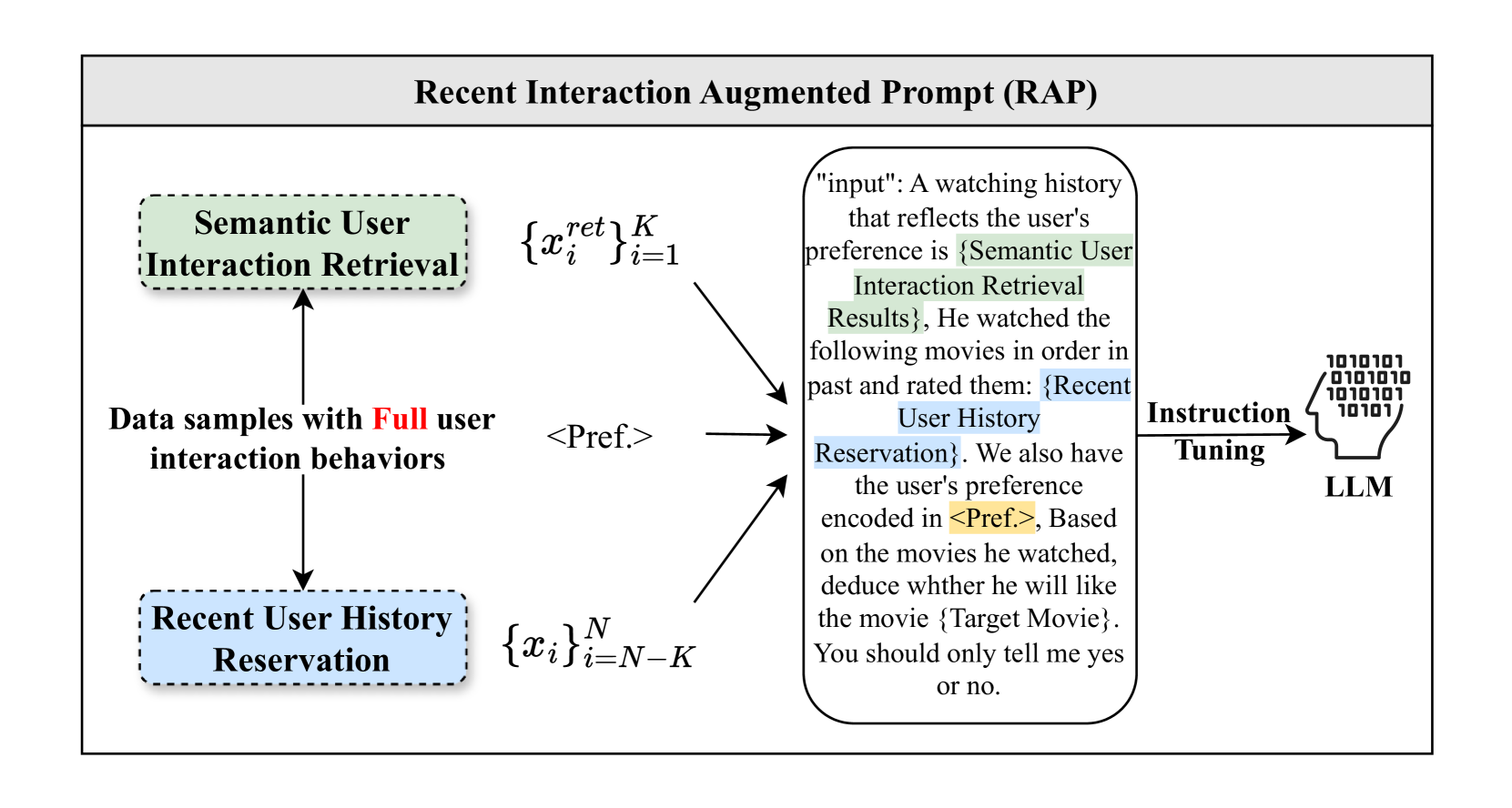
- Uses a 'Recent interaction Augmented Prompt' (RAP) that stitches together semantically retrieved items (for global interest) and strictly recent items (for local trends) to fix sequential breaks
Architecture
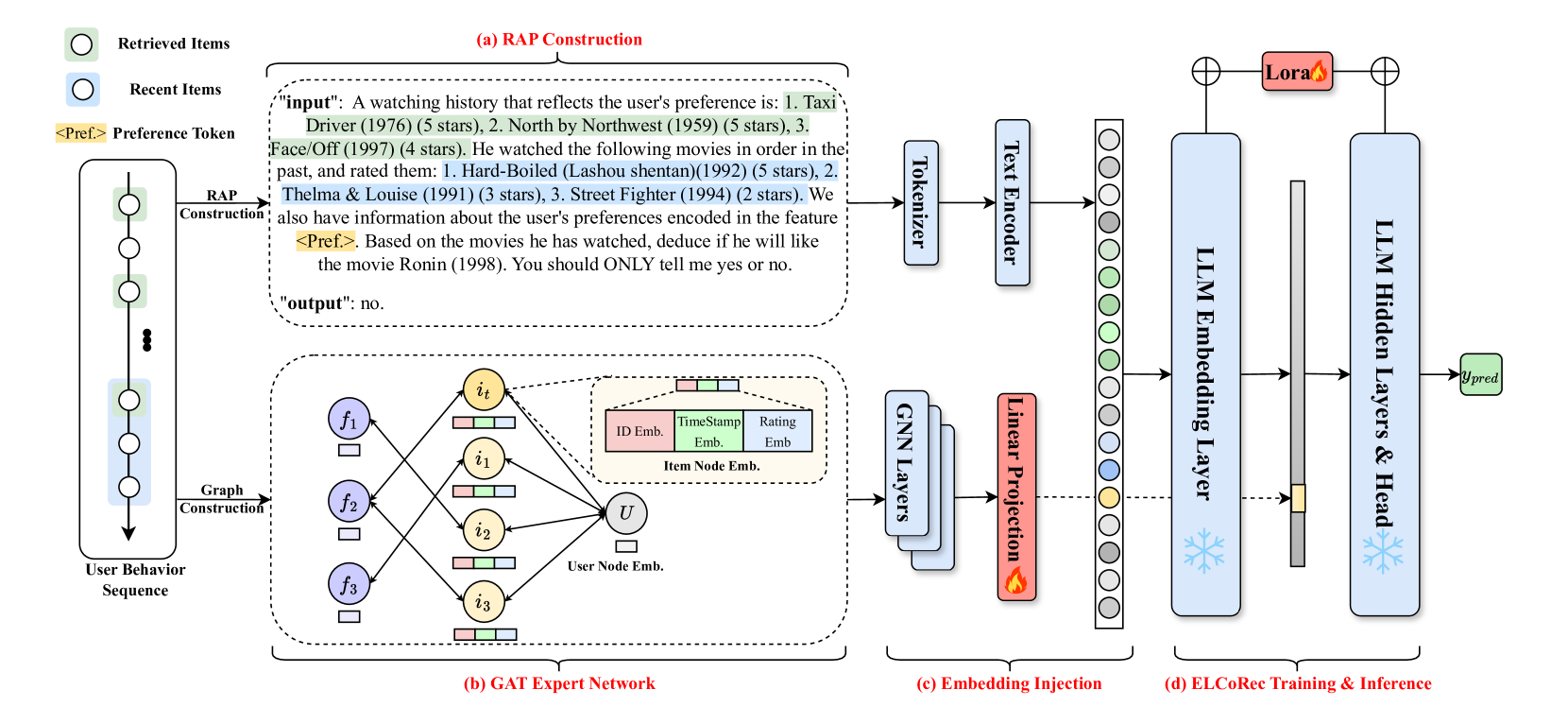
The overall architecture of ELCoRec, illustrating the parallel processing of the RAP textual template and the GAT-based graph encoding, which merge at the LLM input.
Evaluation Highlights
- Achieves highest AUC of 0.9254 on MovieLens-1M, surpassing the best LLM baseline (ReLLa) by +0.0119
- Outperforms strong non-LLM baselines (e.g., DIN, SASRec) and LLM baselines (TALLRec, CoLLM) across three datasets (MovieLens, Amazon Books, Electronics)
- Ablation studies confirm the RAP template contributes significantly, improving AUC by roughly 0.003-0.005 compared to retrieval-only prompts
Breakthrough Assessment
7/10
Solid engineering combination of Graph Neural Networks and LLMs for recommendation. Effectively addresses the specific limitations of text-only LLM recommenders (context length and numerical reasoning) with a practical soft-prompting approach.