📝 Paper Summary
Generative Sequential Recommendation
Session-based Recommendation
SessionRec shifts generative recommendation from predicting the next single item to predicting the entire set of positive items in the next session using session-level representations and a joint retrieval-ranking objective.
Core Problem
Traditional Next Item Prediction Paradigm (NIPP) models train by predicting one item at a time autoregressively, which misaligns with real-world scenarios where users interact with multiple items per session/request.
Why it matters:
- Real-world recommendations occur at the session level (e.g., a homepage refresh), requiring simultaneous generation of multiple relevant items rather than a single next item
- Standard autoregressive models struggle to model diverse user interests efficiently because they focus on a single positive label per step
- Item-level sequences with massive negative interactions create high computational complexity (O(N^2)) for Transformer backbones
Concrete Example:
In a food delivery app, a user opens the app (a session) and sees a list of restaurants. NIPP models try to predict just the *one* next restaurant they will click. However, the user might be interested in *any* of 5 different restaurants shown. NIPP fails to capture this set of potential interests simultaneously and ignores the negative feedback (ignored items) effectively within the session context.
Key Novelty
Next Session Prediction Paradigm (NSPP)
- Hierarchical Encoding: Aggregates item-level interactions (both positive and negative) into compact session-level embeddings before sequence modeling, significantly reducing sequence length
- Session-Level Prediction: Instead of predicting the next token, the model predicts a set of positive items for the next session simultaneously
- Joint Retrieval and Ranking: Incorporates a rank loss within the generative framework to prioritize positive items over hard negatives within the same predicted session
Architecture
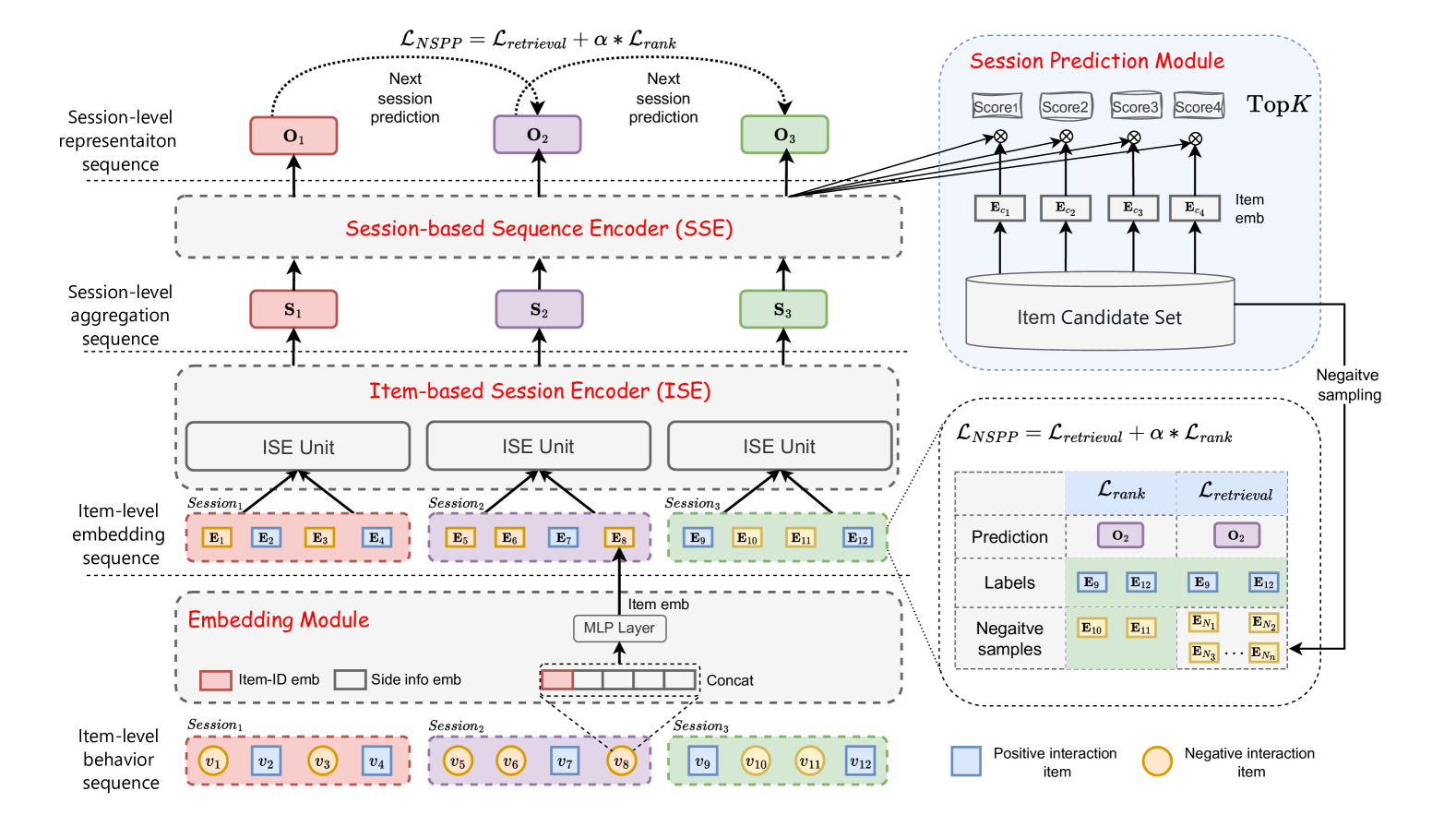
The SessionRec framework, detailing the flow from Item Sequence to Session Representation to User Interest to Prediction.
Evaluation Highlights
- Achieves up to +27% performance gain on average over best baselines (like HSTU and BERT4Rec) on public datasets
- Online A/B testing in Meituan App showed +1.4% gain in Gross Merchandise Value (GMV) and +1.1% in Order quantity
- Reduces computational complexity of the sequence encoder by a factor of roughly M^2 (where M is average session length) due to session aggregation
Breakthrough Assessment
8/10
Proposes a fundamental paradigm shift from item-level to session-level generative recommendation that better aligns with industrial reality. Significant efficiency and performance gains, validated in a large-scale real-world system.