📝 Paper Summary
LLM for Recommendation
Multimodal alignment
RecInterpreter aligns frozen sequential recommenders with LLaMA using a lightweight linear adapter, enabling the LLM to understand and textually describe hidden user behavior representations.
Core Problem
Current LLM-for-Rec approaches rely on text prompts of interaction history, shielding the LLM from accessing the rich, compressed hidden representations learned by ID-based sequential recommenders.
Why it matters:
- ID-based recommenders encode powerful sequential patterns that text prompts might miss or represent inefficiently.
- Bridging this gap allows LLMs to reason over the internal state of existing high-performance recommender models.
- Generative recommenders (like DreamRec) produce latent vectors for 'oracle' items that lack explicit IDs; current methods cannot easily translate these vectors into readable item names.
Concrete Example:
A generative recommender like DreamRec might output a latent vector representing the 'ideal next item'. Without a bridge, we can only find the nearest existing item ID, potentially missing the nuance. RecInterpreter allows LLaMA to take that vector and describe exactly what movie it represents, even if it's not in the candidate set.
Key Novelty
RecInterpreter: Interpreting Latent Space via Alignment
- Treat recommender hidden states like a modality (similar to images in Flamingo/MiniGPT-4) and project them into the LLM's token space via a linear adapter.
- Use a 'sequence-residual' prompt strategy: show the LLM the state *before* and *after* an interaction and ask it to describe the difference (the residual item).
Architecture
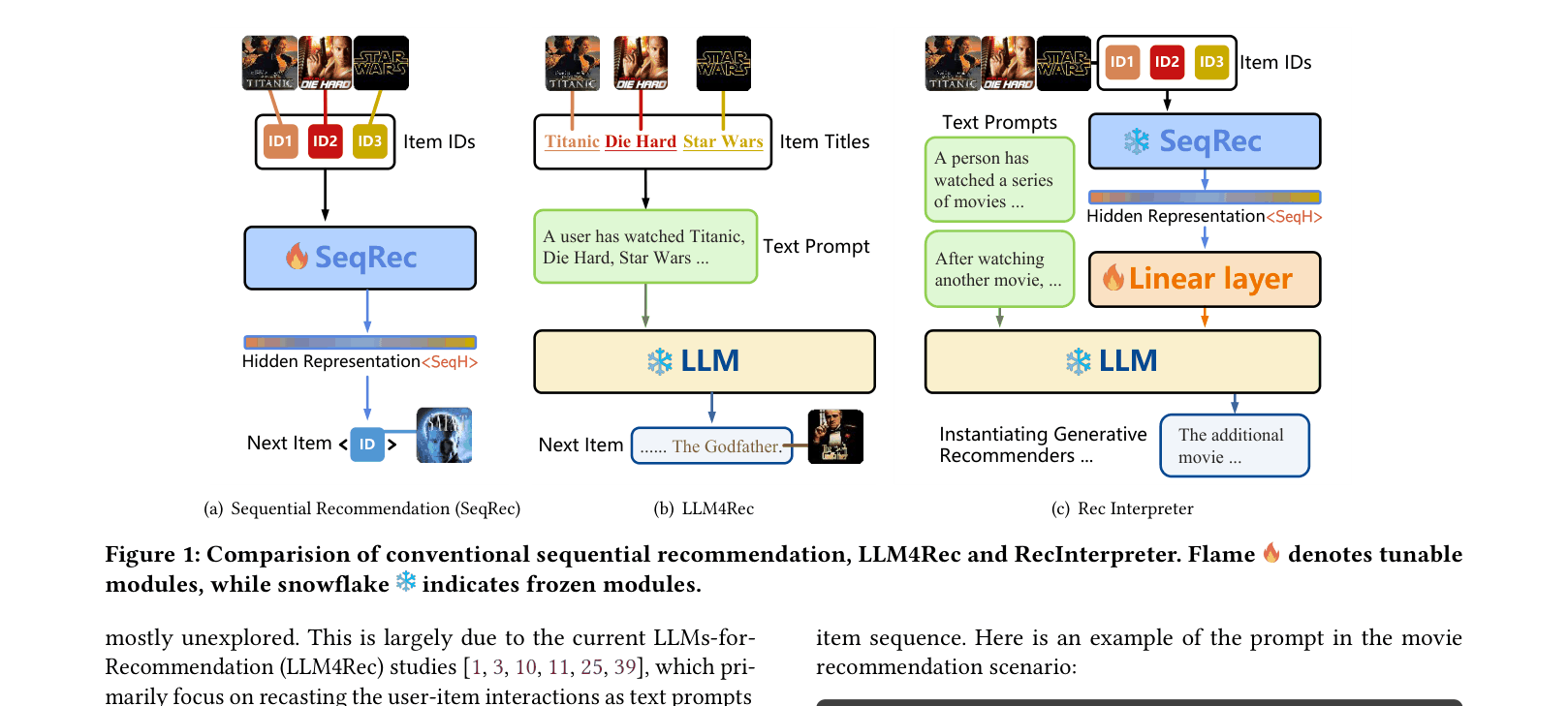
The RecInterpreter framework connecting a frozen SeqRec encoder to a frozen LLM via a trainable linear layer.
Evaluation Highlights
- LLaMA achieves 97.89% accuracy on MovieLens in identifying the residual item from DreamRec's hidden representations using the sequence-residual prompt.
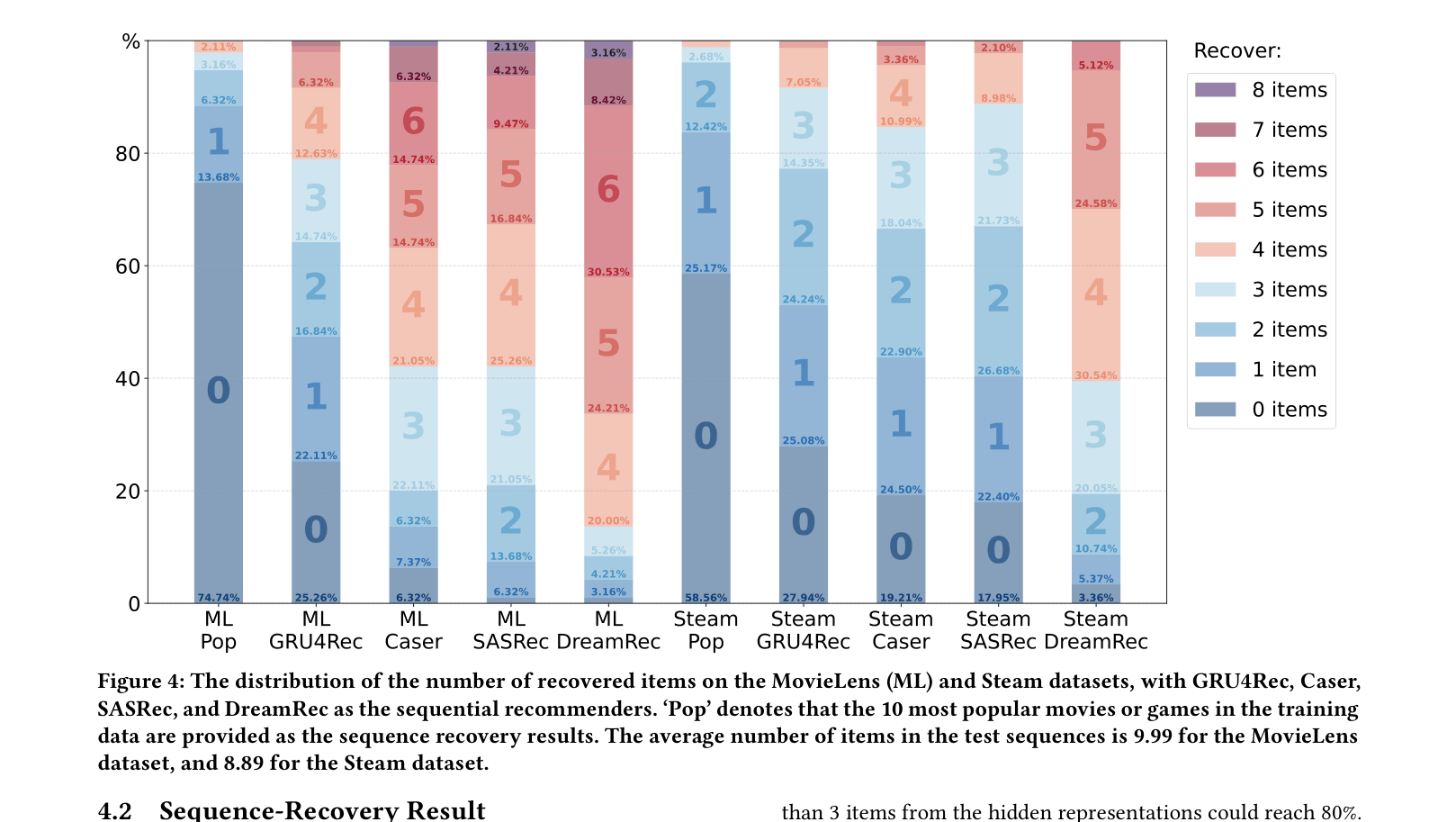
- In sequence recovery (reconstructing history from one vector), LLaMA recovers >5 correct items for over 35% of test samples on MovieLens when aligned with Caser or SASRec.
- Instantiated oracle items from DreamRec (via RecInterpreter) are preferred by ChatGPT over SASRec's top-1 recommendations in 50.53% of cases on MovieLens.
Breakthrough Assessment
7/10
Novel perspective on treating recommender embeddings as a 'modality' for LLMs. Strong empirical results on interpretability, though limited to small datasets.