📝 Paper Summary
Explainable Recommendation
Generative Recommendation
Prism decouples recommendation ranking from explanation generation, using a compact student model distilled from a large teacher to generate faithful, personalized explanations without the hallucinations common in end-to-end approaches.
Core Problem
Coupled recommendation models (optimizing ranking and explanation jointly) face a performance-efficiency trade-off, often compromising ranking accuracy or producing hallucinated explanations to fit the ranking.
Why it matters:
- Black-box deep learning recommenders undermine user trust by failing to provide transparent justifications.
- End-to-end coupled models often sacrifice ranking accuracy for explainability (or vice-versa) due to conflicting objectives.
- Large Language Models in recommendation are prone to hallucinations, generating plausible-sounding but factually incorrect reasons for items.
Concrete Example:
A coupled model might recommend a movie because it's popular but explain it by hallucinating that the user loves the director, simply because that explanation is 'easy' to generate. Prism avoids this by taking the recommended item as a fixed input and generating a faithful explanation based strictly on user history.
Key Novelty
Decoupled Generative Explanation with Faithfulness-Constrained Distillation
- Treats the ranking model as a black box and uses a separate, specialized generation module (Prism) strictly for explanation, resolving the objective conflict of coupled systems.
- Reframes the student model (BART) as a noise filter: by training on a teacher's (FLAN-T5) outputs with specific constraints, the smaller model learns to ignore the teacher's hallucinations and produce more faithful text.
Architecture
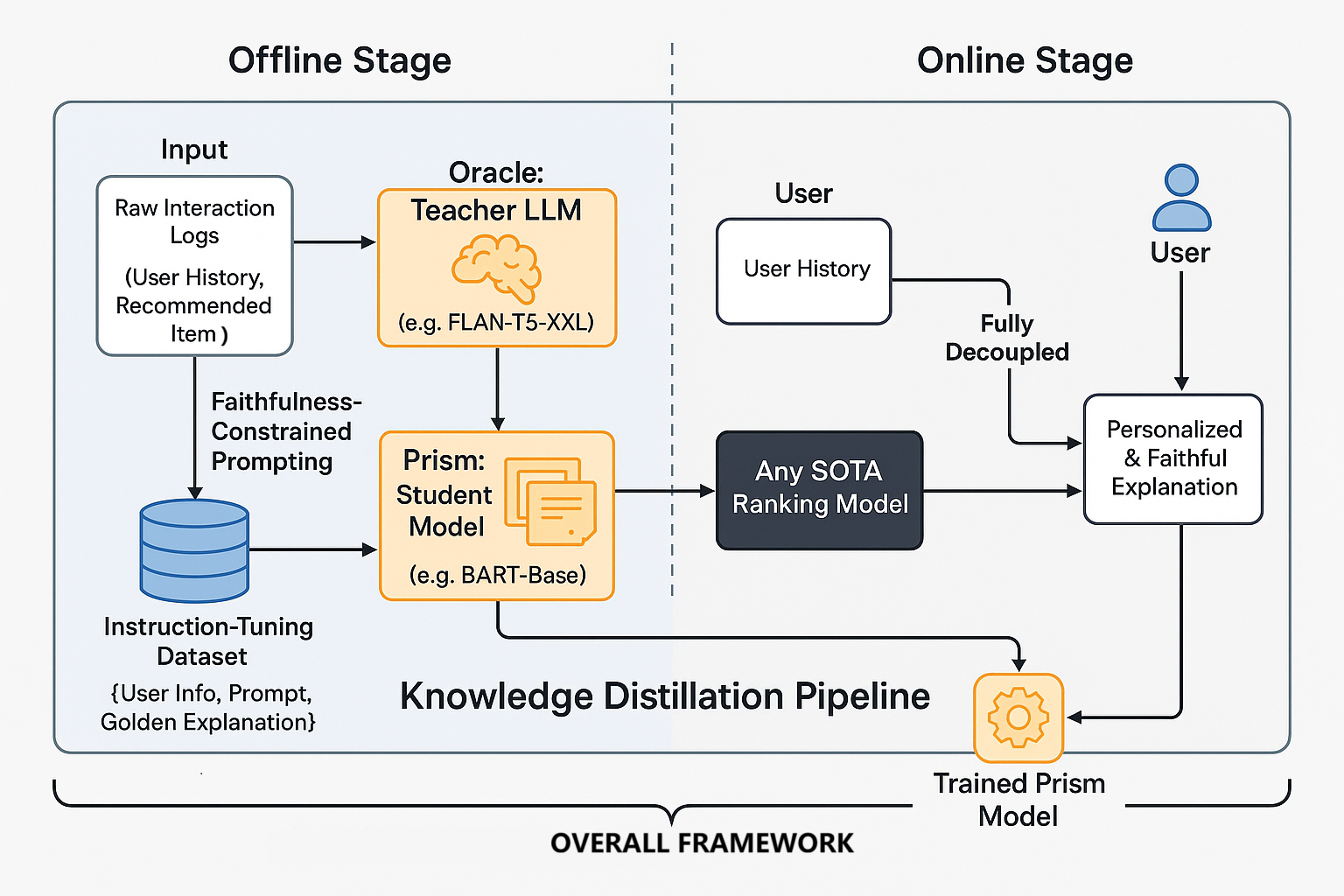
The overall decoupled framework showing the offline distillation/training stage and the online inference stage.
Evaluation Highlights
- 140M-parameter Prism student outperforms its 11B-parameter teacher (FLAN-T5-XXL) in human evaluations of faithfulness and personalization.
- Achieves >24x inference speedup and 10x memory reduction compared to the teacher model.
- Demonstrates emergent 'hallucination correction' where the student model generates fewer factual errors than the teacher it was distilled from.
Breakthrough Assessment
7/10
Strong practical contribution proving that smaller, specialized models can outperform larger generalist models in faithfulness via distillation. The finding that distillation acts as a noise filter for hallucinations is significant.