University of Technology Sydney,
The Hong Kong Polytechnic University,
University of Science and Technology of China,
The Education University of Hong Kong
arXiv
(2025)
RecommendationP13N
📝 Paper Summary
Sequential RecommendationLarge Language Models (LLMs) for Recommendation
AdaptRec improves sequential recommendation by enabling an LLM to actively evaluate and select relevant similar user histories to serve as in-context demonstrations, rather than relying solely on static embedding similarities.
Core Problem
Existing methods integrate collaborative signals into LLMs using static, numerical similarity metrics (e.g., Euclidean distance) that do not align with the LLM's reasoning process, often retrieving uninformative demonstrations.
Why it matters:
Standard collaborative filtering metrics fail to capture the semantic nuances necessary for LLM reasoning, leading to prompts that confuse rather than guide the model
Searching the vast space of user interactions for demonstrations is computationally expensive without an efficient filtering mechanism
Static selection methods cannot adapt to the specific context of the current prediction task, resulting in suboptimal in-context learning performance
Concrete Example:A traditional system might select a 'similar' user based on shared item IDs (numerical overlap), but if the *sequence* or *context* of purchase differs (e.g., gift-buying vs. personal use), the demonstration will mislead the LLM. AdaptRec allows the LLM to read the sequence and reject it if the behavioral pattern doesn't match.
Key Novelty
Self-Adaptive Prompting Framework
Uses a two-phase selection strategy: a coarse-grained embedding retrieval followed by a fine-grained, LLM-driven selection where the model explicitly evaluates candidate user similarities
Treats user histories as natural language demonstrations, transforming collaborative signals (patterns of other users) into an explicit format the LLM can process via in-context learning
Architecture
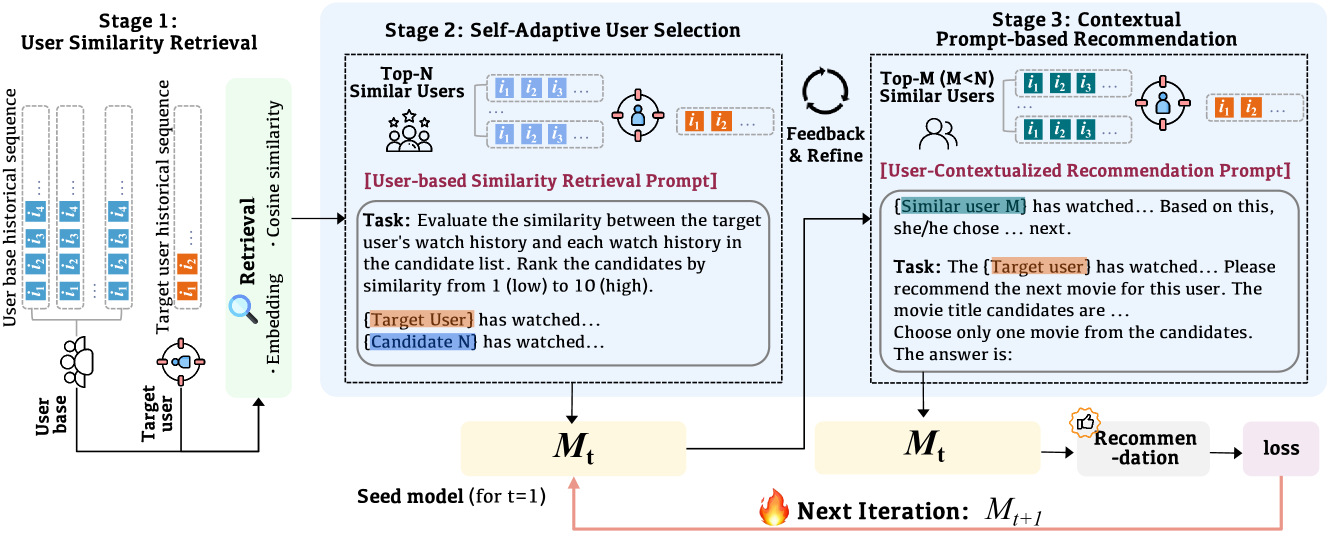
The overall AdaptRec framework comprising three stages: User Similarity Retrieval, Self-Adaptive User Selection, and Contextual Prompt-based Recommendation.
Evaluation Highlights
Achieves HitRatio@1 improvements of 7.13%, 18.16%, and 10.41% across three real-world datasets using full fine-tuning compared to state-of-the-art baselines
Outperforms baselines significantly in few-shot scenarios, with HitRatio@1 gains of 23.00%, 15.97%, and 17.98%
Demonstrates effective integration of collaborative signals where the LLM actively selects inputs rather than passively consuming pre-filtered data
Breakthrough Assessment
7/10
Novel integration of LLM-based evaluation into the retrieval loop for recommender systems. Strong reported improvements, though the reliance on standard LLM backbones limits architectural novelty.
⚙️ Technical Details
Problem Definition
Setting: Sequential Recommendation with Collaborative Signals
Inputs: Target user sequence S_v = [i_1, ..., i_n] and a set of candidate similar users U_2
Reduce search space by identifying top-N potentially similar users using static embeddings
Model or implementation: Cosine Similarity on Item Sequence Title Embeddings
Self-Adaptive User Selection (Retrieval & Selection)
Select the most informative demonstrations from the candidate set using LLM reasoning
Model or implementation: LLM with User-Based Similarity Retrieval Prompt
Contextual Recommendation
Generate the next item prediction using the target sequence and selected demonstrations
Model or implementation: LLM with User-Contextualized Recommendation Prompt
Novel Architectural Elements
Two-phase filtering pipeline where the second phase uses the LLM itself as a similarity metric/selector
Iterative feedback mechanism where the selection criteria refine as the model is fine-tuned
Modeling
Base Model: Large Language Model (Specific architecture not explicitly named in provided text snippet)
Training Method: Supervised Fine-Tuning with LoRA (Low-Rank Adaptation)
Objective Functions:
Purpose: Minimize prediction error for the next item token.
Formally: Negative Log-Likelihood Loss L = - sum log P(i_{n+1} | S_v, {H_u})
Adaptation: LoRA (Low-Rank Adaptation)
Key Hyperparameters:
optimization_method: Gradient Descent
trainable_parameters: Low-rank matrices A and B (rank r << d)
Compute: Not reported in the paper
Comparison to Prior Work
vs. Multi-User Collaborative Prompts: AdaptRec uses the LLM to *actively* select similar users via a specific prompt rather than relying solely on Euclidean/Cosine distance
vs. Single User-specific Prompts: AdaptRec explicitly incorporates collaborative signals (other users' histories) rather than just the target user's history
vs. RAG4Rec: Uses the LLM as the re-ranker for the retrieved context based on behavioral pattern matching [not cited in paper]
Limitations
Computational cost of using an LLM to evaluate similarity for Top-N candidates is higher than pure dot-product retrieval
Context window limits of LLMs constrain the number (M) of similar user histories that can be used as demonstrations
Dependency on the quality of the initial coarse-grained retrieval (Top-N) step
Reproducibility
Code availability is not mentioned in the provided text. The specific base LLM (e.g., Llama-2 vs Llama-3) is not named in the provided snippets. Dataset names are referred to as 'real-world datasets' but specific names (like Amazon Beauty) are not listed in the text.
📊 Experiments & Results
Evaluation Setup
Sequential next-item prediction
Benchmarks:
Real-world datasets (Sequential Recommendation)
Metrics:
HitRatio@1 (HR@1)
Statistical methodology: Not explicitly reported in the paper
Main Takeaways
Incorporating collaborative signals via explicit demonstrations significantly improves LLM recommendation performance compared to single-user prompts.
The self-adaptive selection mechanism (LLM-based filtering) outperforms static retrieval methods, suggesting that semantic pattern matching is superior to simple embedding similarity for constructing prompts.
Few-shot performance sees the largest relative gains (up to 23%), indicating that high-quality demonstrations are particularly critical when training data or fine-tuning is limited.
📚 Prerequisite Knowledge
Prerequisites
Sequential Recommendation
Collaborative Filtering (CF)
In-context Learning (ICL)
Parameter-Efficient Fine-Tuning (PEFT)
Key Terms
Collaborative Filtering: A technique that recommends items by identifying users with similar interaction histories (collaborative signals)
Sequential Recommendation: Predicting the next item a user will interact with based on the chronological order of their past interactions
LoRA: Low-Rank Adaptation—a parameter-efficient fine-tuning technique that freezes pre-trained weights and injects trainable rank-decomposition matrices
In-context Learning: The ability of LLMs to learn tasks from a few examples (demonstrations) provided in the prompt without updating model weights
HitRatio@1: A metric measuring the percentage of times the correct ground-truth item is ranked first in the recommendation list