📝 Paper Summary
Serendipity Recommendation
LLM-based User Profiling
Industrial Recommender Systems
This paper breaks filter bubbles in industrial recommendation systems by using LLMs to infer potential interests via dynamic knowledge graphs and deploying a specialized retrieval model that aligns user embeddings with these interests.
Core Problem
Industrial recommender systems suffer from feedback loops where systems recommend what users clicked, and users click what is recommended, creating filter bubbles that lack novelty.
Why it matters:
- Filter bubbles reduce user satisfaction and retention by confining users to homogeneous content.
- Existing serendipity methods lack data or use small models, while direct LLM inference is too slow (high latency) and prone to hallucinations for real-time industrial use.
Concrete Example:
A user searches for 'basketball shoes'. A traditional system keeps recommending basketball shoes (homogeneous). A direct LLM might hallucinate irrelevant items or take seconds to respond. This system reasons: 'User likes basketball shoes' -> (Hypernym) 'Sports' -> (Co-hyponym) 'Sports drink', finding a relevant but surprising interest.
Key Novelty
Dynamic User Knowledge Graph with Two-Hop Reasoning & Multi-Agent Debate
- Constructs a temporary knowledge graph for each user to reason from 'History' -> 'Core Demand' -> 'Potential Interest' (two-hop), rather than simple similarity matching.
- Uses a multi-agent debate mechanism where LLM instances critique each other's reasoning to reduce hallucinations and ensure the inferred interest is actually relevant.
- Deploys via a 'nearline' cache and a multi-task dual-tower model that forces the user representation to align with the new interest, combining the relevance of item-to-item retrieval with the conversion rates of user-to-item retrieval.
Architecture
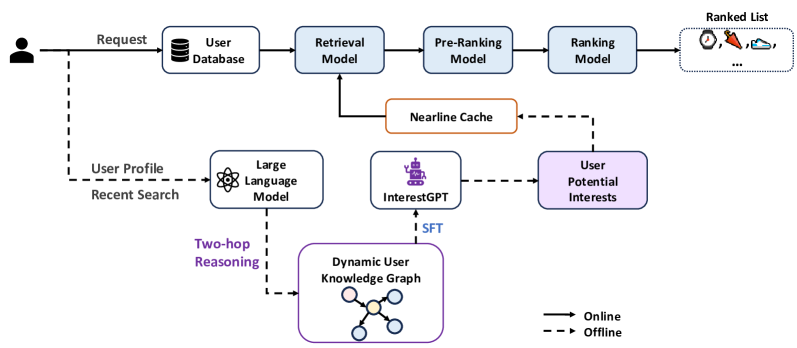
The overall two-stage framework: (1) Offline/Nearline generation of User Potential Interests using LLMs and (2) Online Serendipity Retrieval.
Evaluation Highlights
- +4.62% Exposure Novelty Rate and +4.85% Click Novelty Rate in online A/B testing on the Dewu app (10M+ users).
- +0.15% Average View Duration per person, indicating users actually engage with the novel content.
- 96% of generated potential interests received a relevance score of 2 (highest) in offline human evaluation.
Breakthrough Assessment
7/10
Solid industrial application. While using LLMs for profiling isn't new, the specific integration of dynamic KG construction with a nearline architecture and a custom loss retrieval model for a massive user base is a significant practical engineering contribution.