📝 Paper Summary
Food Computing
Knowledge Graph-augmented LLMs
KERL integrates a food knowledge graph with a small language model using task-specific adapters to unify recipe recommendation, instruction generation, and nutritional analysis into a single system.
Core Problem
Existing food AI systems are fragmented—focusing only on retrieval, generation, or simple calorie counting—and fail to handle complex personalized constraints (e.g., strict ingredient exclusions combined with specific micro-nutrient limits) without hallucinating.
Why it matters:
- Food recommendation directly impacts human health, requiring strict adherence to dietary constraints that standard LLMs often ignore due to hallucination
- Current approaches lack a unified framework: retrieval systems cannot generate cooking steps, while generative models often lack grounded nutritional facts
- Prior work mainly estimates calories from images, neglecting vital micro-nutrients like protein, fiber, and cholesterol needed for medical dietary management
Concrete Example:
A user asks for 'low-protein recipes with baking soda but without yellow cake mix, having cholesterol < 0.07'. A standard LLM might suggest a generic cake recipe that violates the protein or cholesterol limit. KERL retrieves validated subgraphs from FoodKG to filter options, then generates steps and precise nutrient data for 'Aunt Peg's Banana Bread' that strictly meets the criteria.
Key Novelty
Unified Multi-LoRA Food Framework
- Uses a single base LLM (Phi-3-mini) equipped with distinct Low-Rank Adaptation (LoRA) adapters for three stages: recommendation, recipe generation, and nutrition estimation
- Integrates Knowledge Graph retrieval (FoodKG) directly into the LLM context window to ground recommendations in factual dietary data rather than relying on parametric memory
Architecture
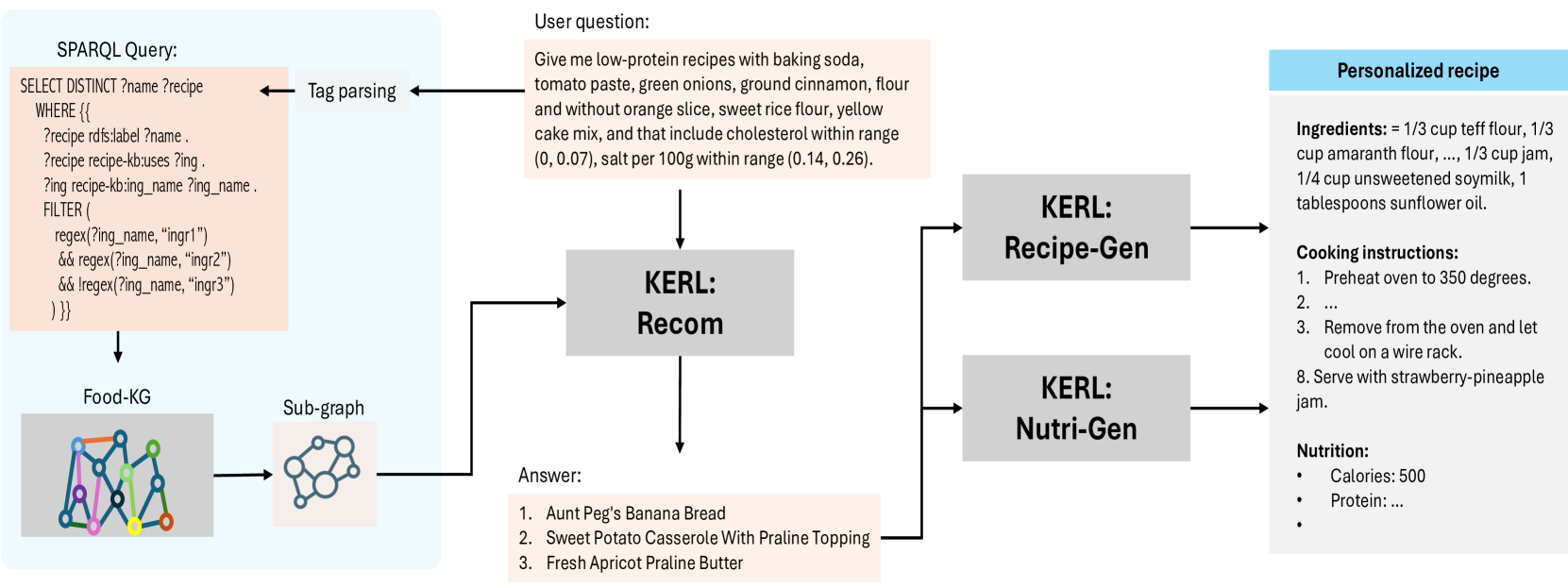
The unified KERL system workflow showing the interaction between the User, FoodKG, and the three LoRA modules.
Evaluation Highlights
- Proposed system unifies three distinct tasks (recommendation, generation, nutrition) within a single efficient architecture using Phi-3-mini
- Generates detailed micro-nutritional information (protein, fiber, fat, cholesterol) rather than just calorie counts common in prior work
- Qualitatively outperforms baseline LLMs in handling complex boolean and numeric constraints (e.g., 'salt per 100g within range 0.14-0.26') by leveraging KG subgraphs
Breakthrough Assessment
7/10
Strong engineering integration of KGs and LLMs for a high-impact domain. While methodologically relying on established techniques (LoRA, RAG), the unified application to food with strict constraint handling is a valuable contribution.