📝 Paper Summary
Medical Dialogue Systems
Medication Recommendation
GAP improves medical dialogue recommendations by constructing a dynamic patient-centric graph to capture fine-grained history and using it to generate path-based prompts for retrieving external knowledge.
Core Problem
In multi-turn medical dialogues, LLMs often miss fine-grained historical details (like specific contraindications) and lack specialized domain knowledge, leading to unsafe or hallucinated recommendations.
Why it matters:
- Safety risks: Recommending contraindicated drugs (e.g., Losartan during pregnancy) can cause severe patient harm.
- Long-tail knowledge gaps: LLMs struggle to memorize rare drug interactions purely from pre-training.
- Context loss: Standard RAG or ICL methods often overlook subtle state changes scattered across long dialogue histories.
Concrete Example:
A patient mentions '30 weeks pregnant' early in a dialogue. Later, when asking for hypertension medication, a standard LLM recommends Losartan (unsafe for pregnancy) because it failed to track the pregnancy state across turns or check contraindications.
Key Novelty
Graph-Assisted Prompts (GAP)
- Constructs an explicit 'patient-centric graph' that evolves during the dialogue, tracking medical concepts (diseases, drugs) and their specific states (e.g., pregnancy status, symptoms).
- Uses 'path-based prompts' derived from this graph to formulate precise queries for external knowledge sources (KGs, Web) rather than just retrieving based on raw text similarity.
Architecture
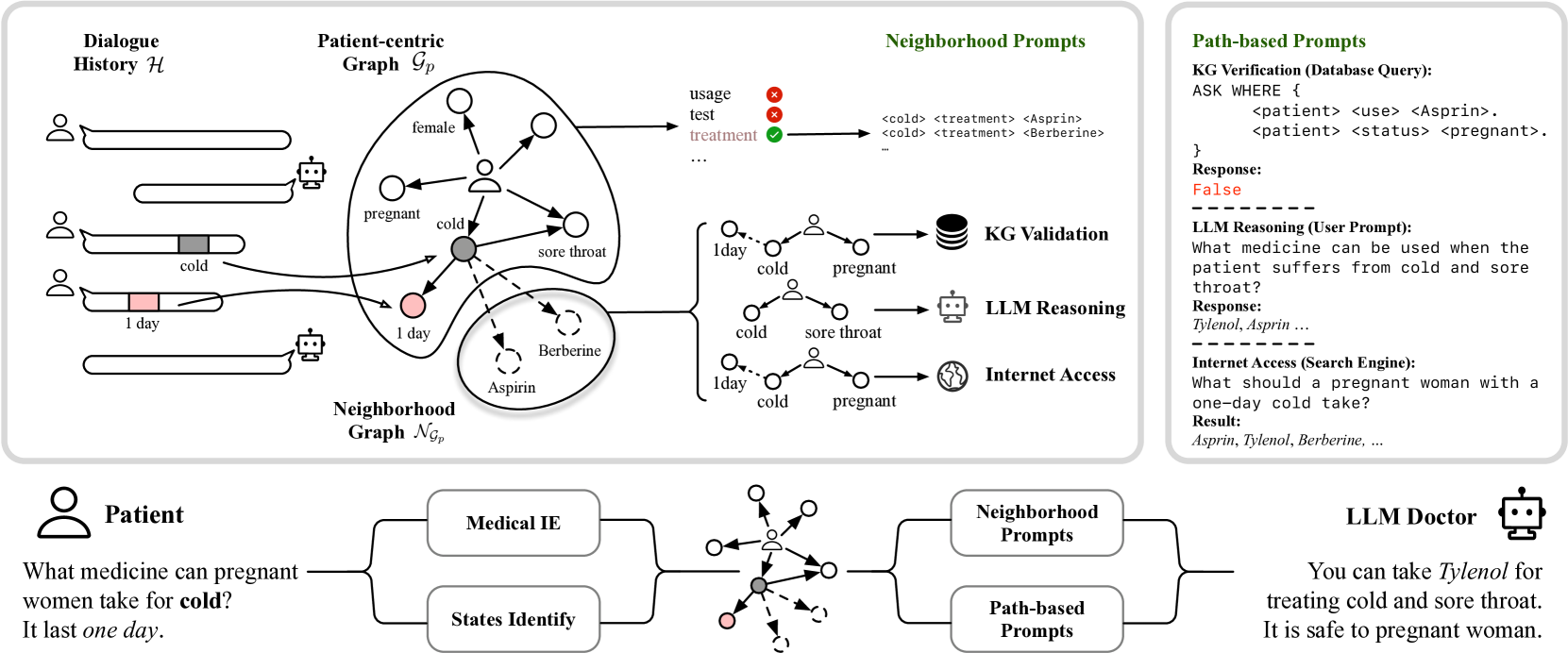
The overall GAP framework architecture.
Evaluation Highlights
- Outperforms strong baselines (like ChatGPT and specialized medical models) on dialogue-based medication recommendation tasks.
- Demonstrates effectiveness in a dynamically diagnostic interviewing scenario, showing better safety and information recall.
- Successfully integrates multiple knowledge sources (Knowledge Graphs and Internet search) to reduce non-factual responses.
Breakthrough Assessment
7/10
A solid application of graph-based memory to RAG in the medical domain. While the components (graphs, RAG) are known, the specific construction of patient-centric graphs for state tracking in dialogue is a practical and effective innovation for safety.