📝 Paper Summary
Generative Recommendation
Large Language Models (LLMs)
Diffusion Models
This survey establishes a comprehensive 'Data-Model-Task' framework to systematize the paradigm shift from discriminative to generative recommendation, incorporating recent advancements in agents, diffusion models, and large recommendation models.
Core Problem
Existing surveys on generative recommendation (up to 2024) are becoming outdated, often overlooking rapid 2025 advancements in agent-based simulation, diffusion models, and tasks beyond simple supervised fine-tuning.
Why it matters:
- Traditional discriminative models (matching users to item IDs) struggle with cold-start, lack semantic understanding, and cannot generate creative content
- The field is evolving too fast for previous taxonomies (which focused mainly on LLM embeddings or tuning methods) to capture the full scope of agentic and multimodal approaches
- Researchers lack a unified roadmap connecting data synthesis, model architecture changes (e.g., scaling laws), and novel generative applications
Concrete Example:
A traditional recommender fails to serve a new user with no history (cold start). A generative approach described in this survey can use an LLM agent to simulate this user's behavior based on a profile, synthesizing 'fake' interaction data to train the model before the user ever clicks an item.
Key Novelty
Unified Data-Model-Task Taxonomy
- Data-Level: Categorizes methods using generative models for open-world knowledge augmentation, agent-based behavior simulation, and multi-modal data unification
- Model-Level: Distinguishes between LLM-based recommenders, Large Recommendation Models (LRMs) that follow scaling laws, and Diffusion-based approaches for generation
- Task-Level: Identifies emerging applications enabled by generation, including conversational interaction, explicit reasoning/explanation, and personalized content creation (AIGC)
Architecture
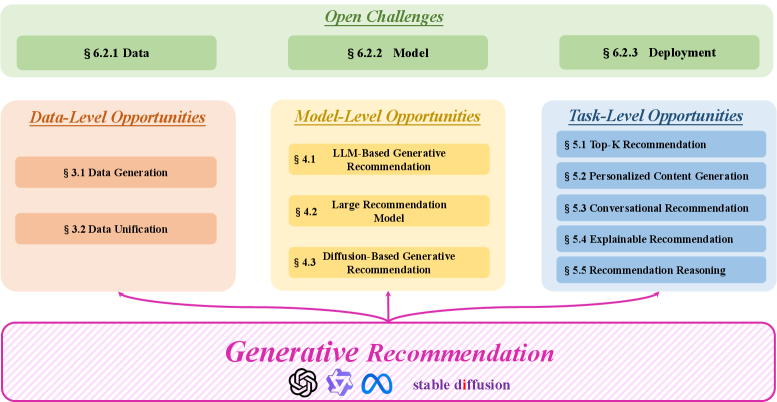
The hierarchical taxonomy of the survey, dividing the field into Data, Model, and Task levels.
Breakthrough Assessment
8/10
Provides a timely and necessary update to the recommendation taxonomy, specifically integrating 2025-era concepts like agentic simulation and LRMs which were absent in prior surveys.