📝 Paper Summary
LLM-enhanced Recommender Systems
Debiasing in Recommender Systems
CLLMR mitigates LLM propensity bias in recommender systems by encoding side information with interaction spectral data to prevent dimensional collapse and removing biased causal effects via counterfactual inference.
Core Problem
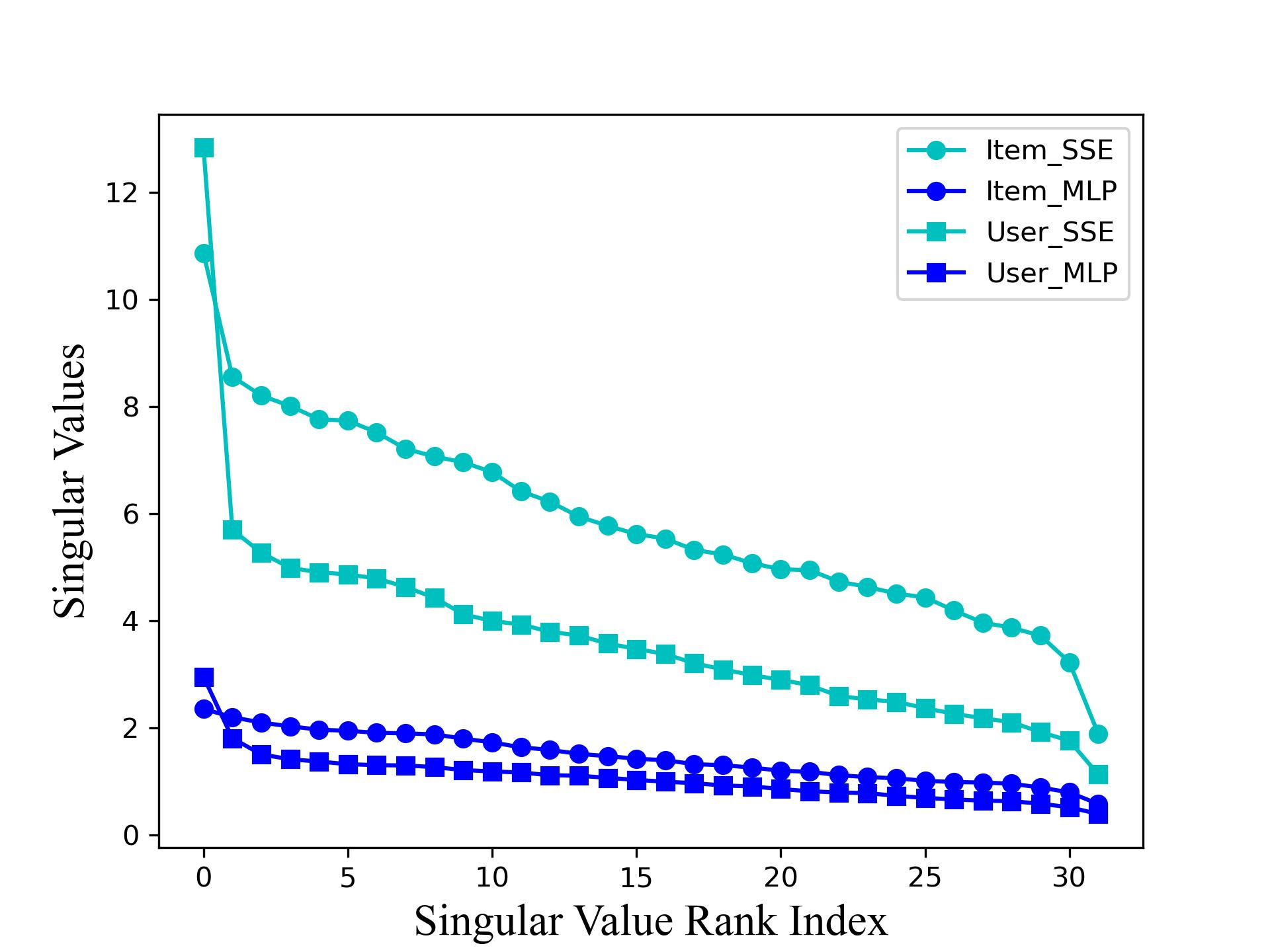
Aligning LLM-generated side information with collaborative filtering embeddings causes 'dimensional collapse' due to lack of structural data, while LLM 'propensity bias' (stereotypes) distorts recommendations.
Why it matters:
- LLM biases towards certain cultures or viewpoints create unfair user experiences and homogeneous representations
- Dimensional collapse restricts the recommender's ability to capture nuanced user preferences, forcing representations into a low-dimensional subspace
- Blindly removing all bias strips away valuable real-world knowledge (user/item propensity bias); only 'unrelated' bias should be removed
Concrete Example:
For User ID 5596 in the Amazon dataset who reads thrilling books, an LLM overlooks this specific history and generalizes the preference simply as 'entertaining' due to propensity bias, ignoring the nuance.
Key Novelty
Counterfactual Large Language Model Recommendation (CLLMR)
- Spectrum-based Side Information Encoder (SSE): Implicitly embeds interaction graph structure into LLM text representations and injects noise to prevent the vectors from collapsing into a limited subspace.
- Causal Bias Mitigation: Models LLM propensity as a mediator variable in a causal graph, allowing the system to mathematically subtract 'unrelated propensity bias' (the indirect effect) while keeping useful preference signals.
Architecture
A causal graph (DAG) illustrating the relationships between Exposure (X), Mediator (M), and Outcome (Y), along with counterfactual scenarios
Breakthrough Assessment
7/10
Addresses a critical, specific failure mode of LLM-RecSys integration (dimensional collapse + propensity bias) with a theoretically grounded causal approach, though the text provided lacks the empirical results to confirm magnitude of improvement.