📝 Paper Summary
LLM-enhanced Recommendation
Representation Learning
RLMRec integrates LLMs with recommender systems by aligning the semantic space of LLM-generated profiles with ID-based collaborative signals via mutual information maximization, avoiding slow runtime inference.
Core Problem
Graph-based recommenders miss textual semantics by relying on IDs and noisy implicit feedback, while direct LLM usage is computationally expensive and prone to hallucination.
Why it matters:
- Pure ID-based methods overlook valuable textual data, reducing representation quality.
- Direct LLM inference (e.g., TALLRec) is not scalable for real-time systems with large user bases due to high latency.
- Implicit feedback (clicks) contains noise like false negatives or popularity bias, which degrades model performance.
Concrete Example:
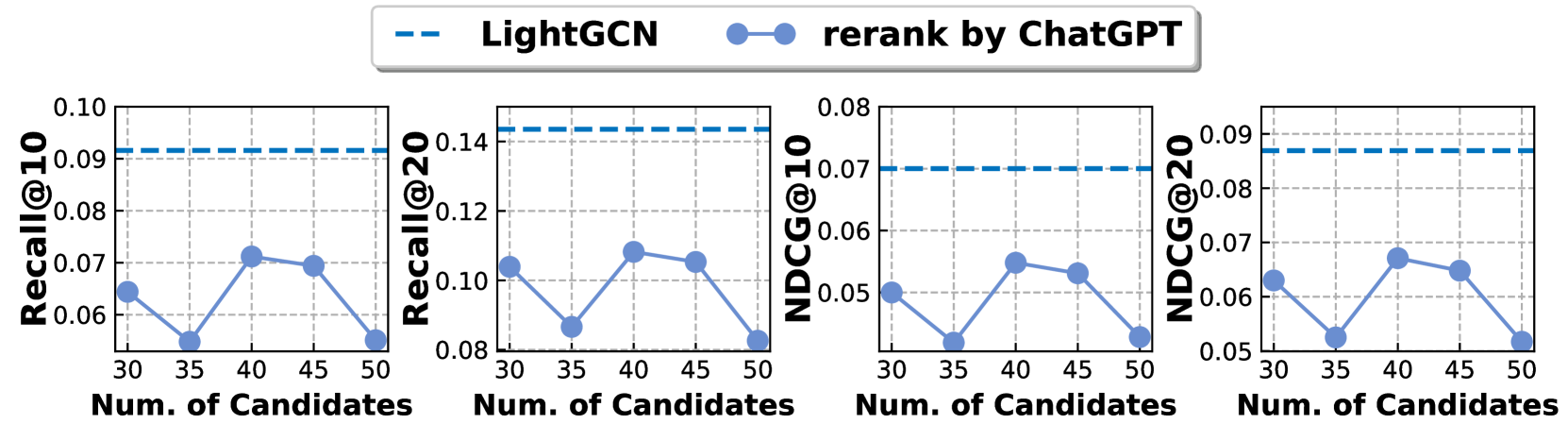
Using LLaMA2-13B for TALLRec takes ~3.6 seconds per user recommendations. Furthermore, a preliminary study shows ChatGPT-refined recommendations perform worse than LightGCN due to hallucinating non-existent items.
Key Novelty
Model-Agnostic Representation Learning Framework (RLMRec)
- Uses LLMs offline to generate denoised semantic profiles for users and items from raw text.
- Theoretical alignment of Collaborative Filtering (CF) signals and LLM semantic signals using Mutual Information Maximization.
- Aligns representations via Contrastive Learning (pulling pairs together) or Generative Modeling (reconstructing masked semantic vectors).
Architecture

The RLMRec framework illustrating the alignment between the Collaborative Filtering view (ID-based) and the LLM view (Text-based).
Evaluation Highlights
- Preliminary study: ChatGPT re-ranking performs worse than LightGCN baseline due to hallucinations (suggesting non-candidate items).
- Demonstrates theoretical proof that maximizing mutual information between CF and LLM representations minimizes the impact of noise.
- Integrates with state-of-the-art models (LightGCN, NGCF) effectively (Quantitative performance metrics not reported in the provided text snippet).
Breakthrough Assessment
7/10
Addresses critical scalability issues of LLM-based recommendation by moving LLM usage to representation alignment rather than inference, backed by theoretical mutual information grounding.