📝 Paper Summary
LLM-based Recommendation
Graph Neural Networks (GNNs)
GAL-Rec aligns Large Language Models with collaborative filtering semantics by using graph-aware contrastive learning that mimics GNN aggregation patterns on user-item bipartite graphs.
Core Problem
LLMs pre-trained on natural language struggle to understand the implicit collaborative signals and behavioral patterns essential for recommendation, leading to a semantic gap between text space and interaction space.
Why it matters:
- Standard fine-tuning aligns LLMs with instructions but fails to capture community-level behavioral patterns found in interaction graphs.
- LLMs treat items with similar text descriptions as similar, even if user interaction patterns show they appeal to distinct user groups (collaborative semantics).
- Current methods use LLMs as predictors or encoders but do not explicitly teach them the structural aggregation logic of Graph Neural Networks.
Concrete Example:
Items in the same category with minor textual differences might be accessed by completely different user groups. In the LLM semantic space, these items appear identical due to text similarity, but in the collaborative space, they are distinct. GAL-Rec forces the LLM to distinguish them based on interaction neighbors.
Key Novelty
Graph-Aware Learning for Language Model-Driven Recommendations (GAL-Rec)
- Embeds multi-hop graph neighborhoods (e.g., users who bought the same item) directly into the LLM's text prompt to simulate GNN receptive fields.
- Applies a graph-aware contrastive learning objective that explicitly aligns the LLM's representations of users/items with their aggregated 1-hop and 2-hop graph neighbors.
- Uses a dynamic queue (inspired by MoCo) to maintain negative samples for contrastive learning, overcoming the batch size limitations of LLM training.
Architecture
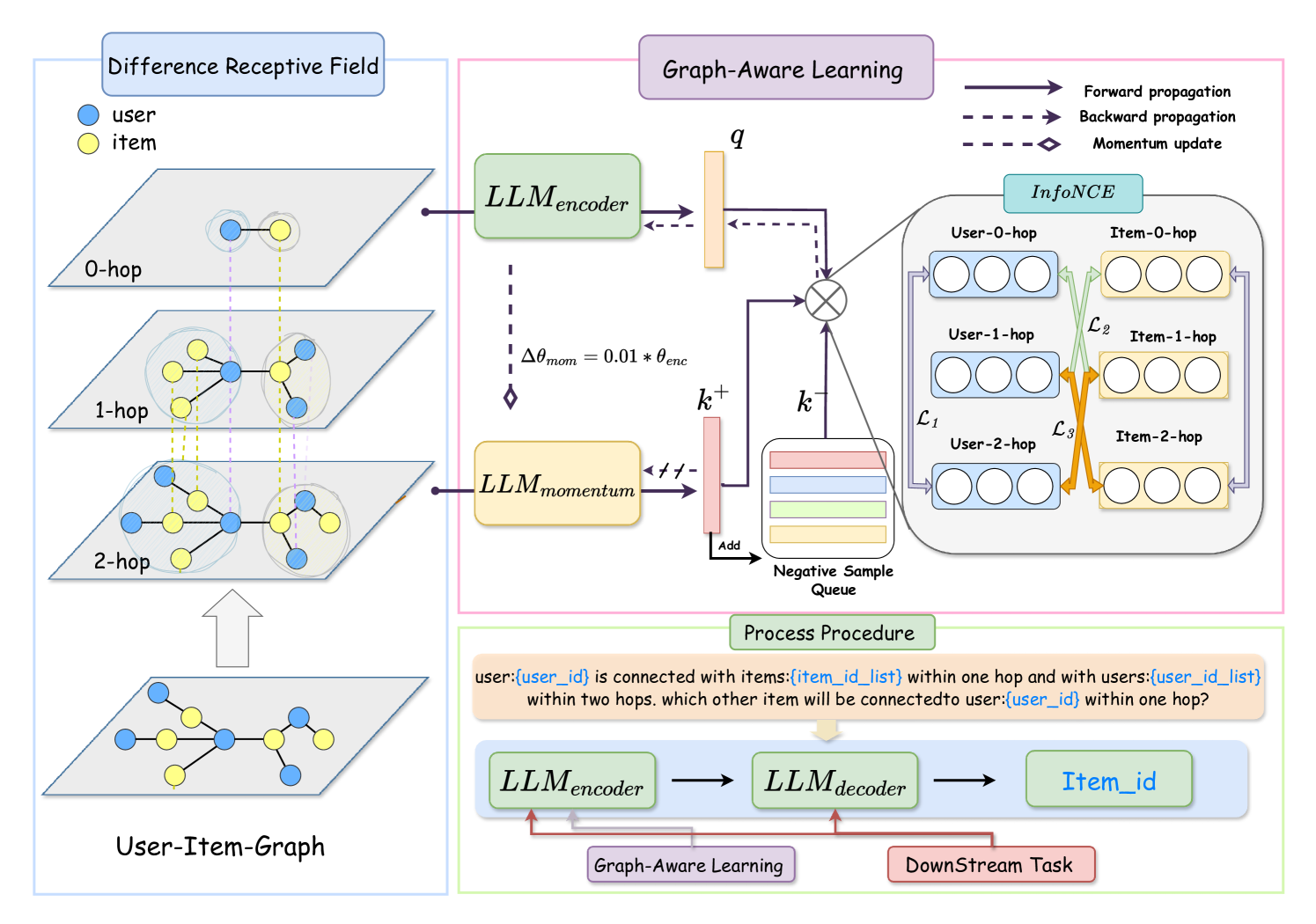
The overall framework of GAL-Rec, illustrating the four main components: External Embeddings, Prompt Construction, Graph-Aware Learning Module, and Dynamic Queue Storage.
Evaluation Highlights
- Outperforms state-of-the-art baselines on three real-world datasets, significantly enhancing the comprehension of collaborative semantics.
- Demonstrates that aligning LLM representations with GNN-style aggregated neighbors improves recommendation performance beyond standard instruction tuning.
- Effectively bridges the gap between the semantic space of natural language and the collaborative signal space of user-item interactions.
Breakthrough Assessment
7/10
Novel integration of GNN aggregation logic into LLM fine-tuning via contrastive learning. Addresses a critical semantic gap, though reliability depends on the specific baselines and datasets used.