📝 Paper Summary
Clinical Decision Support
LLM Alignment in Healthcare
LAMO adapts LLMs for medication recommendation by processing unstructured clinical notes into structured inputs and using group-wise LoRA adapters to improve accuracy and prevent the severe overprescription seen in general LLMs.
Core Problem
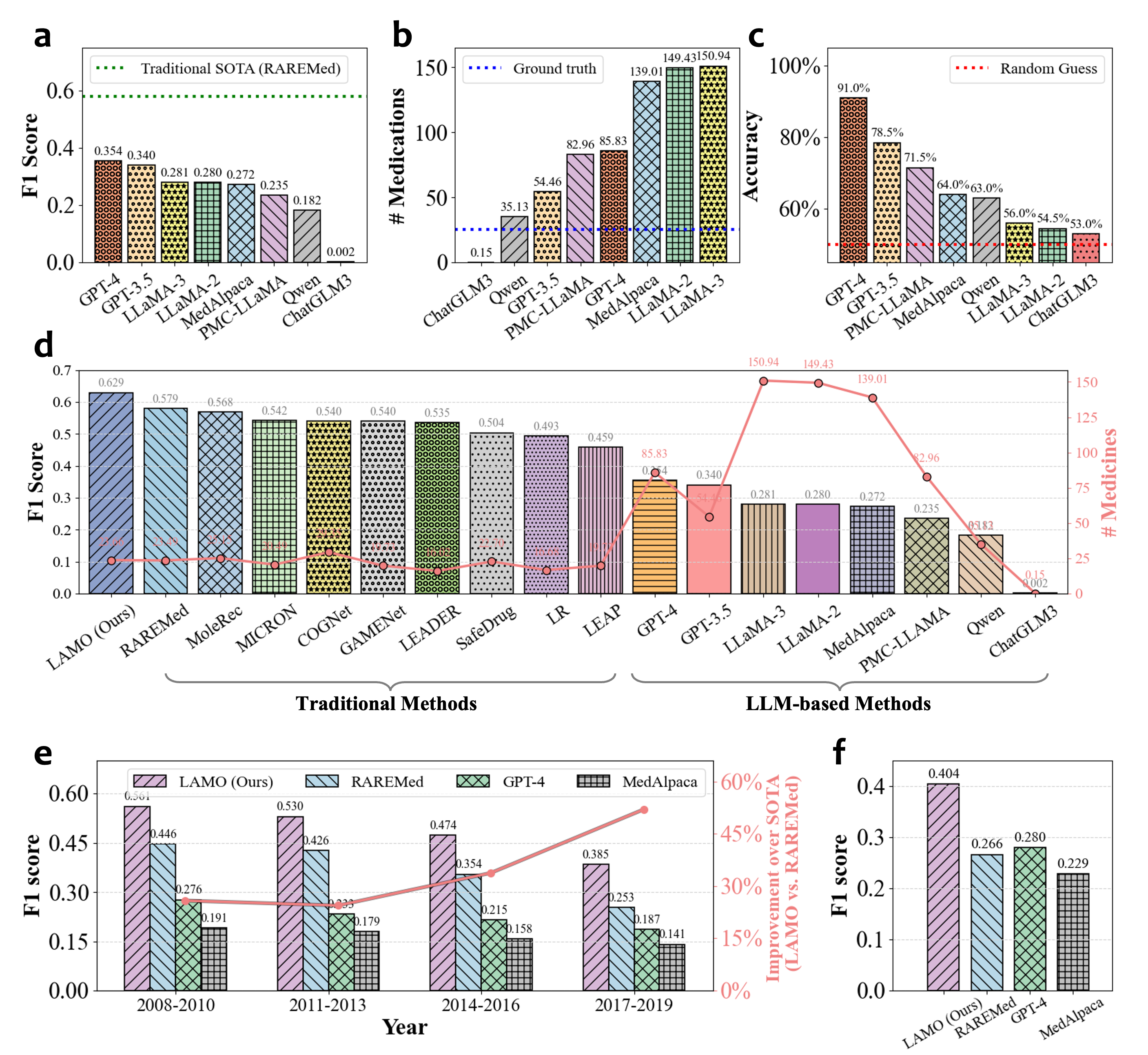
General and medical LLMs exhibit severe overprescription (recommending far more drugs than necessary) and poor precision when recommending medications, while traditional systems fail to utilize rich unstructured clinical notes.
Why it matters:
- Overprescription increases healthcare costs, elevates the risk of adverse drug events (approx. 3.5% of hospital admissions), and accelerates antimicrobial resistance
- Existing systems rely on ID-based encoding and structured EHR data, missing 80% of clinical information residing in unstructured notes
- Current LLMs lack nuanced understanding of drug-disease constraints, leading to 'shotgun' prescribing behavior
Concrete Example:
When tasked with recommending medications for a patient, GPT-4 suggests over 80 medications on average, whereas practicing physicians prescribe approximately 23 (Ground Truth). ChatGLM3 frequently fails to generate any recommendations.
Key Novelty
Language-Assisted Medication recOmmendation (LAMO)
- Mixture-of-Experts style adaptation where medications are clustered into groups, and a dedicated LoRA (Low-Rank Adaptation) adapter is trained for each group to capture specific pharmacological patterns
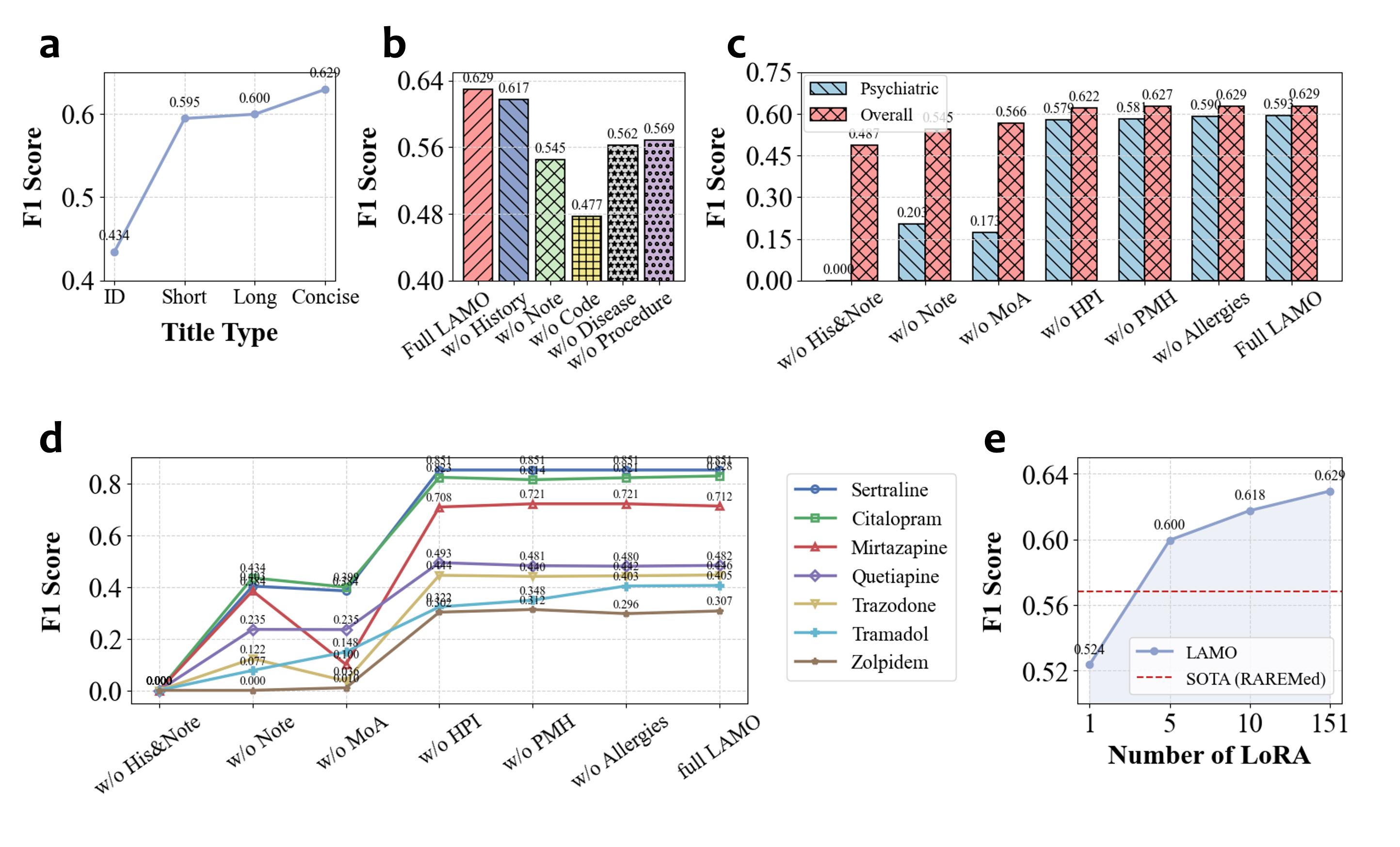
- Pre-processing pipeline using GPT-3.5 to extract and summarize unstructured clinical notes (History, Allergies) into concise, structured text inputs for the recommendation model
Architecture
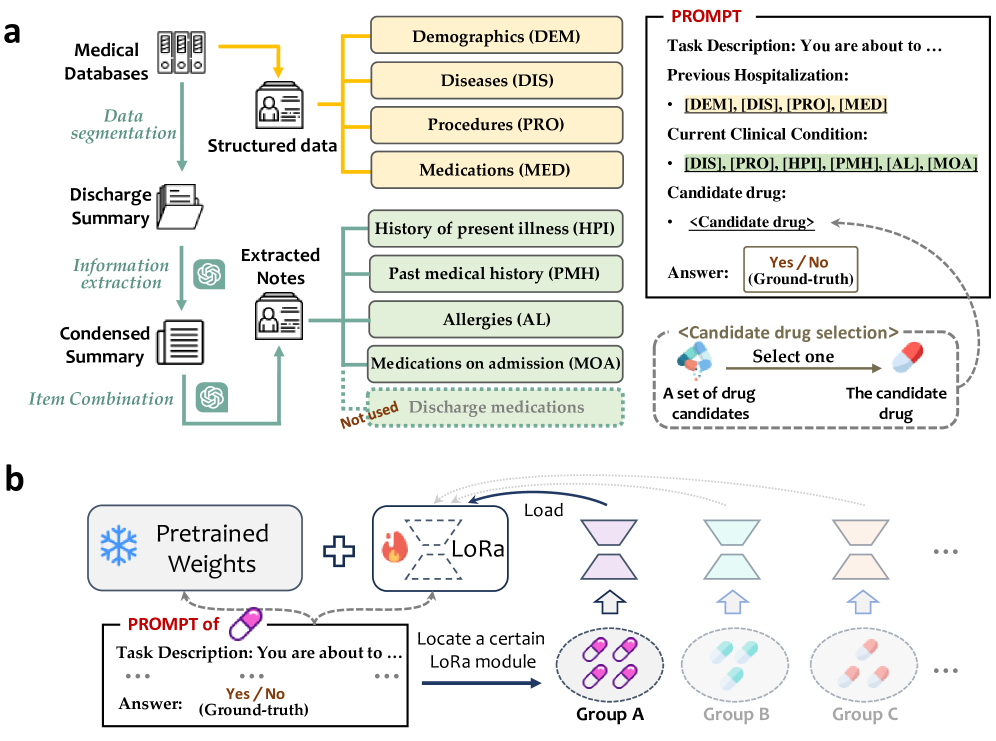
The data processing pipeline and fine-tuning architecture of LAMO
Evaluation Highlights
- Outperforms existing methods by more than 10% in internal validation on the MIMIC-III dataset
- Drastically reduces overprescription compared to GPT-4 (which suggests ~3x the volume of actual physicians)
- Demonstrates strong generalization across temporal shifts (MIMIC-IV) and external multi-center data (eICU)
Breakthrough Assessment
7/10
Addresses a critical safety failure (overprescription) in applying LLMs to healthcare. The group-wise LoRA approach is a practical architectural innovation for handling large output spaces (medications) efficiently.