📝 Paper Summary
Cross-Domain Recommendation
E-commerce Search & Discovery
A two-stage recommender system bridges the gap between routine grocery and discretionary merchandise by using LLMs to generate novel associations and a transformer-based ranker to optimize for real-time cart context.
Core Problem
Traditional recommenders struggle to bridge the gap between high-frequency, low-price Grocery (OG) items and low-frequency, high-price General Merchandise (GM) due to category bias and lack of historical co-purchase data.
Why it matters:
- Shoppers focused on routine groceries often miss relevant general merchandise, leading to lost revenue opportunities
- Traditional collaborative filtering reinforces existing behaviors rather than sparking new category discovery (e.g., always recommending milk with cereal, never with frothers)
- Offline analysis shows multi-category shoppers (OG + GM) generate 2.5x more revenue than single-category shoppers
Concrete Example:
A customer buying milk is typically recommended cereal or cookies (grocery items). Current systems fail to recommend a 'milk frother' (general merchandise) because historical interaction data between these distinct categories is sparse or non-existent.
Key Novelty
Cross-Pollination (XP) Framework
- Uses 'Agentic' LLMs to reason about item utility and lifestyle scenarios, generating cross-category connections (e.g., 'milk' -> 'frother') that do not appear in historical purchase graphs
- Evaluates candidates using a 'Semantic Evaluation Agent' that acts as a judge, filtering poor matches before they reach the user
- Re-ranks candidates using a transformer that encodes the entire real-time shopping cart, capturing dynamic user intent beyond single-item relevance
Architecture
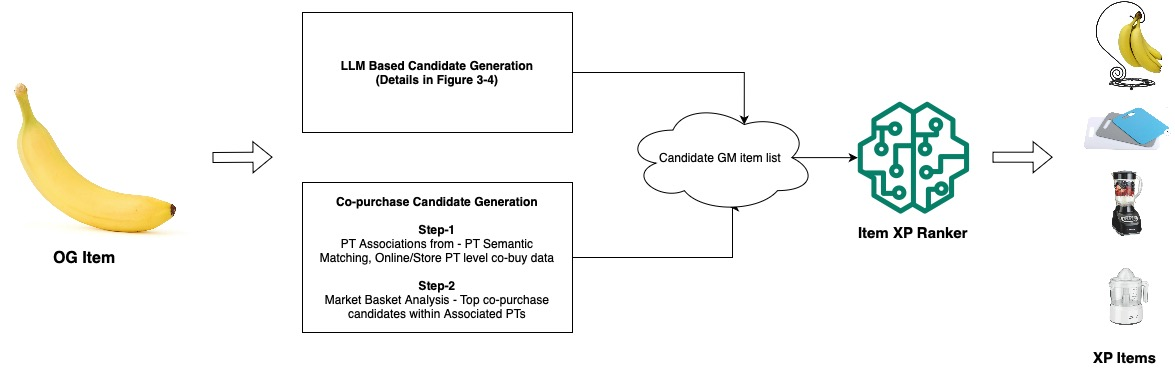
End-to-end framework illustrating the two-stage process: Candidate Generation (Historical + LLM) followed by Real-Time Cart Context Ranking.
Evaluation Highlights
- +36% increase in add-to-cart rate using LLM-based retrieval compared to baselines in A/B testing
- +27% lift in NDCG@4 using the Cart Context-based Neural Ranker compared to item-only baselines
- 94% relevancy rate achieved on LLM-generated recommendations based on human evaluation of 200 anchor items
Breakthrough Assessment
7/10
Strong practical application of LLMs for cold-start cross-domain discovery. The combination of generative association with discriminative real-time ranking is effective, though the architecture uses standard components (GPT-4o, Transformer).