📝 Paper Summary
Conversational Recommender Systems (CRS)
Retrieval-Augmented Generation (RAG)
CRAG augments black-box LLMs with collaborative filtering capabilities by retrieving behaviorally similar items from interaction history and using an LLM-based reflection mechanism to filter results for context relevance.
Core Problem
State-of-the-art LLMs excel at understanding context but lack access to proprietary user-item interaction data (collaborative filtering signals), while adding raw external knowledge often introduces noise.
Why it matters:
- Collaborative filtering (CF) is fundamental to recommendation accuracy but is difficult to represent in natural language for LLMs.
- Existing RAG methods often retrieve irrelevant items that bias the LLM, as simple similarity search ignores the specific conversational context (e.g., sentiment or constraints).
- Current zero-shot LLMs hallucinate or fail to map informal user mentions (abbreviations, typos) to specific items in a database.
Concrete Example:
A user mentions liking 'City of God' (a Brazilian movie). A standard CF retriever might return 'The Enemy Within' because it is behaviorally similar to 'City of God', even though it is not Brazilian. Without context-aware reflection, the LLM might recommend this irrelevant title simply because it appeared in the prompt.
Key Novelty
Collaborative Retrieval Augmented Generation (CRAG)
- Combines a collaborative filtering module (EASE) with a black-box LLM by using the LLM to 'reflect' on retrieved items, filtering out those that are behaviorally similar but contextually irrelevant.
- Introduces a 'Reflect-and-Rerank' step where the LLM explicitly scores generated recommendations against the dialogue context to correct ranking biases.
- Uses an LLM-driven entity linking process that extracts 'attitudes' (sentiment scores) alongside items to ensure only positively mentioned items drive the retrieval.
Architecture
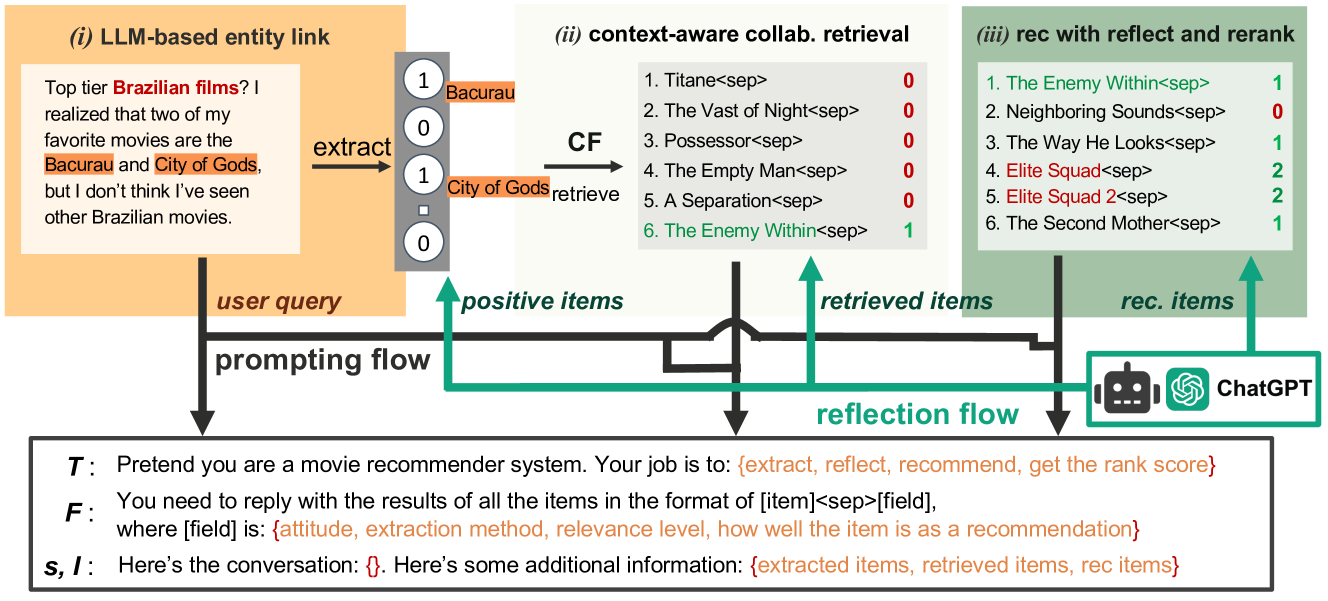
The overall framework of CRAG showing the three-stage pipeline: Entity Linking, Collaborative Retrieval, and Recommendation Generation.
Evaluation Highlights
- Demonstrates superior item coverage and recommendation performance on Reddit-v2 and Redial datasets compared to zero-shot LLMs and traditional CRS baselines.
- Improvements are specifically attributed to better accuracy on recently released movies, addressing a common weakness in static models.
- Establishes a refined 'Reddit-v2' dataset with substantially improved entity extraction ground truth compared to previous versions.
Breakthrough Assessment
8/10
First approach to effectively combine black-box LLMs with collaborative filtering for conversational recommendation, addressing the critical 'proprietary data' gap in LLM deployment.