XRec integrates collaborative filtering signals into large language models via a mixture-of-experts adapter and multi-layer embedding injection to generate personalized explanations for user-item interactions.
Core Problem
Collaborative filtering models are accurate but act as black boxes, while existing explanation methods lack the data efficiency and generalization capabilities to justify recommendations effectively.
Why it matters:
Users need transparency to trust recommender systems and understand why specific items are shown to them
Existing ID-based explanation methods struggle with zero-shot scenarios and unseen users/items due to reliance on specific ID embeddings
Standard LLMs lack specific knowledge of collaborative user preferences and interaction patterns inherent in recommendation data
Concrete Example:A standard collaborative filtering model might accurately recommend a restaurant based on purchase history but cannot explain *why* (e.g., 'because you like spicy food and casual dining'). An LLM might generate fluent text but hallucinate reasons unrelated to the user's actual behavior history.
Key Novelty
Deep Collaborative Instruction Tuning
Treats a Graph Neural Network (LightGCN) as a 'tokenizer' that converts user interaction graphs into collaborative embeddings
Bridges the gap between graph embeddings and LLM text space using a Mixture-of-Experts (MoE) adapter
Injects these adapted collaborative tokens into *every* layer of the LLM (not just the input) to prevent the signal from being diluted during long-text generation
Architecture
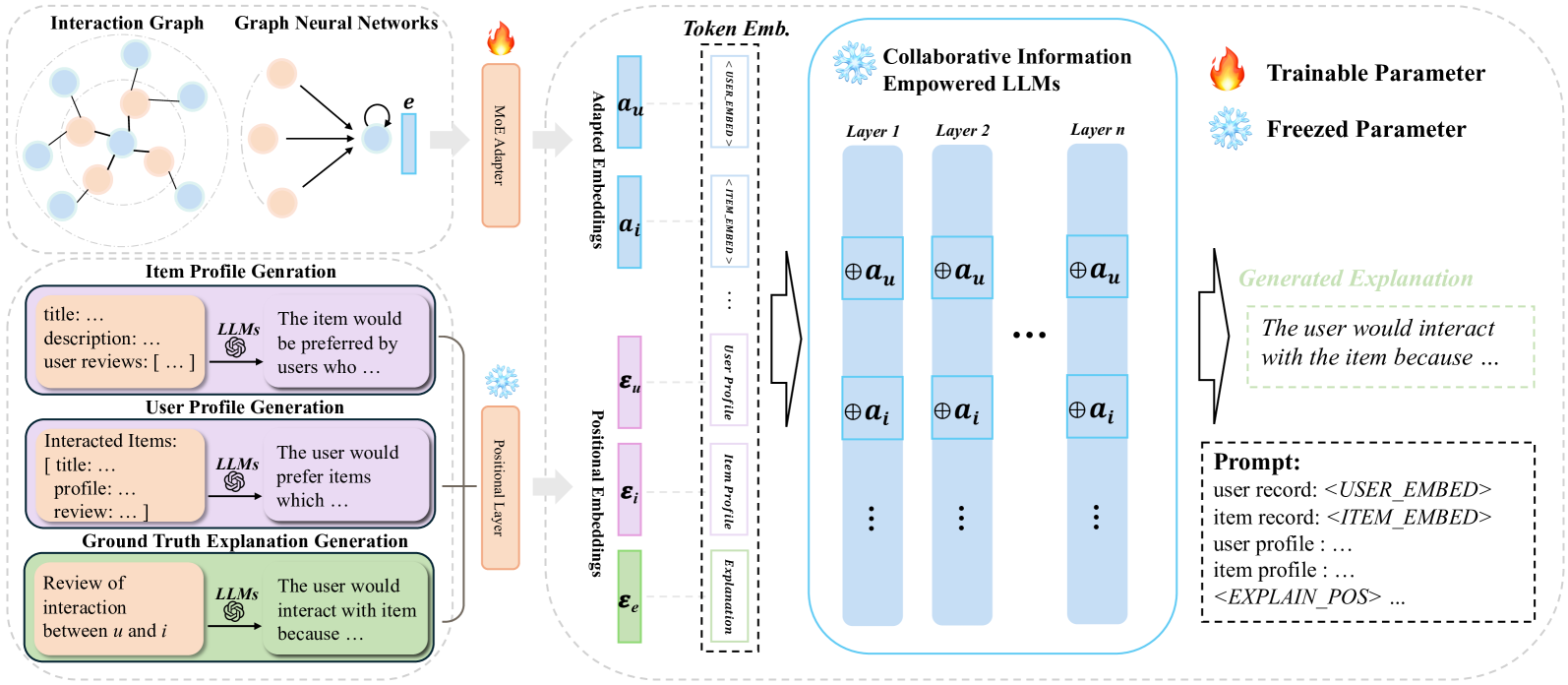
The XRec framework pipeline: (1) Interaction Graph, (2) LightGCN Tokenizer, (3) MoE Adapter, (4) LLM with Deep Injection.
Breakthrough Assessment
8/10
Proposes a novel architectural integration (layer-wise injection) to solve the 'signal dilution' problem in LLM-based recommendation, moving beyond simple prompt tuning.
⚙️ Technical Details
Problem Definition
Setting: Generate textual explanations for a user-item interaction given historical behaviors
Inputs: User u, Item i, Interaction histories X_u and X_i, Side information tau
Outputs: Natural language explanation E_ui justifying the interaction
Encodes high-order collaborative relationships from the user-item graph into latent embeddings
Model or implementation: LightGCN
Collaborative Adapter (Input Processing)
Aligns the semantic space of collaborative embeddings with the LLM's token space
Model or implementation: Mixture of Experts (MoE) with linear experts and gating router
Generator
Generates the textual explanation using injected collaborative signals
Model or implementation: Large Language Model (Specific backbone not named in snippet)
Novel Architectural Elements
Deep Injection Mechanism: Modifying the Key, Query, and Value projection matrices in *every* layer of the LLM to incorporate adapted collaborative embeddings, ensuring continuous access to user preference signals throughout the network
Collaborative Adapter using Mixture of Experts to bridge graph-based and text-based semantic spaces
Modeling
Base Model: Large Language Model (Specific backbone not specified in provided text)
Trainable Parameters: MoE Adapter parameters (LLM is frozen)
Training Data:
Ground truth explanations are distilled from raw user reviews using an LLM to extract explicit user intentions/sentiments, reducing noise
Comparison to Prior Work
vs. ID-based methods (Att2Seq, NRT): XRec leverages LLM semantic knowledge and isn't limited to fixed ID embeddings, allowing better generalization
vs. Standard LLM Prompting: XRec injects collaborative signals into *all* layers to prevent signal dilution, rather than just appending context to the input prompt
Limitations
Relies on the availability of user reviews to construct ground truth explanations via distillation
Computational overhead of calculating and injecting embeddings into every layer of the LLM during inference
Specific quantitative results and statistical significance are not available in the provided text snippet
Code is publicly available at https://github.com/HKUDS/XRec. The paper mentions utilizing LightGCN and an unspecified LLM backbone. Ground truth construction uses an LLM-based distillation process on reviews.
📊 Experiments & Results
Evaluation Setup
Explainable Recommendation (Text Generation)
Benchmarks:
Not listed in text snippet (Explanation Generation)
Metrics:
Negative Log-Likelihood (NLL) used for training loss
Quantitative metrics not reported in provided text snippet
Statistical methodology: Not explicitly reported in the paper
Main Takeaways
The framework unifies graph collaborative filtering with large language models to provide explanations.
Deep injection of collaborative signals into all LLM layers is proposed to handle the issue of information dilution in long prompts.
A Mixture-of-Experts adapter is used to align the disparate semantic spaces of graph embeddings and textual tokens.
📚 Prerequisite Knowledge
Prerequisites
Collaborative Filtering (CF)
Graph Neural Networks (GNN)
Large Language Models (LLM) and Prompt Tuning
Mixture of Experts (MoE)
Key Terms
CF: Collaborative Filtering—recommendation technique predicting interests based on the preferences of similar users
LightGCN: A simplified Graph Neural Network architecture for recommendation that learns user/item embeddings via linear propagation on the interaction graph
MoE: Mixture of Experts—a neural architecture using multiple specialized sub-networks ('experts') and a gating mechanism to handle different semantic subspaces
BPR Loss: Bayesian Personalized Ranking—a loss function that optimizes the relative order of items (ranking positive items higher than negative ones)
NLL: Negative Log-Likelihood—the standard loss function for training language models to predict the next token in a sequence
Collaborative Signal: Information derived from the structure of user-item interactions (e.g., 'users who bought A also bought B') rather than just item content
Signal Dilution: The phenomenon where the influence of initial prompt embeddings diminishes as the generated sequence gets longer and the model processes deeper layers