📝 Paper Summary
Hyperbolic Graph Neural Networks
LLM-enhanced Recommender Systems
HERec combines hyperbolic graph embeddings with LLM-derived semantic profiles to model hierarchical user preferences and allows users to explicitly adjust the trade-off between exploring new content and exploiting known interests.
Core Problem
Modern recommender systems create 'information cocoons' by over-exploiting similar content in Euclidean space, failing to capture hierarchical user interests or effectively balance exploration with exploitation.
Why it matters:
- Users get trapped in feedback loops of familiar content (exploitation), missing diverse items (exploration) that might align with broader interests
- Existing hyperbolic models capture hierarchy but lack semantic understanding, while Euclidean LLM methods miss the power-law structure of user-item networks
- Current systems lack a principled mechanism for users to control how much they want to explore vs. exploit
Concrete Example:
A jazz enthusiast might want to explore rock music, but standard models keep recommending jazz (exploitation). Without a hierarchical structure, the system cannot easily pivot to a sibling genre like 'rock' at the appropriate level of granularity.
Key Novelty
Hyperbolic Graph-LLM Framework (HERec)
- Aligns LLM-processed semantic descriptions with collaborative filtering signals directly in hyperbolic space, using adaptive gradient magnitudes to preserve hierarchy
- Constructs a binary hierarchy tree from learned hyperbolic embeddings by optimizing Dasgupta’s cost, enabling a hyperparameter-free discovery of structure
- Introduces a user-controllable exploration mechanism where recommendations are sampled from ancestor clusters in the hierarchy tree based on a temperature parameter
Architecture
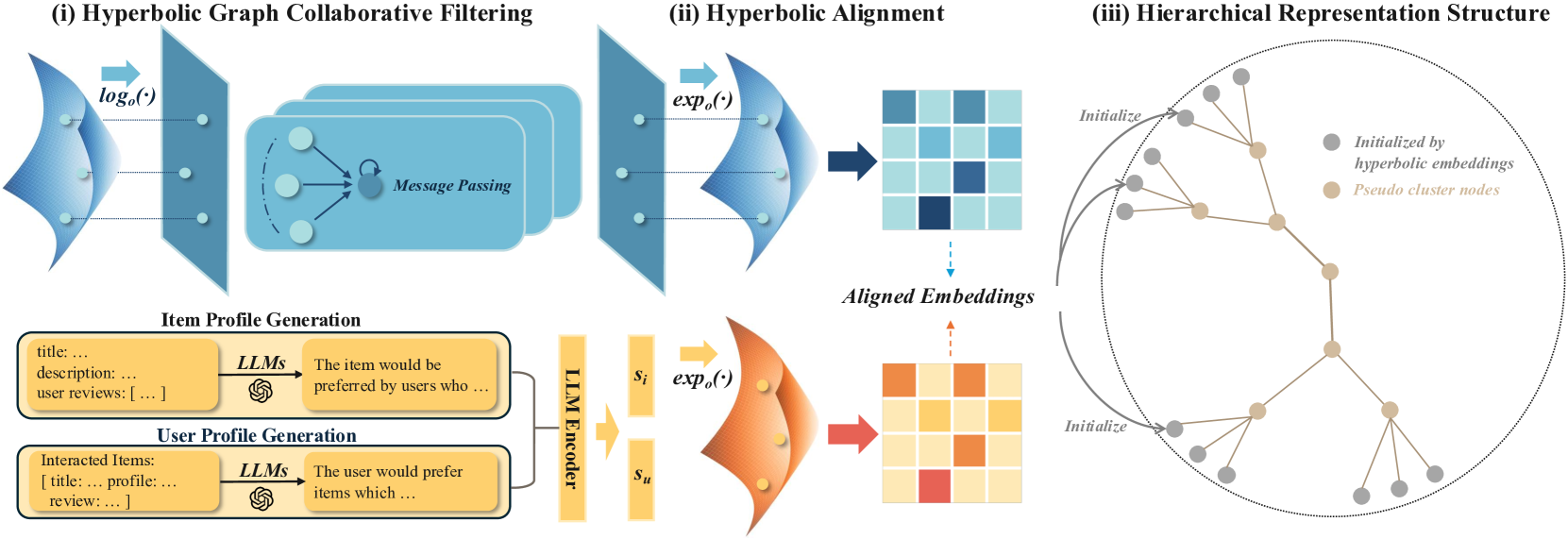
The overall HERec framework, illustrating the parallel processing of collaborative information (Hyperbolic GCN) and semantic information (LLM + Encoder), their alignment in hyperbolic space, and the subsequent hierarchy tree construction for exploration.
Evaluation Highlights
- Outperforms best baseline (HICF) by up to 5.49% in Recall@20 on Amazon-Book dataset
- Achieves 11.39% improvement in Diversity metrics compared to baselines on Amazon-Book, effectively mitigating information cocoons
- Successfully balances utility and diversity simultaneously, whereas baselines typically trade one for the other
Breakthrough Assessment
7/10
Strong integration of semantic (LLM) and structural (hyperbolic) signals with a novel user-controllable exploration mechanism. Significant improvements in both diversity and utility.