📝 Paper Summary
Multi-Domain Learning
Cross-Domain Recommendation
Large Language Models for Recommendation
A unified foundation model leverages LLM-extracted invariant text features, adaptive gating fusion, and domain-adaptive multi-task learning to transfer knowledge effectively to cold-start search and recommendation tasks.
Core Problem
Jointly modeling search and recommendation is difficult due to data imbalance, item heterogeneity across domains, and negative transfer, resulting in poor performance for cold-start scenarios.
Why it matters:
- Single-domain models fail to capture user intent comprehensively because interactions are fragmented across apps
- Cold-start scenarios (new services/products) lack sufficient interaction data, making traditional ID-based recommendation ineffective
- Naive multi-task learning often suffers from negative transfer where dominant tasks degrade the performance of smaller tasks
Concrete Example:
In a 'Super App' like Alipay, a user might click a service card in a recommendation feed. When they later search for that service, a standard model trained only on search data lacks the signal from the recommendation interaction, failing to rank the item correctly.
Key Novelty
S&R Multi-Domain Foundation Model
- Uses LLMs to extract domain-invariant text features from queries and items, bridging the semantic gap between heterogeneous domains
- Introduces Aspect Gating Fusion to dynamically weight the importance of ID, text, and sparse features based on domain contexts
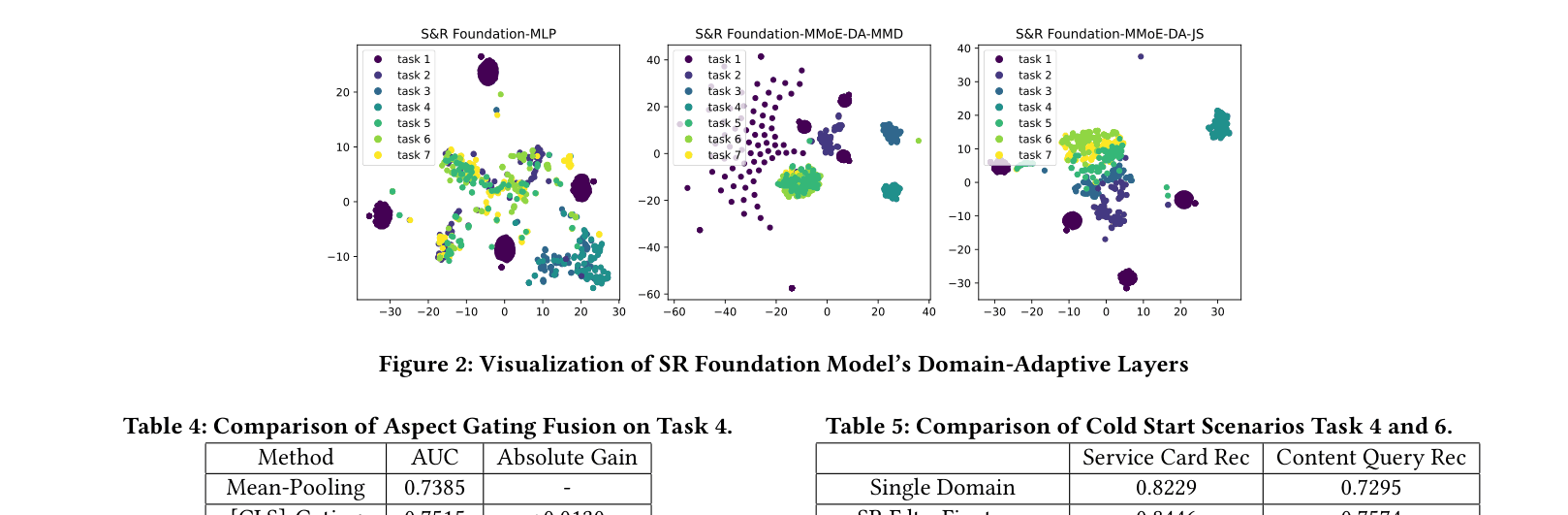
- employs a Domain Adaptive Layer with Jensen-Shannon divergence regularization to align feature distributions across different domains in a shared vector space
Architecture
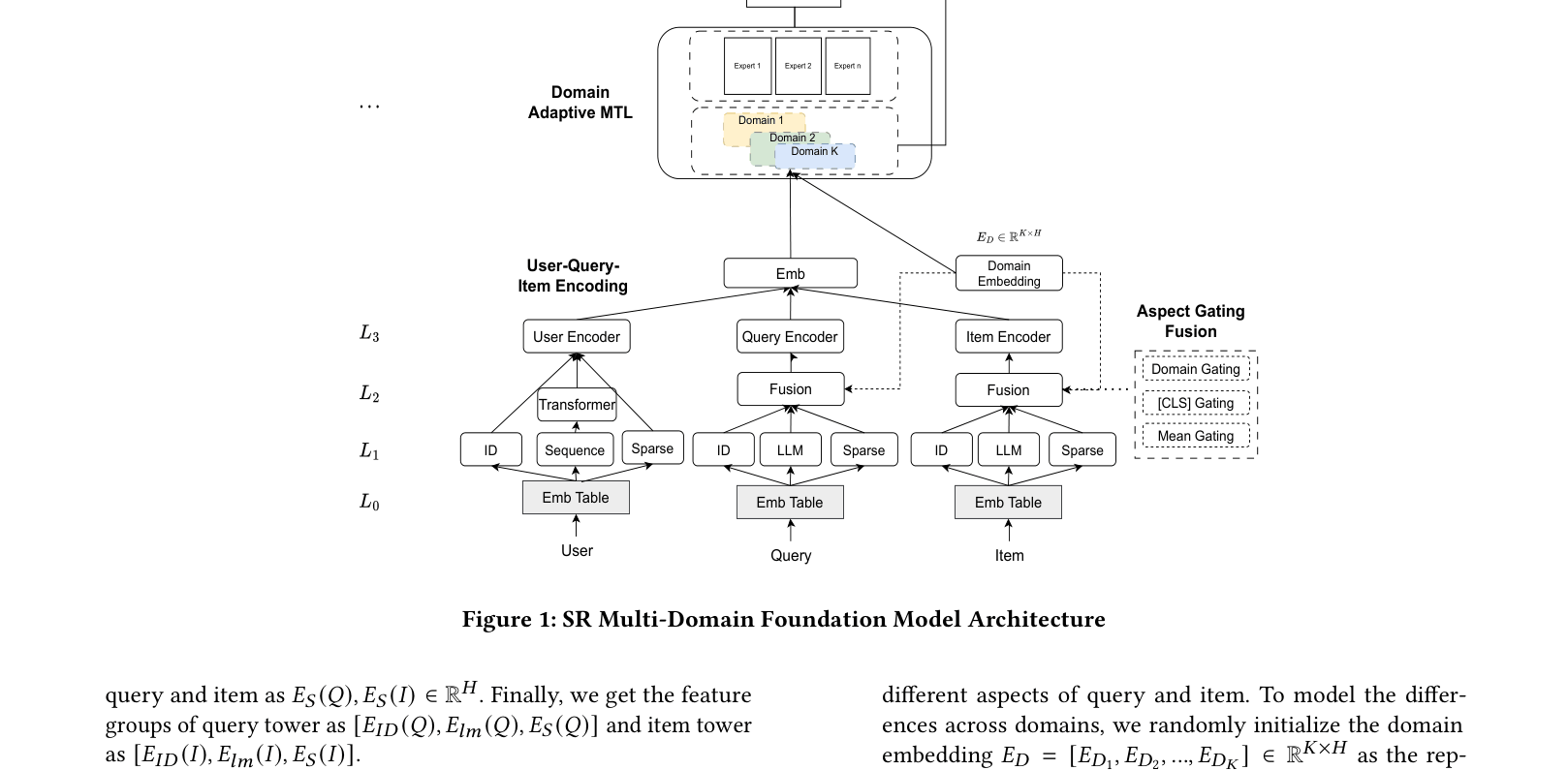
The complete S&R Multi-Domain Foundation Model architecture.
Evaluation Highlights
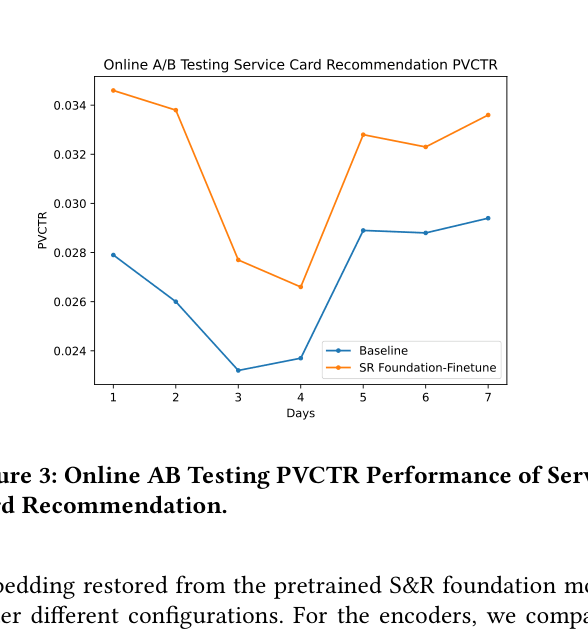
- Achieves +17.54% relative gain in PVCTR (Page View Click-Through Rate) over single-domain DNN baseline in an online A/B test for Service Card Recommendation
- Outperforms SOTA multi-task baselines (PLE, MMoE) on 4 out of 7 industrial datasets, with AUC gains up to +0.0404 on Content Query Recommendation
- Fine-tuning the foundation model improves AUC by +0.0279 on cold-start Content Query Recommendation compared to training from scratch
Breakthrough Assessment
7/10
Strong industrial application combining LLMs with multi-domain learning for practical cold-start gains. While the architectural components (MMoE, Domain Adaptation) are known, their specific integration with LLM features for S&R unification is novel and effective.