📝 Paper Summary
Cold-Start Recommendation
Generative Recommendation
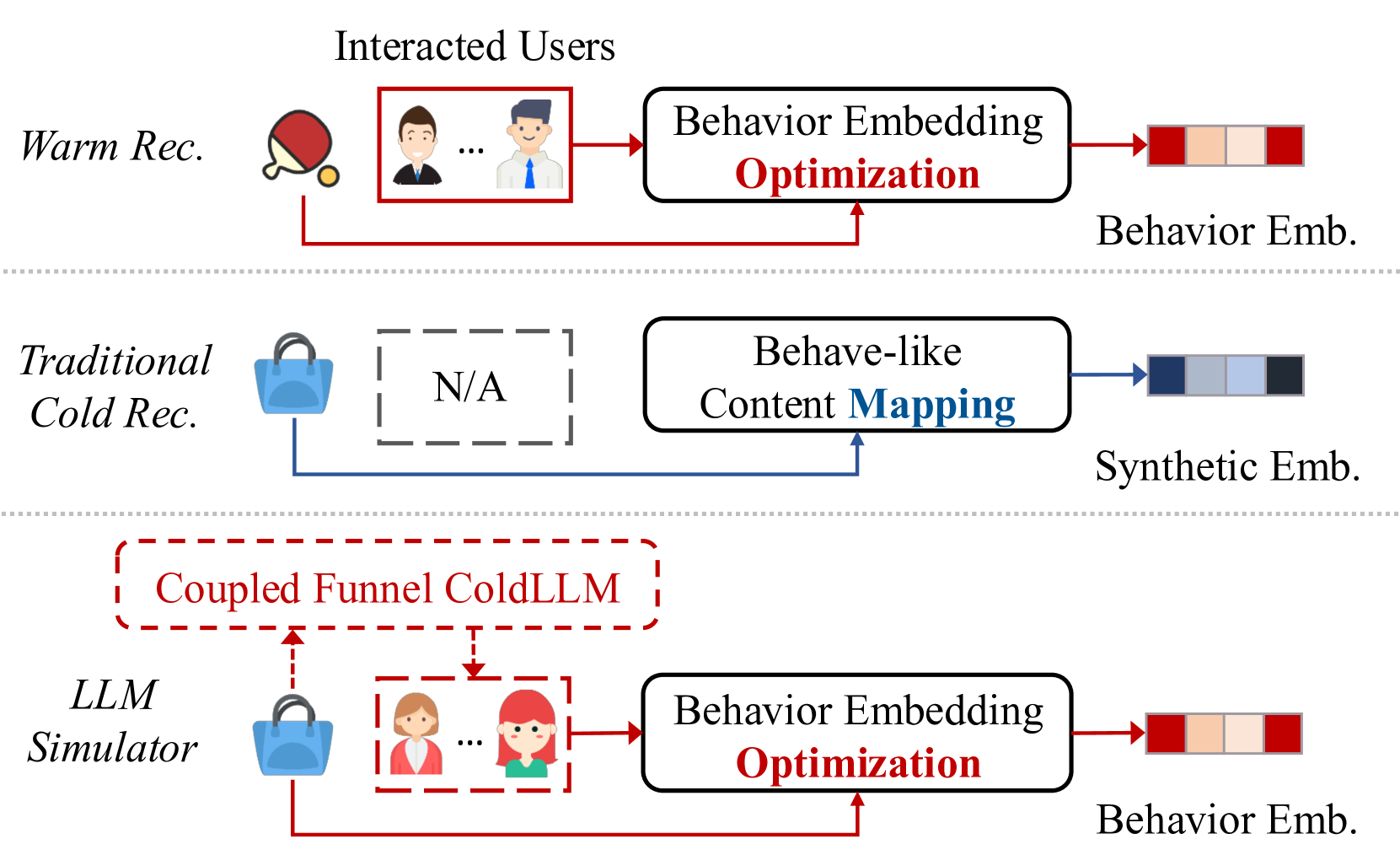
ColdLLM addresses the cold-start problem by using an LLM to simulate realistic user interaction sequences for new items, enabling standard embedding optimization methods to work as if the items were warm.
Core Problem
Cold items lack historical interaction data, forcing systems to rely on content-based synthetic embeddings that suffer from a content-behavior gap and fail to capture true user intent.
Why it matters:
- Synthetic embeddings derived solely from content features have a significant discrepancy compared to embeddings learned from actual user behaviors
- Existing methods often conflate content-based and behavior-based signals, leading to suboptimal recommendation performance for both cold and warm items
- Simply applying LLMs to simulate behavior for all users is computationally infeasible in billion-scale systems
Concrete Example:
A new movie (cold item) has description text but no clicks. Traditional models map this text to a vector, which might not match the vector space of user behaviors. ColdLLM instead uses an LLM to predict which existing users *would* click it, generating a fake click history (e.g., 'User A, User B') so the system can train a standard behavioral embedding.
Key Novelty
Coupled Funnel ColdLLM Framework
- Treats cold-start not as a content-mapping problem but as a missing-data problem: uses an LLM to hallucinate realistic user interaction histories for new items
- Solves the computational bottleneck of LLM simulation with a 'coupled funnel': a lightweight filter model (trained to mimic the LLM) first selects top candidate users, and the heavy LLM only verifies this small subset
Architecture
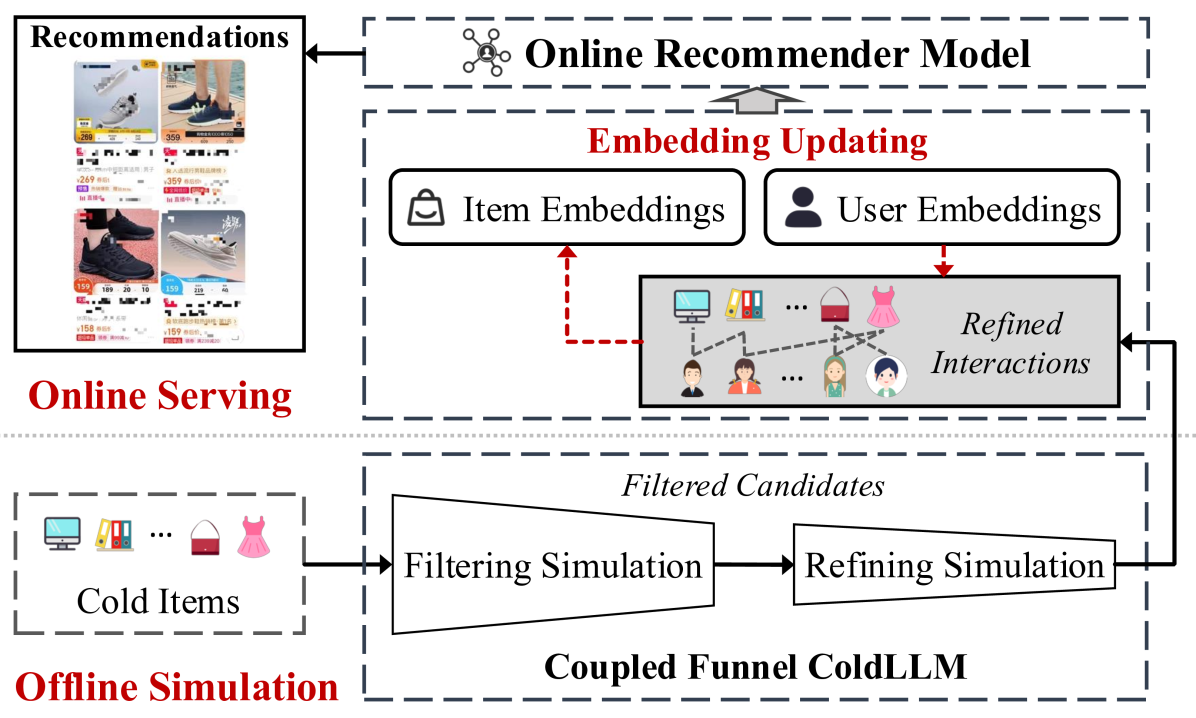
The overall ColdLLM framework including Offline Simulation, Online Training, and Online Serving phases
Evaluation Highlights
- Outperforms state-of-the-art cold-start baselines by up to +21.69% on offline metrics (Recall@200, NDCG@200)
- Validated in a two-week online A/B test on a large-scale platform, showing effective increases in Gross Merchandise Value (GMV) during the cold-start period
- Achieves O(1) complexity for candidate filtering using efficient similarity search, scaling successfully to billion-scale user bases
Breakthrough Assessment
7/10
Novel framing of cold-start as a simulation problem rather than just feature mapping. The coupled funnel architecture makes the expensive LLM simulation feasible for industrial scale.