📝 Paper Summary
Sequential Recommendation
Large Language Models (LLMs) for Recommendation
Reasoning Strategies in LLMs
GOT4Rec adapts the Graph of Thoughts framework to sequential recommendation, enabling LLMs to explicitly reason about short-term, long-term, and collaborative user interests in parallel before aggregating them.
Core Problem
Existing LLM-based recommenders rely on simple input-output prompting or basic Chain-of-Thought (CoT), which fails to decompose complex user behaviors into distinct preference patterns (like short-term vs. long-term interests).
Why it matters:
- Simple prompting underutilizes the reasoning potential of LLMs, leading to task-irrelevant or inaccurate recommendations.
- User sequences contain rich, multi-faceted information (dynamic short-term needs vs. stable long-term tastes) that linear reasoning models like CoT struggle to capture simultaneously.
- Current methods often focus narrowly on recent interactions (recency bias) while neglecting broader preference structures.
Concrete Example:
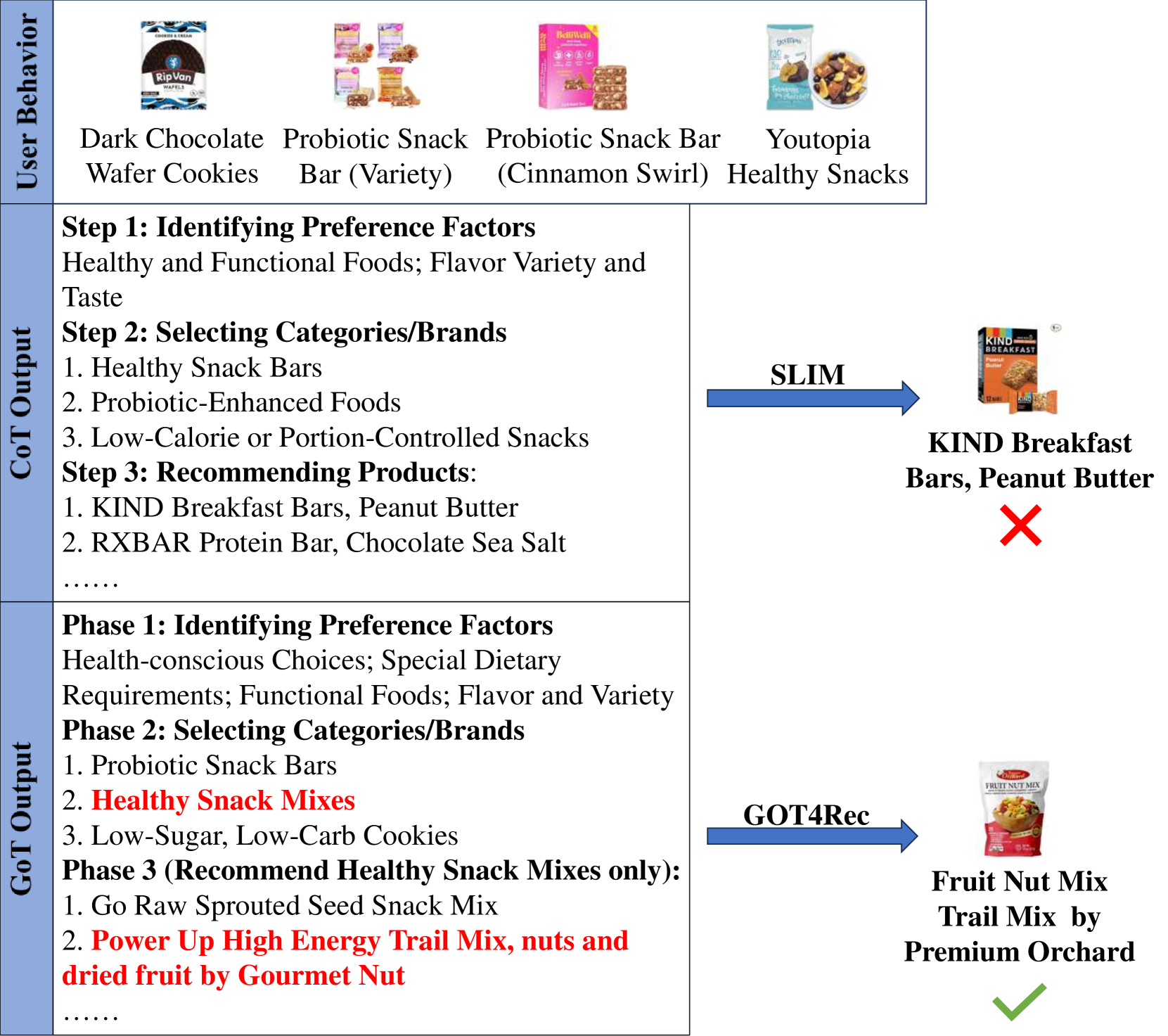
If a user historically buys 'fruit nut mix' (long-term) but recently browsed 'snack bars' (short-term), a standard Chain-of-Thought model might narrowly predict 'snack bars'. GOT4Rec separately reasons about both and combines them to predict the correct 'fruit nut mix'.
Key Novelty
Graph of Thoughts (GoT) for Recommendation
- Decomposes the recommendation task into a graph where nodes are 'thoughts' representing specific preference aspects: short-term, long-term, and collaborative interests.
- Enables non-linear reasoning: LLMs generate multiple candidate item sets for each preference aspect independently in parallel branches.
- Uses an 'aggregation transformation' to vote on and merge these diverse candidate sets into a final consensus recommendation.
Architecture
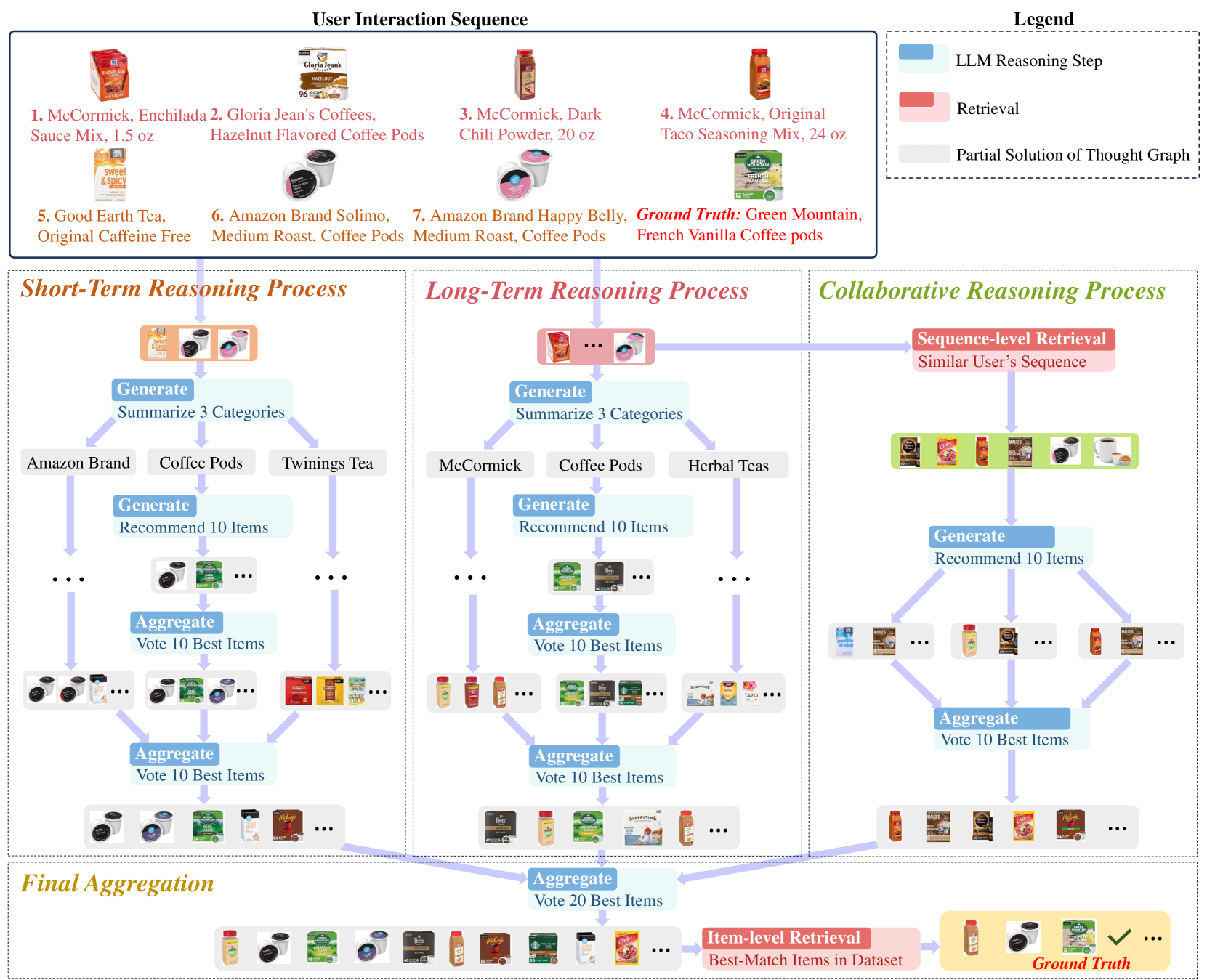
The overall GOT4Rec framework showing the decomposition of the recommendation task into three parallel reasoning branches (Short-term, Long-term, Collaborative) and their subsequent aggregation.
Evaluation Highlights
- Outperforms state-of-the-art baselines with an average improvement of 37.11% across three real-world datasets (Beauty, Sports, Toys).
- Surpasses standard Chain-of-Thought (CoT) and Self-Consistency (CoT-SC) strategies, demonstrating the superiority of the graph-structured reasoning approach.
- Achieves higher accuracy than supervised neural models (like SASRec and BERT4Rec) in a zero-shot setting on the tested benchmarks.
Breakthrough Assessment
7/10
Novel application of GoT to recommendation with strong zero-shot empirical results. While the core GoT concept exists, adapting it to specific recommendation sub-tasks (short/long/collaborative) is a meaningful contribution.