📊 Experiments & Results
Evaluation Setup
Asset recommendation using historical transaction and price data.
Benchmarks:
- FAR-Trans dataset (Financial Asset Recommendation)
Metrics:
- Pref@3 (Behavioral Alignment)
- Comb@3 (Joint Profitability and Alignment)
- Statistical methodology: Not explicitly reported in the paper
Key Results
| Benchmark | Metric | Baseline | This Paper | Δ |
|---|---|---|---|---|
| FLARKO demonstrates superior alignment and joint performance compared to baselines. | ||||
| FAR-Trans | Pref@3 | Not reported in the paper | Not reported in the paper | Not reported in the paper |
| FAR-Trans | Performance (General) | Not reported in the paper | Not reported in the paper | Not reported in the paper |
Experiment Figures
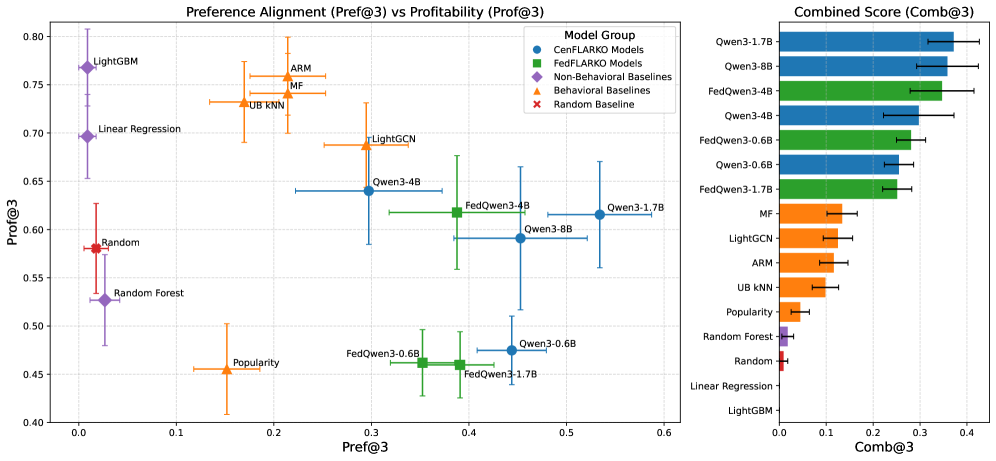
Comparison of FLARKO against state-of-the-art baselines on FAR-Trans dataset.
Main Takeaways
- FLARKO consistently outperforms baselines on behavioral alignment (Pref@3) and joint profitability (Comb@3), validating the dual-objective approach.
- Performance does not scale linearly with model size; mid-sized models (1.7B-4B) are optimal, suggesting efficiency for real-world deployment.
- FedFLARKO remains robust in federated settings with non-IID data, enabling cross-institutional collaboration without data sharing.
- Using KTO with binary labels (profitable & aligned) is effective and more practical than ranking-based alignment for this domain.