CoReLLa integrates efficient conventional recommenders (CRMs) for easy tasks and reasoning-capable LLMs for hard tasks using an entropy-based routing mechanism and layer-wise alignment training.
Core Problem
Existing methods use either LLMs or CRMs exclusively, or blindly combine them, failing to leverage their distinct strengths: CRMs excel at collaborative signals (easy samples) while LLMs excel at semantic reasoning (hard samples).
Why it matters:
CRMs struggle with low-confidence scenarios like long-tail items or noisy data where semantic reasoning is needed
LLMs are computationally expensive and struggle to capture collaborative signals without massive training data
Training models independently leads to 'decision boundary shifts,' causing inconsistencies when combining their predictions
Concrete Example:A CRM might assign low confidence to a long-tail book due to sparse interaction data (high entropy). A standalone LLM might misinterpret user history without collaborative signals. CoReLLa detects the CRM's uncertainty and routes this specific 'hard' sample to the LLM, which uses semantic knowledge to predict the click.
Key Novelty
Collaborative Recommendation with Conventional Recommender and Large Language Model (CoReLLa)
System 1 vs. System 2 architecture: Uses the fast CRM (System 1) for most queries and activates the slow, reasoning-heavy LLM (System 2) only when the CRM is uncertain
Entropy-based routing: Dynamically determines sample difficulty based on the entropy of the CRM's prediction probability
Layer-wise alignment: Syncs the internal representations of the CRM and LLM during joint training to prevent decision boundary shifts
Architecture
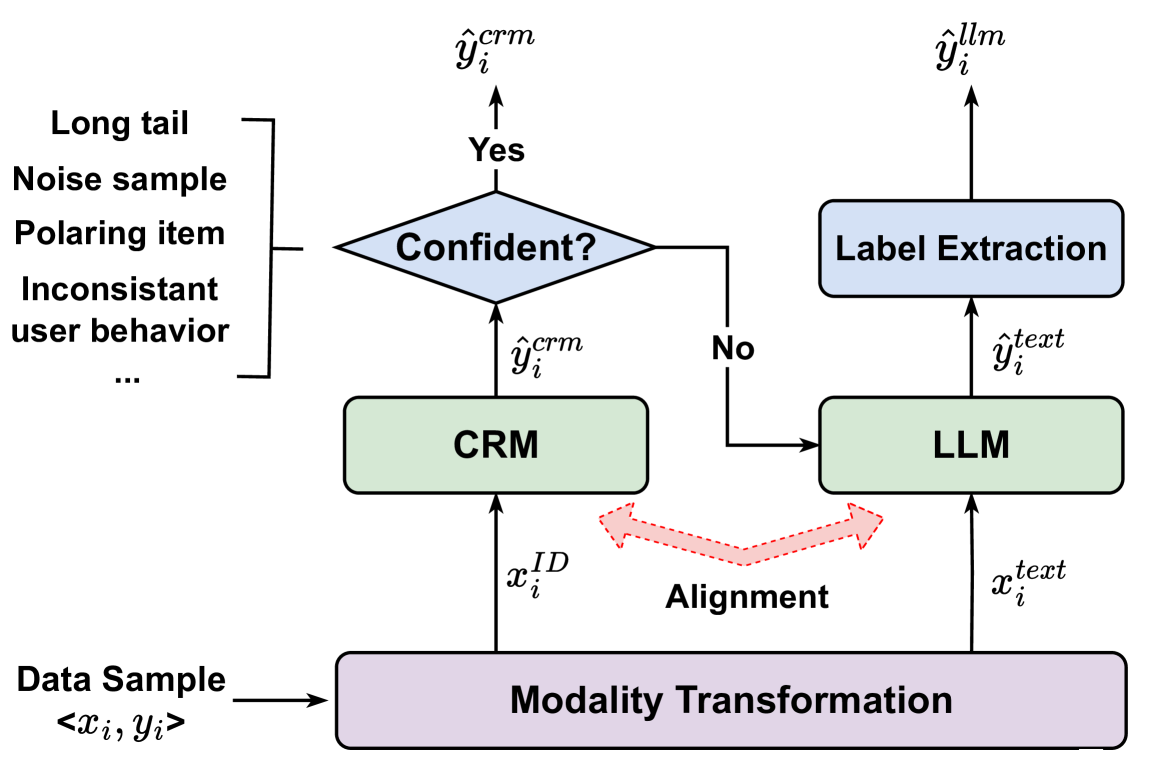
The CoReLLa framework showing the dual-path inference (CRM vs LLM) and the joint training alignment strategy.
Evaluation Highlights
Achieves 1.38% reduction in LogLoss and 1.03% increase in Accuracy on Amazon-Books dataset compared to state-of-the-art baselines
Improves AUC by 0.72% and Accuracy by 1.08% on MovieLens-1M compared to the best performing baselines
Significantly outperforms pure LLM-based methods (like TALLRec) and pure CRM methods (like DCNv2) by effectively combining their strengths
Breakthrough Assessment
7/10
Offers a pragmatic 'best of both worlds' approach (speed vs. reasoning) with a solid theoretical grounding in System 1/2 thinking, though the core components (DCN, LLaMA) are standard.
⚙️ Technical Details
Problem Definition
Setting: Click-Through Rate (CTR) prediction formulated as binary classification
Inputs: Categorical features x_i (item ID, user history) transformed into ID modality for CRM and text template for LLM
Outputs: Binary label y_i (Click/No Click)
Pipeline Flow
Input Processing: Data transformed into ID vectors (CRM) and Text Templates (LLM)
vs. TALLRec/P5: CoReLLa uses a hybrid approach where LLM only sees 'hard' samples, whereas TALLRec/P5 use LLM for all inference
vs. KAR/LLM-Rec: These inject LLM knowledge *into* the CRM or vice versa, but CoReLLa maintains two distinct active models (System 1/2) coupled via routing and alignment
Limitations
Requires maintaining two models (LLM and CRM) in memory, increasing resource usage compared to pure CRM
Inference latency for 'hard' samples is bounded by the slower LLM
Alignment training relies on a multi-stage process that may be complex to tune (seesaw phenomenon observed between CRM and LLM performance)
Reproducibility
No replication artifacts (code, weights, prompts) are explicitly provided in the text. The method relies on standard architectures (DCNv2, LLaMA-2) and public datasets (MovieLens, Amazon-Books).
📊 Experiments & Results
Evaluation Setup
CTR prediction on standard recommendation datasets
Benchmarks:
MovieLens-1M (Movie Recommendation (CTR))
Amazon-Books (Book Recommendation (CTR))
Metrics:
AUC (Area Under ROC Curve)
ACC (Accuracy)
LogLoss (Binary Cross-Entropy)
Statistical methodology: Not explicitly reported in the paper
Key Results
Benchmark
Metric
Baseline
This Paper
Δ
Specific baseline numeric values are not extractable from the provided text snippet (paper text describes relative improvements/deltas only). The following qualitative takeaways summarize the reported gains.
Experiment Figures
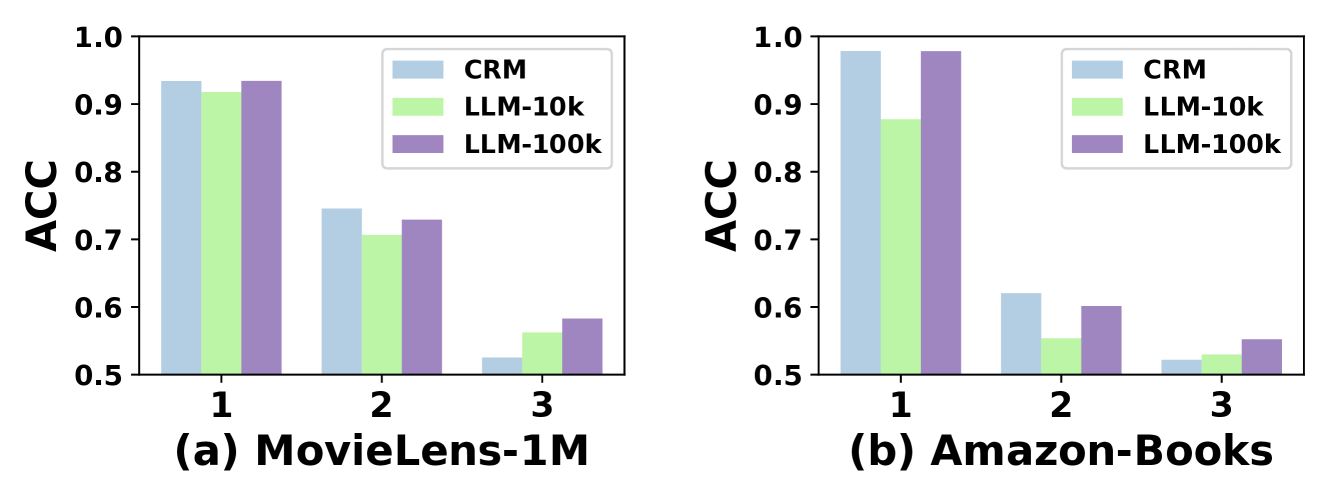
Performance comparison of CRM (DCNv2) vs LLM (LLaMA) across three data groups split by CRM confidence.
Main Takeaways
LLMs do not universally outperform CRMs; they specifically excel on data where CRMs have low confidence (high entropy), such as sparse or noisy samples.
Joint training with alignment loss is critical; removing the alignment stage results in performance inferior to the standalone CRM due to decision boundary shifts.
The mix-up strategy (routing based on difficulty) outperforms using either model individually, validating the System 1 (CRM) + System 2 (LLM) hypothesis.
Warm-up training for the CRM (Stage 1) is essential; without it, the CRM fails to learn collaborative signals effectively from the small joint-training subset.
📚 Prerequisite Knowledge
Prerequisites
Basics of Recommender Systems (CTR prediction)
Understanding of Large Language Models (LLMs) and Fine-tuning
Knowledge of Entropy as a measure of uncertainty
Key Terms
CRM: Conventional Recommender Model—traditional deep learning models for recommendation (e.g., DCNv2) that rely on ID-based collaborative signals
CTR: Click-Through Rate—the ratio of users who click on a specific link to the number of total users who view a page, used here as a binary prediction task
Entropy: A measure of the uncertainty in a probability distribution; high entropy in the CRM's output implies the model is unsure
Decision Boundary Shift: A phenomenon where two models trained independently develop different thresholds for classification, leading to inconsistency when combined
DCNv2: Deep Cross Network v2—a specific type of CRM that explicitly learns feature interactions
LoRA: Low-Rank Adaptation—a parameter-efficient fine-tuning technique for LLMs
System 1 / System 2: A cognitive theory where System 1 is fast/intuitive (CRM) and System 2 is slow/analytical (LLM)