📝 Paper Summary
Recommender Systems
Graph Neural Networks (GNN)
Large Language Models (LLM) Integration
RecMind improves consumer recommendations by treating a frozen LLM as a semantic preference prior and aligning it with a collaborative GNN through contrastive learning and intra-layer gated fusion.
Core Problem
Traditional GNN recommenders capture collaborative structure but miss semantic nuances in text, while LLM-based recommenders grasp semantics but lack collaborative inductive bias and are costly to deploy.
Why it matters:
- Sparse interactions and rapid content churn in consumer tech (shopping, streaming) make standard collaborative filtering brittle
- LLMs as monolithic rankers are too slow and expensive for real-time retrieval at scale
- Existing hybrids often rely on late fusion or disjoint training, failing to fully leverage the complementary strengths of structural and semantic signals
Concrete Example:
In a cold-start scenario where a new electronic gadget has detailed specs (text) but no purchase history (graph), a standard GNN produces random embeddings, while an LLM might hallucinate popularity. RecMind uses the text to ground the initial embedding, allowing the GNN to function effectively even with sparse graph connectivity.
Key Novelty
LLM-as-Prior with Gated Graph Fusion
- Uses a frozen LLM with lightweight adapters to generate semantic embeddings from item/user text, treating this as a 'prior' belief about preferences
- Aligns these semantic embeddings with graph-based collaborative embeddings via a contrastive objective, ensuring the two modalities speak the same language
- Fuses the signals dynamically inside the GNN layers using a learned gate, allowing text to dominate when graph data is sparse (cold start) and graph structure to take over when interactions are rich
Architecture
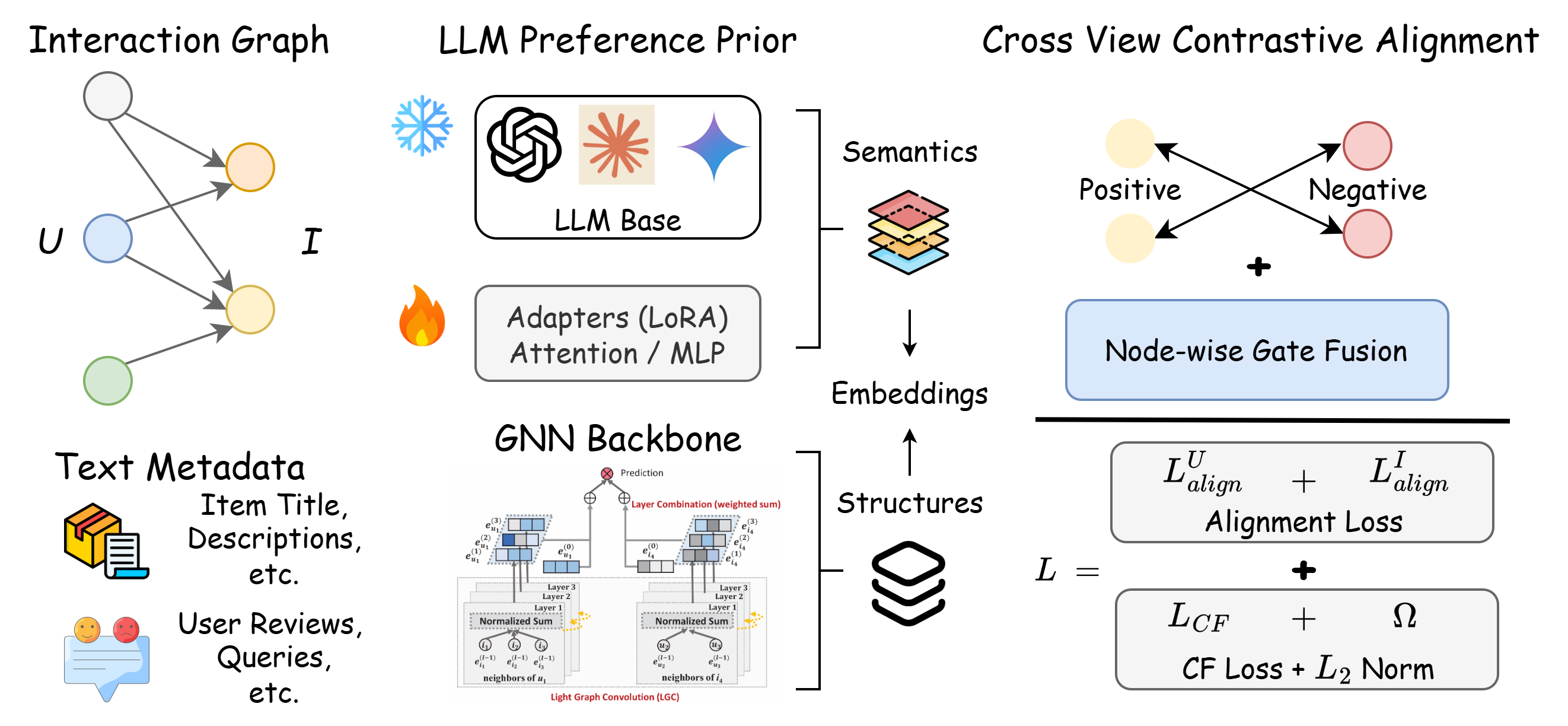
The RecMind architecture showing the parallel Graph and Language branches, their alignment via contrastive loss, and the intra-layer fusion mechanism.
Evaluation Highlights
- +4.01% relative improvement in NDCG@40 on Yelp compared to the strongest baseline
- +4.53% relative improvement in Recall@40 on Amazon-Electronics compared to the strongest baseline
- Ablation studies confirm the necessity of alignment: removing item-side alignment caused a -22.7% drop in Recall@20 on Yelp
Breakthrough Assessment
7/10
Solid engineering of LLM-GNN integration. The intra-layer gating and contrastive alignment are principled and effective, particularly for cold-start, though the architectural components themselves (LightGCN, LoRA) are standard.