The paper introduces a news recommendation system that combines algorithmic dual-calibration (balancing topic and locality) with LLM-rewritten headlines to nudge users toward consuming diverse domestic and global news.
Core Problem
Recommendation systems often optimize for short-term engagement, creating filter bubbles, while users frequently ignore diverse content even when it is exposed to them (the exposure-consumption gap).
Why it matters:
Reinforcing narrow preferences prevents the long-term societal goal of a well-informed public
Existing research focuses on exposure diversity (showing diverse items) but fails to convert this into actual consumption (users clicking diverse items)
Users find diverse content cognitively demanding or irrelevant if not framed correctly
Concrete Example:A user who primarily reads U.S. sports news might be algorithmically pigeonholed into a 'Domestic Sports' bubble. Even if a 'World Politics' article is recommended for diversity, the user ignores it because the headline seems irrelevant. The proposed system would rewrite the World news headline to highlight a connection to a domestic event the user previously read.
Extends calibration beyond just topics (e.g., Sports vs. Politics) to include locality (Domestic vs. World), ensuring geographic balance within topics
Uses Large Language Models (LLMs) to rewrite news previews (headlines/subheads) for diverse articles, explicitly explaining their relevance to the user's reading history to reduce cognitive friction
Architecture
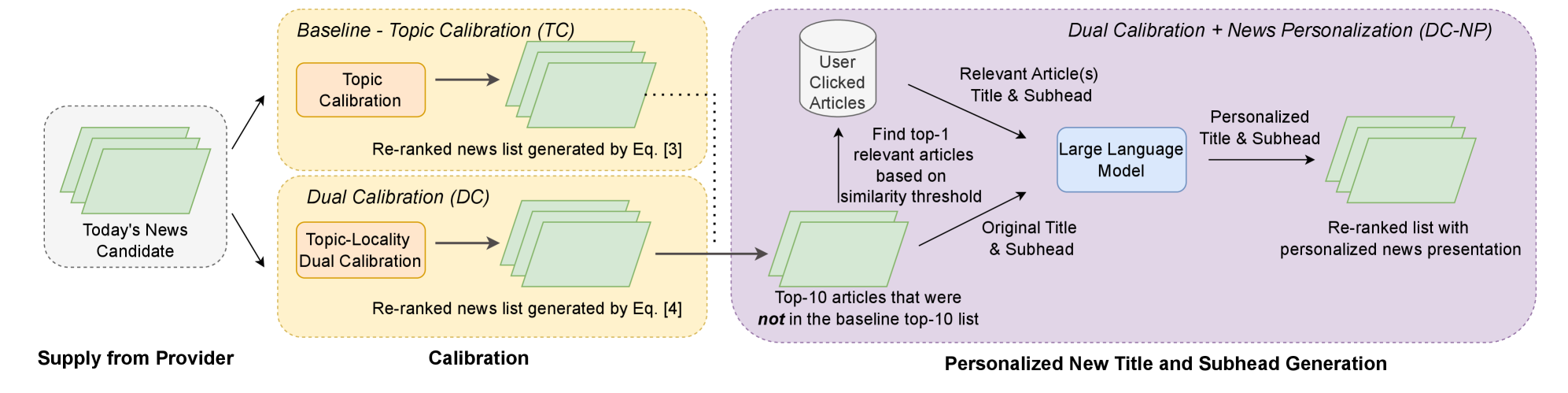
The pipeline for generating personalized news previews for diverse articles
Breakthrough Assessment
7/10
Novel combination of calibration objectives and generative UI nudges tested in a real-world longitudinal study (POPROX), addressing the critical gap between exposure and consumption diversity.
⚙️ Technical Details
Problem Definition
Setting: Personalized news recommendation with diversity constraints on both topic and locality
Inputs: Set of candidate articles A, User reading history H
Outputs: Ranked list of articles J with personalized headlines/subheads
Pipeline Flow
Base Recommendation (NRMS)
Dual-Calibration Re-ranking
Context Retrieval
LLM Preview Generation
System Modules
Base Recommender (Retrieval & Selection)
Generate initial preference scores for candidate articles
Model or implementation: NRMS (Neural News Recommendation with Multi-Head Self-Attention)
Dual-Calibrator (Retrieval & Selection)
Re-rank articles to balance accuracy with topic and locality diversity distributions
Model or implementation: Greedy re-ranking optimization
Context Matcher (Generation)
Identify articles in user history relevant to the new diverse recommendations
Model or implementation: Sentence Transformers (cosine similarity)
Preview Generator (Generation)
Rewrite headline and subhead to highlight relevance
Model or implementation: GPT-4o-mini
Novel Architectural Elements
Integration of a locality-based calibration term (Domestic/World) alongside standard topic calibration
Conditional generation pipeline that selects between Event-based and Topic-based framing based on embedding similarity thresholds
Modeling
Base Model: NRMS (for recommendation) / GPT-4o-mini (for generation)
vs. Topic Calibration: Adds 'Locality' (Domestic vs. World) as a distinct calibration axis to prevent geographic filtering
vs. NRMS: Sacrifices pure accuracy (NDCG) to satisfy diversity constraints (KL divergence)
vs. Gao et al.: Focuses on rewriting individual article previews to highlight relevance rather than generating bridging narratives between items
Limitations
Relies on news provider metadata (AP tags) which may not generalize to other datasets
ROUGE-L used for tuning is an imperfect proxy for rewrite quality (addressed via user pilots)
Similarity threshold tuning is sensitive and domain-dependent
No statistical significance tests reported in the provided text snippet
Reproducibility
No specific code repository is provided in the text. The POPROX platform is mentioned as the experiment bed. Hyperparameters for calibration weights (0.4, 0.3, 0.3) and similarity threshold (0.4) are explicitly reported.
📊 Experiments & Results
Evaluation Setup
5-week longitudinal field study on POPROX platform
Benchmarks:
Real-user study (News Consumption) [New]
Metrics:
Exposure Diversity
Consumption Diversity
Click-through Rate (implied)
User subjective satisfaction (implied)
Statistical methodology: Not explicitly reported in the paper
Main Takeaways
Algorithmic nudges (Dual-Calibration) successfully increase exposure diversity by balancing Domestic and World news availability
LLM-based presentation nudges have mixed effectiveness; explicitly highlighting relevance to prior reading (Event-based) works better than generic topic highlighting
User interest remains the strongest predictor of consumption, but longitudinal exposure to calibrated lists can gradually shift reading habits
Locality serves as a valuable within-topic diversity dimension (e.g., exposing users to World Sports vs. just Domestic Sports)
📚 Prerequisite Knowledge
Prerequisites
Recommender Systems (collaborative filtering, content-based)
Information Retrieval metrics (NDCG, KL Divergence)
Large Language Models (prompting)
Key Terms
NRMS: Neural News Recommendation with Multi-Head Self-Attention—a deep learning model that learns user and news representations to predict click probability
Dual-Calibration: An optimization process that adjusts recommendation lists to match a target distribution across two dimensions simultaneously (here: Topic and Locality)
KL Divergence: Kullback-Leibler divergence—a statistical metric used here to measure the difference between the distribution of topics/localities in the recommendation list versus the user's history
NDCG: Normalized Discounted Cumulative Gain—a measure of ranking quality that prioritizes relevant items appearing earlier in the list
POPROX: An open-source platform for conducting longitudinal news recommendation experiments with real users
ROUGE-L: A metric for evaluating automatic summarization by measuring the longest common subsequence between the generated text and reference text