📝 Paper Summary
Recommender Systems
Denoising Implicit Feedback
LLaRD utilizes Large Language Models to generate semantic and relational knowledge from interaction graphs, then applies the Information Bottleneck principle to filter noise and hallucinations for robust recommendation.
Core Problem
Implicit feedback in recommender systems is inherently noisy (e.g., accidental clicks), and existing denoising methods rely on limited observational data or rigid assumptions that fail to capture true user intent.
Why it matters:
- False positive interactions (accidental clicks) and false negatives (unexposed items) severely degrade recommendation accuracy.
- Current methods struggle to identify 'noise' that actually represents latent interests (e.g., an art lover clicking a gardening video might indicate a new hobby, not noise).
- LLMs have world knowledge but struggle to directly process complex collaborative graph structures or align their broad knowledge with specific recommendation targets.
Concrete Example:
If an art enthusiast accidentally clicks a gardening video, traditional methods label it noise because it mismatches their profile. LLaRD uses an LLM to reason that 'gardening sketches' links the two, identifying it as a potential latent interest rather than pure noise.
Key Novelty
LLM-enhanced Recommendation Denoiser (LLaRD)
- Generates 'Preference Knowledge' by using LLMs to infer user profiles and item characteristics from text, expanding the scope of observational data.
- Generates 'Relation Knowledge' via a user-centric Chain-of-Thought (CoT) on the interaction graph, reasoning about multi-hop neighbors to find collaborative signals.
- Applies the Information Bottleneck (IB) principle to align this generated knowledge with the recommendation task, explicitly filtering out LLM hallucinations and irrelevant noise.
Architecture
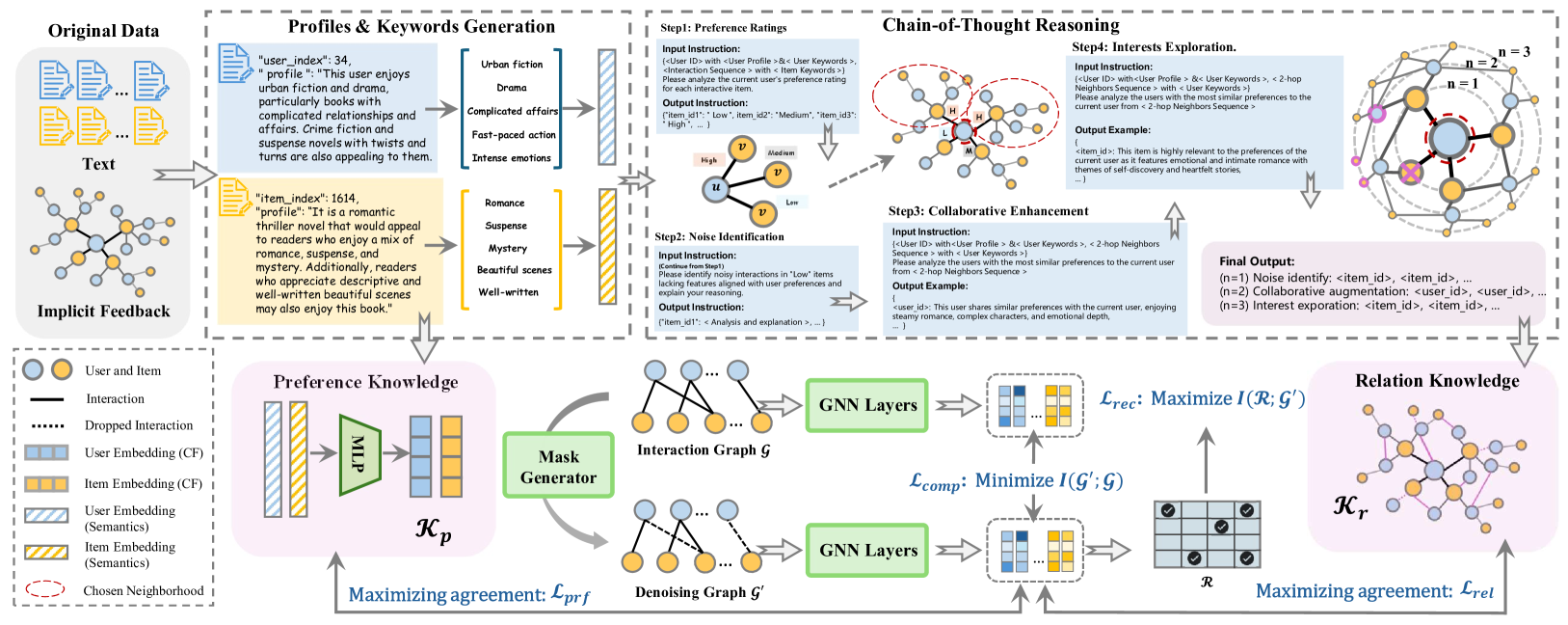
The overall framework of LLaRD, detailing the Knowledge Generation Module and the Knowledge-Enhanced Denoising Module.
Evaluation Highlights
- Outperforms state-of-the-art denoising methods (e.g., RGCF, ROC) by significant margins on Amazon-Book, Yelp, and TikTok datasets.
- Achieves up to +14.29% improvement in Recall@20 on the TikTok dataset compared to the best baseline.
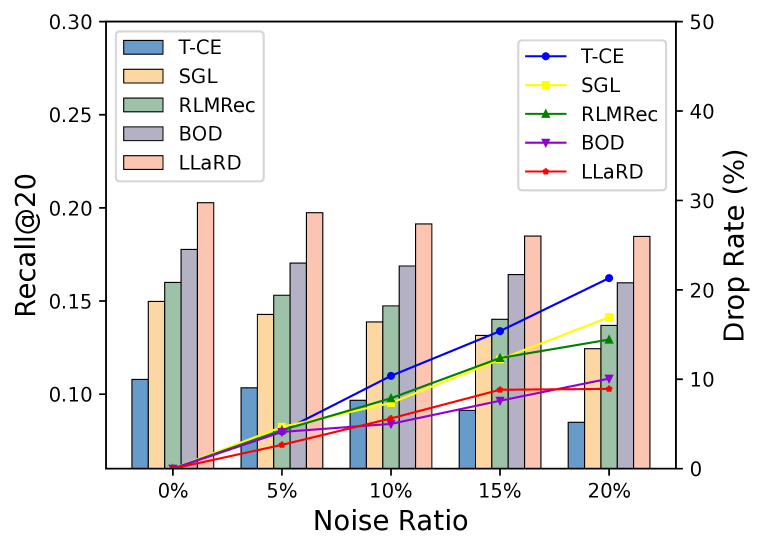
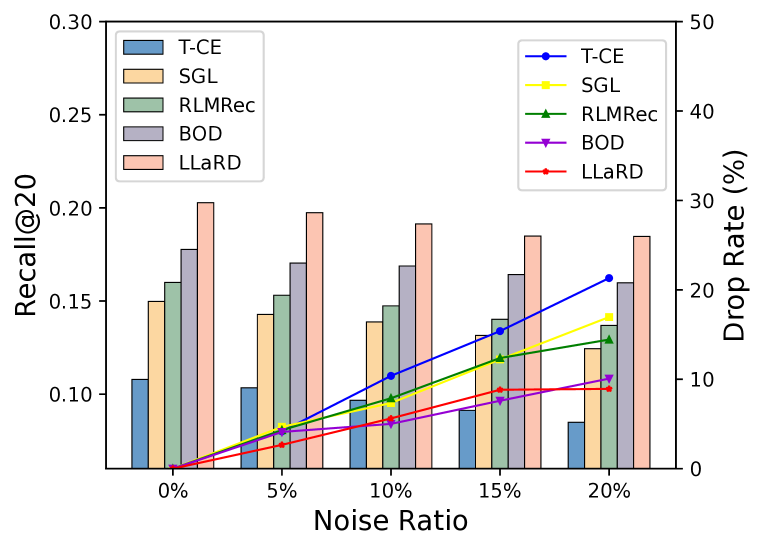
- Demonstrates robustness to noise, maintaining performance even when 20% additional noise is injected into the training data.
Breakthrough Assessment
8/10
Strong methodological contribution effectively bridging LLMs, graph reasoning, and information-theoretic denoising. The integration of CoT on graphs for noise detection is particularly novel.